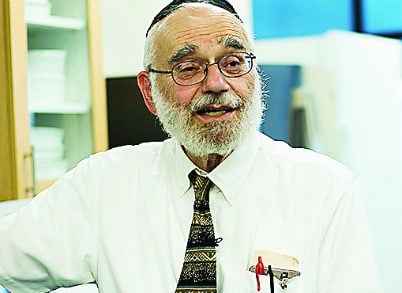
A new kosher restaurant, L’Chaim Ma’adenei Melech is slated to open soon at 909 S. Oneida St., Suite 1-B. The eatery, owned and operated by the Katanov family, will feature Middle Eastern — notably Bukharian — cuisine from Uzbekistan, which L’Chaim’s manager Benjamin Katanov says is “full of flavor boosts.”
Purim has arrived, and the decibel level in the Denver Jewish Day School gym is rising by the moment. Many of the 160 lower division kids are dressed as Mordechai and Queen Esther, anxiously awaiting the Purim spiel. As the conclusion of the spiel – including the requisite vocal disdain expressed at every mention of Haman – music quickly fills the air. Everyone is dancing and singing. So is Rabbi Shalom Lebowitz. Dressed as Mordechai, he is prancing from group to group, injecting doses of enthusiasm.
Growing and maintaining a collection can be a fulfilling and meaningful hobby for many. People collect things such as coins, stamps, art, rare books, comic books and baseball cards. Then there is Isaac Pollak of New York City who collects chevra kadisha artifacts. That’s right — objects from Jewish sacred burial societies, many often used in tahara — the ritual cleansing — and dressing of dead bodies in accordance with Jewish law. Not your typical items to be collected.
Out of the 613 mitzvahs in the Torah, there are three that are considered the foundational block of observant Judaism: kashrut, Shabbat and taharat hamishpacha (family purity). While most are …
The rules for the duration of Shabbat are pretty clear: Roughly 25 hours and a few minutes after candlelighting on Friday night. Unless you are in a place like Reykjavik, Iceland. There, Shabbat can sometimes last a lot longer.
In 2011, insurance agent Adam Moskowitz took a trip to Israel with The Jewish Experience and came home inspired to become more observant in his Judaism. Starting Jan. 1, 2012, …
Rabbi Eddie Shapiro is a man of many skills and much experience; of many varied clients, both Jewish and non-Jewish, both living and dead; and of many titles.
A new cookbook, Flipping Houses & Pancakes: Kosher Recipes & Kitchen Design Tips from an Amateur Professional, is written by former Denverite Dora (Krausz) Segan-Kohanim.
Since 2009, the Denver Kosher Information Exchange, a Facebook group, has become an online stream of communication between metro-area, kosher-observant Jews (and some non-Jews as well) who trade information on everything from what supervisory authorities have to say about the kashrut of particular food items, which grocery stores or delis are providing which products, when holiday-specific food items will be available to local consumers, even suggestions on how to prepare kosher meals.
Shabbat services are just a few days away, and the sanctuary, in orderly fashion, is ready for congregants to arrive. Chairs are neatly placed, prayer books arranged on shelves and the traditional wine bottle stands within reach of the rabbi’s lectern.
The son of Bela Rubinstein (1908-1967) always wondered why his father sustained a youthful appearance even into old age. Bela Rubinstein was rosy-cheeked and wrinkle free. His explanation, as recorded by his son: “In April, 1943, he [Bela] was in a mukatabor, a forced labor camp on the outskirts of Budapest, working in a munitions factory. One day, the air-raid siren sounded, signaling an imminent attack by enemy aircraft. Before anyone could take shelter, a large bomb came crashing through the roof. It ignited the phosphorous supply and sent a searing flash of fire through the plant. My father lost consciousness and fell to the floor. He was taken to a hospital in Budapest, where he convalesced for many months. The explosion of the bomb at close quarters had punctured his eardrums, while the phosphoric blaze had burned off all his hair and turned the skin of his face totally black. This skin eventually peeled off, exposing a baby-pink new epidermis. Thus, my father explained his youthful-looking face.”
There are many things in today’s world that aren’t what they used to be. Some cars are no longer mere mechanical slaves of their drivers. Most telephones are no longer connected to wires. Then there’s meat. Meat used to be simple. It was loved by carnivores, hated by vegetarians. It invariably came from an animal, raised, grazed and slaughtered in the usual ways. Not anymore.
A quarter of a century ago, the southeast Denver suburban neighborhoods, nestled between the Denver Tech Center and Cherry Creek State Park, were home to many Jewish families. There were probably Jews living on nearly every block within a one-to-two-mile radius of the intersection of East Belleview Avenue and South Yosemite Street, where Denver meets Greenwood Village. There were Jewish residents, but it was not a Jewish community. That started to change in 1995 when Rabbi Yaakov Meyer, the director of outreach for Yeshiva Toras Chaim — at the urging of some loyal students who had been attending his outreach classes in a Yeshiva-sponsored trailer on a vacant lot in southeast Denver — ventured further south and further east to open the “Southeast Center for Judaism.”
Rabbi Avraham Berkowitz, is a trained “shatnez checker.” His expertise — in Torah and textiles — ensures that the Torah prohibition against mixing wool and linen in the same garment is observed thread by potentially offending thread. The eighth-grade teacher at Hillel Academy examines clothing with the zealousness of a Sherlock Holmes in pursuit of a murderer — except Berkowitz’ mission is fulfilling G-d’s law. Shatnez first appears in Leviticus 19:19, then in Deuteronomy 22:11 — passages prohibiting the mixture of wool and linen in the same garment, the blending of different species of animals and the planting of different kinds of seeds together. This prohibition of mixtures is known collectively as kilayim. The laws of shatnez “are chukim,” says Berkowitz, 46. “Some laws in the Torah are logical, and some are not. There’s no logical reason why we can’t mix wool and linen together.
Ice cream lovers may be delighted to know that they can enjoy kosher ice cream during a shopping expedition in Cherry Creek. Nicki and Aaron Toys are the owners of …
The prospect of being stuck in a strange city for Shabbat should be stressful, but a well-oiled machine of Shabbat hospitality, honed through generations, and passed on from parent to …
When a vegetarian “goes kosher,” it takes a chunk of the necessary adaptation out of the equation. Such was the case with Alyse Opatowski, who took the kosher “plunge” two …
It’s the morning of the Fast of Esther. Ellyn Hutt, immaculately attired, quickly apologizes for not offering her guest coffee or even a glass of water. Those are the rules …
Jonah Ottensoser knows a thing or two about appliances. A mostly retired mechanical engineer from Baltimore, he knows pretty much everything about how these increasingly complex and sophisticated contraptions work …
Steve Lipman, staff writer at the Jewish Week in New York, has led Passover seders in far-flung communities for Jews with minimal or no connection to Judaism since 2003. Lipman, …
Did you know that cider can taste of bananas? Canteloupe? Vanilla? What makes this all the more astounding is that the drink contains only apples and yeast. So what accounts …
Foodies and cheese lovers may recall an Intermountain Jewish News article from 2014 about a man in New York dedicated to bringing good cheese to kosher consumers. Now, some three-and-a-half …