
PASSOVER EDITION 5786
SECTION C PAGE 2
A little over a year ago, it was unfathomable that Eliya Cohen would be in Denver, Colorado, because a little over a year ago Eliya was being held captive by Hamas terrorists in the tunnels of Gaza.
A little over a year ago, it was unfathomable that Eliya would be reunited with his family and longtime girlfriend, Ziv Aboud, who he believed for 505 days had been killed on Oct. 7, 2023.
On Feb. 22, 2025, everything changed. Eliya Cohen came back to life.
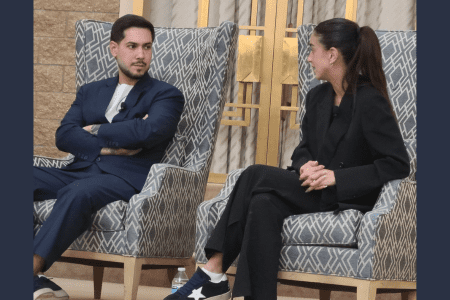
Fast-forward to March 18, 2026. Eliya Cohen and Ziv Aboud, now engaged to be married, are in the HEA sanctuary, in Denver, Colorado, sharing their story.
Miraculous.
Eliya Cohen grew up in Zur Hadassah in a religious family of two parents and three younger sisters. For his army service, he served in special forces. He and Ziv, who is from Tel Aviv, are both 28 and have been dating for six years. Prior to Oct. 7, 2023, Eliya was planning a wedding proposal. On Oct. 6, the two, along with Ziv’s nephew, Amit, and his girlfriend, Karin, decided to go to the Nova music festival in Kibbutz Re’im.
The days prior to Oct. 7 were festive ones in the Aboud household. It was a week before Ziv’s brother’s wedding, and the family was in the midst of the henna party traditional in Moroccan homes such as hers. The four drove through the night arriving in Re’im at 4:40 a.m., Oct. 7, 2023. The “vibe was super,” recounts Ziv, “four young people that just want to have fun on a holiday in Israel.” The four of them regularly attended music festivals, she said.
“At 6:29 a.m., the music stopped.”
Even though they didn’t fully understand what was happening when “thousands of missiles” began raining down, and when Eliya’s cousin, also at the festival, called to tell him someone had shot at her car, the four ran to a bomb shelter — the shelter now infamously known as the Shelter of Death.
The shelter where Aner Shapira heroically tossed back multiple grenades, before he was killed by Hamas terrorists; the shelter where Hersh Goldberg-Polin lost half his arm.
Twenty-nine people were packed into this roadside shelter meant for 10.
Eliya covered Ziv with dead bodies — she doesn’t remember much until 3 p.m. that afternoon, when a father searching for his son rescued seven lives — including Ziv — driving them to the nearest hospital, but his son was not among those who survived. Only after Ziv arrived at the hospital did she learn that Eliya had been kidnapped.
In the shelter, Eliya remembers that he and Ziv said goodbye to each other, with plans to meet in Heaven.
“The last thing I saw before being taken to Gaza,” Eliya recounts, was one of the many terrorists who were loaded with all kinds of weapons.
“He went back to the shelter to make sure that no one was left alive there. He shot many bullets from all directions.”
Eliya was certain that Ziv, Ziv’s nephew Amit and Amit’s girlfriend Karin were dead.
“I remember I said to myself, ‘OK, I lost everything . . . but thanks G-d.’ My soul screamed, thanks G-d. Abba, todah rabbah, Abba, todah rabbah.’ Because I couldn’t forget what I went through in the shelter. The terrorists arrived, they shot me, they threw a lot of grenades. I saw a lot of bodies. But all I asked from G-d was to stay alive.
“I am alive,” Eliya told himself. “I don’t know what will be in the future. But I am alive.”
When he was 14, Eliya chose a path different from his religious family’s.
At the time, he told his mother, “I believe in G-d. I really believe in G-d. But I want to find my own way.”
He likely never imagined how much his faith would sustain him years down the line. After being in a terror attack during his army service, Eliya decided he wanted to return to some of the rituals he grew up with. He started putting on tefilin daily. Again, he likely never imagined how that decision would one day sustain him.
Unknown to Eliya, Ziv was alive, and for 505 days, she was fighting the same battle he was — to bring him home alive.
In captivity, Eliya experienced what he describes as miracles — escaping unharmed from a hospital, dressed as a woman, surrounded by people looking to kill any Israeli or Jews; surviving a surgery performed by “the best doctor in Gaza” who was 16 years old; surviving in a truck bed surrounded by Gazans looking to harm him and his fellow hostages as the kidnappers left Israel, as he was screaming “Shema Yisrael”; escaping an exploding building into the streets of Gaza, recognized as Jewish when he was surrounded — “it really felt like the last second of our lives,” he recounts.
All of that “was just Oct. 7 for me.
“After that I spent another 504 days in captivity.”
His story is recorded in his memoir, Negotiation, currently only available in Hebrew but in the process of being translated into English.
Some weeks after arriving in Gaza, he was moved to the tunnels.
They entered from a mosque, and months later when they were being moved to a new tunnel, they moved through a school classroom.
“I remember how I looked at the chairs, and the colorful numbers, and said, Wow, how is it possible? How they can do something like this, build terror tunnels at the place where you should teach people to be a good person, an accountant, a lawyer? And this is what you do with your money, build terror tunnels.”
It was in his last tunnel where the conditions were the worst. Hostages chained to each other, no light, no water, no food.
“We had to lick the wall just to feel dry water,” Eliya says. “After two weeks, we couldn’t move anymore, we couldn’t speak anymore. We just lay on the floor, waiting for death.”
As he details these horrific conditions, Eliya takes a sudden turn — the turn that enables him to sit in front of a packed crowd sharing his trauma.
“We had all the reasons in the world to give up and commit suicide, but instead we chose life.
“What does it mean to choose life?” He recalled something Hersh Goldberg-Polin had told him: ‘He who has the why, will find the how.’
“I realized, my why is my family, who is waiting for me, and I have to do anything to survive.”
Every day, he put on tefilin. How? He went into a corner and went through the motions as if he had his tefilin with him.
One day a fellow hostage asked Eliya how he prayed.
They started praying together every day — the hostage who said he didn’t know how to pray, and Eliya: Shema Yisrael, Birchot HaShachar (the morning blessings) and “20 seconds to be thankful that we are alive and have the chance to go home,” he recalls.
“The most important day in captivity for me was Friday. I knew, no matter how much the situation is hard, my family is making a huge Kiddush, with a huge smile.
“And they are singing everything with a huge smile.”
He would keep the meager rations from lunch, put water in a glass, and the group would make Kiddush.
“I felt like I sent energy to my family, and I dreamed myself sitting next to them.
In fact his mother later told him that every Friday they put a poster of Eliya on a chair at their Shabbat table. They sang to him and he did to them. “Because of that we felt so connected.”
In Israel, throughout the 505 days, mourning the death of her nephew Amit and Amit’s girlfriend Karin, Ziv became a fighter. When asked by HEA’s Rabbi Sarah Shulman, who moderated the talk, how Ziv found the ability to keep showing up and fighting, Ziv has a simple reply: “It’s power that G-d gave me at that time.
“Every day I woke up and I told myself, ‘OK, I’m here, what can I do today to save Eliya?’”
She travelled across the world — Israel, Europe, the US, the White House — to share their story, the same mission she and Eliya are currently on.
Their mission made the stop at HEA, co-sponsored by StandWithUs, a perfect fit. Shortly after Oct. 7, 2023, HEA members Lynn and Bill Geller were asking themselves what they could do to help Israel and the Jewish people.
Inspired by congregants who had set up a music fund, the Gellers spoke to synagogue leadership to start a pro-Israel education series in memory of her parents, who were Holocaust survivors.
Among the speakers the Gellers have helped bring to Denver was Shai Davidai, the embattled former Columbia University professor.
At his talk, Lynn says, he encouraged people to wear a Magen David, to be proud of their Jewish identity. “And now there are a lot of people in our congregation wearing one who were not before.”
When Eliya was in captivity, one of the reasons that Shabbat became so important was because “this is our identity, and we have to do anything to keep it.”
That decision allowed him and the hostages he was with to bond with the Jewish community outside of their tunnel.
Now free from Gaza, the mission to encourage Jewish pride continues.
Eliya was especially struck by “how many people around the world screamed my name and walked with my poster . . . this is the Jewish community around the world, and this is so powerful, because we are brothers and sisters [even if] we don’t know each other.”
Traveling in the Diaspora, Eliya has also been confronted with what anti-Semitism looks like. When he saw how some people speak to Jews, he realized he doesn’t want anyone to be ashamed of saying they are Jewish. He believes sharing their story strengthens those who hear it.
“For thousands of years, people have tried to hurt us . . . and they can hurt us, they can kill us, they can kidnap us, they can do a lot of things. But there is one thing they cannot take from us, and it’s our identity.”
That was greeted with rousing applause from the large crowd at HEA — and from the many others who have since thanked the Gellers for helping bring the couple to Denver.
As Eliya puts it, his and Ziv’s story is inspiring and empowering for those who hear it.
Eliya says there are three conclusions from his experience.
“The first is that G-d is listening. Maybe He doesn’t answer fast, but He’s listening. And ask Him whatever you want, and you will see, He will answer.
“The second, your family is the most important thing in your life. And only when you lose them, you’ll understand how much they mean to you. I lost them and I got them back, so I know the value of my family.”
The third lesson — find at least one positive thing every day. According to both Eli Sharabi and Eliya, the hostages actually managed to do this.
“We were 50 meters underground, with no food, with no light. They beat us every day. They abused us every day. But we chose every day to look for the good.
“What is a good thing in this situation?” A few more minutes of sleep, use of a bathroom, not being screamed at in the face, he says.
“We have all the reasons in the world to look for the bad, but if you are looking for the good, you will find it.
“And it will remain with you.”
© IJN 2026