
PASSOVER EDITION 5786
SECTION B PAGE 10
First woman heads Israel Space Agency
Dr. Shimrit Tirosh Maman, 45, is the first woman to be appointed chair of the Israel Space Agency.
“I’m also the youngest to be selected. But the important thing is to highlight my achievements, not my gender,” she says.
Her achievements are impressive.
A senior scientist and space researcher at Ben-Gurion University of the Negev, she heads the UN’s regional support office in Israel for space-based information supporting disaster management and emergency response and represents Israel on the Committee on the Peaceful Uses of Outer Space.
Maman founded “She Space,” a BGU project that encourages high school girls to become involved in STEAM (science, technology, engineering, arts and mathematics).
“Space is not only about exploration. It is a strategic infrastructure that underpins economic growth, security and scientific excellence,” she says.
“Space is a tool that can — and absolutely should — be used to focus on urgent, down-to-earth issues and to save lives.”
For example, in February, 2023, a massive earthquake struck Turkey. Tens of thousands of people were killed, and rescue missions were rushing to get there from around the world.
At the time, totally by chance, Maman happened to be at Ben Gurion International Airport with some of her She Space students. They ran into an Israeli rescue team from United Hatzalah that was on its way to the disaster zone. A member of the team jokingly asked, “What can you do to help? Get me a satellite picture of the area?”
Maman immediately called ISI, an Israeli provider of space-based intelligence solutions, and the images she managed to get were the very first satellite photos in the world to reach the rescue teams on the ground.
They helped find survivors in the rubble and get them out.
However, she says, “the applications are not limited to disaster scenarios.
“For instance, the expansion of certain towns in the Negev is causing friction with wildlife. To alleviate the situation, they’re using satellites to track environmental changes and combine that data with motion cameras on the ground and even an AI system that can analyze an animal’s body language to see if it’s stressed out.
“The core information comes from satellites. It’s space that is directly connected to the environment.”
Creating ‘real benefits for society’
Her role, she says, “is to ensure that space technologies translate into real benefits for society, ranging from climate monitoring and disaster preparedness to innovation.”
“In fact, half of the data we could gain about climate change comes from satellites. People don’t know that.”
In a pilot program in the southern Israeli town of Omer, her student Maria teaches residents important tools for preparedness.
“First of all — know your tech,” Maman says. “Do you even know if your smartphone has satellite capabilities? Most of us don’t.
“Recent regional events highlight that space is an integral part of our national security infrastructure.
“Space-based systems enable situational awareness, anticipation, and preparedness — transforming information into actionable insight.
“In an age of multi-domain threats, national resilience depends not only on what surrounds us, but also on what operates above us.”
According to Maman, “the current security reality makes it unmistakably clear that space is no longer a future domain; it is an operational one.
“Space-based capabilities support decision-making, early warning and real-time situational understanding.
“In an era when threats transcend traditional boundaries, superiority is shaped not only at sea, in the air or on land, but also by our ability to see, interpret and act from space.”
She — and her two kids — all over the world
Maman is married with two children — an 18-year-old son and a 15-year-old daughter. “It’s very demanding, but I prioritize, like with everything else,” she says.
“Since the children were very young, they have been used to the activity. My career started a long time ago. Luckily for me, I have a very, very good relationship with my spouse, who is very supportive. We’re very good partners. He has a PhD in physics, and he also works for BGU.
“When my children were very young, I often tried to turn some work trips into family trips when possible. Growing up, they were exposed to many places, cultures and experiences.”
Maman was also privileged to travel in her youth. Her parents, originally from Morocco, were shlichim (emissaries) for the Jewish Agency. When she was a month old, the family moved to Brazil until she was five. They went back to Israel for four years and then moved to Toronto for four years before returning to Israel.
Do something you’ve never done before
How does the She Space program helps young women advance in the field? “The program is designed for high school girls, and the reason is that when they enter university, it’s often too late to switch majors. In high school, they’re at a stage where we could influence their decision and remove many barriers and social prejudices.
“It’s a very demanding program. I won’t lie. It’s very serious. A student in 10th grade does work at a master’s level. But it’s doable. Everything they need to learn, they will learn. We invest in them, but they must be very motivated to stay in the program.
“I want students who want to dare to do something they have never done before. We have had incredible results. This program has operated in 11 countries. They present their results among other partners worldwide.
“Some of them traveled to places where, otherwise, they would never have gone. In fact, we were the first Israeli youth group to go to the United Arab Emirates after the Abraham Accords were signed.
“Our girls won third place in a competition in South Korea against people with 10 years of experience in the industry. These are high school girls. I’m so proud of them.”
Her daughter is not pursuing the field; she plans to become a doctor. “But speaking of my daughter, the program started with her asking me, at the age of four-and-a-half, why I don’t have any female friends who are astronauts.
“She grew up having dinners and lunches with astronauts because of my job. I had never noticed that all she was seeing were men.
“That’s how the She Space program started. That’s what sparked the program.”
Israel’s first lunar spacecraft
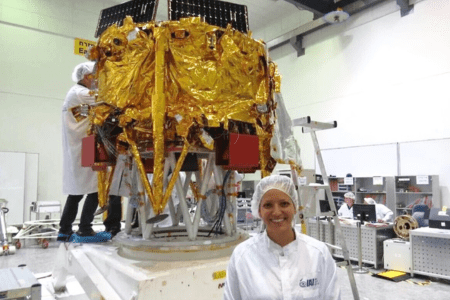
Beresheet, Israel’s first lunar spacecraft, launched by SpaceIL from Cape Canaveral, FL, on Feb. 22, 2019, aboard a SpaceX Falcon 9 rocket, crashed during its landing attempt on April 11, 2019, due a malfunction in its main engine.
A new national innovation lab is getting a $19.5 million budget. Its purpose is to supercharge startups that are researching the space sector.
This is paving the way for Israel’s next big ambition. “We are going back to the moon,” Maman declares. “NASA’s Artemis Accords are not only about returning to the moon. They are about shaping how humanity explores space together, responsibly and cooperatively.”
Israel is planning to send its first woman to space, an initiative led by Minister of Innovation, Science and Technology, Gila Gamliel.
Why specifically a woman? “Promoting any sector of society promotes society as a whole,” Maman says. “It all comes down to one goal: to make life better for people on earth.”