
I recently spoke with Phil Rosen, chair of World Jewish Congress (American division) and a board member of Yeshiva University. He is intimately familiar with the situation of the Jewish people both in Israel and in the US, and is optimistic about our future.
“I’m not worried, because we have the best youth in the world. The younger generation shows us what our future will look like. Take a look at the role models of young people in the West today. For example, Greta Thunberg. She is a young woman with mixed-up values who has become a symbol without really knowing anything at all, not about climate change nor about terror. Her values are so confused that she is supportive of Hamas. Is this a suitable role model for young people?
“Now consider the students on campuses who protested for Hamas. These are kids who are so lost. They scream ‘Apartheid’ and ‘Intifada’ without knowing what these terms mean, and haven’t been taught to distinguish between good and evil.
“In contrast, look at the young people of Israel. First of all, they maintain moral clarity, which is so rare in today’s progressive political environment. If you look at Israeli youth and the Jewish people, in general, you see strength, spirit, connection to their roots, unity, creativity and mainly — joy. This is a happy generation. I listen to the Israeli playlist, watch young people flocking to the Kotel for Selichot, and observe how they cope with crisis, and it fills me with hope for the future.”
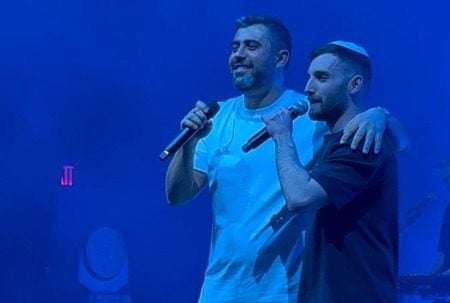
I noticed this trend last month: Ishay Ribo performed at the United Palace Theater in Manhattan, each night in front of about 3,000 young people. In an era of AI-generated words, these young people wanted to dance for hours to Ribo’s ancient-but-new lyrics.
I was given the unique opportunity to speak on stage, to interview Ribo in front of the audience, and to talk with some of the young people after the show. They spoke with glowing eyes about making aliyah, about college students discovering and asserting their Jewish identity, and the growth of Jewish pride everywhere.
The star of the show was Matan Angrest. Ribo wanted to dedicate one of his songs to Matan and asked him to choose the song. Matan was a tank driver who was kidnapped by Hamas from his tank in Nahal Oz on Oct. 7. The three other soldiers in his tank were killed.
He was almost lynched after losing consciousness and was kidnapped to Gaza. For two years, he was violently interrogated, severely tortured and often held in isolation.
He requested a pair of tefilin, a siddur and a Tanach from his captors, which they gave him. Matan drew closer to his faith during his captivity.
So here was this hero standing on stage next to Ishay Ribo in front of thousands of young American Jews, and which song did he request from Ribo? Matan chose “Tocho Ratzuf Ahava” — a song about G-d’s love for us and our love for Him. It is incredible that this is how Matan feels. Ribo started singing this song and Matan joined him, as the audience erupted in applause.
Countless shows and performances have been staged on Broadway, but I’m certain that there has never been a performance like this one before. As Phil Rosen suggested, I looked around at the young people and saw light and holiness.
A medical milestone and a shared vision
Rabbi Yitzchak Ginsburg and Dr. Abed Halaila recently held a joint press conference that was unexpected and very moving.
A year ago, Rabbi Ginsburg, who is associated with Chabad and many of the “hilltop” communities, underwent a kidney transplant at Hadassah Ein Kerem hospital. Other medical centers had declined to operate on him due to his advanced age, but Dr. Halaila, head of Hadassah Ein Kerem’s transplant unit, reviewed the file of the 80-year-old rabbi and agreed.
“Age is only a number,” he explained. “A kidney transplant can be beneficial even at an older age, enabling the patient to continue giving.”
The donor was at the press conference through the Matnat Chaim organization. Senior Hadassah leadership attended as well, headed by Prof. Yoram Weiss. With everyone present, the rabbi delivered a brief teaching on the meaning of kidneys in Jewish thought. Halaila sat beside him, and when the rabbi called him a “righteous gentile,” he patted his hand. Halaila smiled and then shared what had impressed him most.
“I asked to check what the rabbi has done since the transplant,” he said. “Well, every Shabbat, a booklet of his is published in Hebrew — 13,000 copies, as well as an English edition read by thousands here in Israel and around the world. It’s simply incredible. This year he published 11 books of Torah scholarship and three children’s books, and he’s planning another six in the coming year.”
He added: “The rabbi has a book about the ‘Fourth Revolution.’ I urge you to study this topic. It’s very important, and I personally believe in it.”
“The Fourth Revolution” is a concept Rabbi Ginsburg has been advancing in recent years: expanding Torah and Jewish learning to non-Jews as well. In his view, Judaism is meant to illuminate the world, and the time has come for that message to break outward. Only when the Jewish people inspire respect, he argues, can genuine peace take root.
At the gathering marking one year since the successful transplant, it felt as though one could already see the first shoots of that idea beginning to emerge.
Parashat Va’era: Five Points to Ponder
This week’s Torah portion includes the first seven of the Ten Plagues of Egypt: blood, frogs, lice, wild beasts, pestilence, boils and hail. The plagues are not only miracles, but a kind of “educational workshop”: 10 lessons against idolatry and false gods, and in favor of faith in the Creator and the journey from slavery to freedom.
Twice in the portion, Moses describes himself as “arel sefatayim,” a person with impaired speech. Yet G-d chooses him for leadership (perhaps even precisely because of it?). Clearly, eloquence and charisma are not the main measure of a person.
Pharaoh, by contrast, embodies a leadership style that is stubborn and arrogant. Reality speaks to him loudly and repeatedly, but he refuses to listen. With each plague, instead of softening, he hardens, entrenching himself in his arrogance. In every encounter between Pharaoh and Moses, the contrast is striking.
When Moses comes to the people with the promise of redemption, they do not listen. Why? “They did not listen to Moses, because of shortness of spirit and hard labor.” It is chilling to think that they were so exhausted and overwhelmed that they could not even hear the news that the bondage was ending. Our commentators explain that we, too, can miss moments of redemption because we are overloaded and stretched too thin.
The Shabbat before the new month is called Shabbat Mevarchim; we bless the new month that will begin in the coming week. This Shabbat, we bless the month of Shevat, which begins on Monday. Shabbat Shalom and Chodesh Tov!
Translated by Yehoshua Siskin and Janine Muller Sherr