
I first heard the mourner’s Kaddish as I stood next to the open ground at my Grandpa Wasserkrug’s graveside service. I was nine — too young to understand so many things yet mature enough to attend his funeral.
In my mind, Grandpa died in autumn. I remember leaves weeping in the cold. He actually died on March 4, as spring approached. But I’m confident the St. Louis wind blew fiercely that day.
I should explain that Grandpa Wasserkrug, my mother’s father, was my most beloved and only surviving grandparent. He lived in our home and kept me safe. Grandpa took me fishing in Forest Park, his pervasive enthusiasm transforming the scrawniest fish into a victorious catch. We loved each other unconditionally.
At some point, Grandpa started coughing and stopped eating because it was too difficult to swallow. Esophageal cancer ate him alive. That’s why we had gathered in the cemetery that morning.
Vacillating between past and present, I stared at the clouds. I believed Grandpa was in the sky, looking down on me. No coffin exists in my memory, no intimations of eternal separation.
Our rabbi recited prayers — meaningless utterances at my age. I watched my mother’s lips, too tight for words. My father said nothing. But the majority of adults responded with practiced intimacy.
The mourner’s Kaddish came at the end, after Grandpa disappeared beneath shovels of earth. As I listened to the poetic intonation, the hair on my neck stood up. I felt haunted, mystified, enchanted.
Dad averted his gaze, but my mother rocked back and forth. Everyone around me said the words, so poignant, resounding and hopeful — an exclamation mark inside an ellipsis. Years later, the Kaddish is one of the few prayers I can recite by heart, where it waits.
The mourner’s Kaddish is the Jewish prayer for the dead. Much has been written and theorized about why it celebrates life, praises G-d and omits death. Perhaps in the darkest moments, our lost loved ones must soar on celebratory wings. Otherwise we might relegate them to permanent absence.
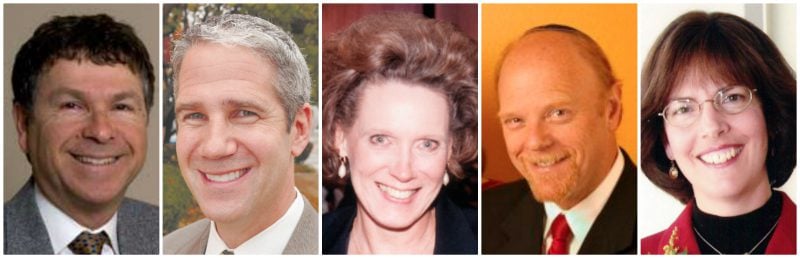
The IJN asked a rabbi, cantor, psychiatrist, funeral director and an educator to examine the mourner’s Kaddish from their own faith perspectives.
Rabbi Eliot J. Baskin, JFS Jewish community chaplain
Saying the Kaddish with a mourner at a funeral, an unveiling or a hospital bedside is one of my most favorite rabbinic privileges. I am a sacred guide for four millennia of Jewish tradition that escorts a mourner on his or her bereavement journey using this ancient memorial “password.”
The word “Kaddish” comes from the root “set apart.” This ancient prayer sets apart and connects both mourners and the mourned.
Many Jews consider the Kaddish the most sacred Hebrew prayer for the dead, but actually Judaism teaches that it is not the most sacred prayer, it is not in Hebrew (rather Aramaic) and doesn’t even mention the dead.
Rather it praises the living G-d, as the Kaddish is all about helping the living navigate their bereavement journey from the immediacy of the funeral to the unveiling about a year later, and each year on the death anniversary, the yahrzeit, and four times each year on the major holidays with yizkor.
For most, the Kaddish is the Jewish oath of allegiance to the deceased whereby the mourners fulfill an honored obligation to metaphorically accompany the soul heavenward to reconnect with their loved ones.
For me, the Kaddish becomes a Jewish mantra for memorializing the deceased. Just as a Sanskrit mantra or Hebrew phrase helps in meditation, so does the Aramaic Kaddish help us focus on our loved ones.
When we say Kaddish in a minyan we comfort one another as we share our grief together. As we remember the deceased’s name before we say Kaddish together, we link our memories with theirs as a loving benediction.
Jean Guthery, Psychiatrist, Temple Sinai member
Being Jewish by choice, my encounter with the Kaddish occurred later than others who are Jewish by birth. But now, after 34 years, I can hardly recall when I first recited it, can hardly remember when it felt strange, or even if it did.
But I do remember learning over and over again its power within the Jewish community — how it brings a comfort, a sense of unity, the support of a people who know loss and hurt.
Written in Aramaic, the lingua franca of the time it was written (only its last stanza is in Hebrew), the words have within them a rhythm, “Yitgadal, v’yitkadash, sh’mei raba . . . that surrounds and encircles those who grieve, reminding them of G-d’s creation, its grandeur and G-d’s majesty in the world and G-d’s plan for the world, never uttering a word about loss or death.
I found more poignant meaning to the Kaddish two years ago when I lost my husband, Peter. There were times when I couldn’t say it; could only mouth the words when the pain of losing half my soul was so intense. But those around me did say it and the rhythm of those words, “Yitgadal, v’yitgadash, sh’mei raba,” brought a steadying comfort because the Kaddish cannot be said alone. It must be recited when at least a minyan is present — hence the community is always there.
And rejoining the community to say the words is paramount in order to join one’s people and not be alone in grief.
An example of the Kaddish’s words of praise of G-d and for the majesty of creation functioning as healing was suggested one evening after we sat shiva for my husband. A friend and teacher, Dr. David Sanders, said quietly to me, “Go walk around the block; you’ll feel better.” “What?” I thought, “what kind of idea is that?” But I knew that such a walk is part of the Jewish tradition of grieving — to walk around the block and then re-enter the house as a symbol of re-entry into the world.
So I walked around the block in my neighborhood and, being spring-time, I saw grass beginning to green, heard birds chirping, a blue sky overarching trees about to leaf, a neighbor tinkering in his garden, breezes blowing through fir trees, a forsythia just about to bloom.
I returned home and felt better. I realized that the walk conveyed the same message as the Kaddish — praising G-d for the splendor of creation, for G-d’s constant presence and majesty, and that I am not alone.
Now two years later, I can recite the Kaddish, getting through about 90% before losing it, knowing that 100% will come in time. I also understand that the power of the Kaddish for me is its connection to the community that must always be present when it is recited.
“Yitkadal, v’yitkadash sh’mei raba” . . . the rhythm of the words . . . come back to the world, one step at a time, one day at a time. Come back to G-d’s people.
Ellyn Hutt, Jewish educator
It’s always struck me as odd. The mourner’s Kaddish, which begins with the words, “May His great Name be exalted and sanctified,” is often recited in a plodding, somber tone of voice which is inconsistent with the uplifting and sublime words that make up the Kaddish.
Kaddish is a declaration of faith and an expression of confidence and hope that in the future the ideals that make up the mission of the Jewish people, and G-d’s very purpose for creation, will be realized. Kaddish is from the word, kadosh, which means holy or sanctified; and every opportunity we have to sanctify G-d’s name should fill us with great happiness.
There are other times when we recite verses that are related to sanctifying Hashem’s name, such as the communal Kedushah during the Amidah or when making Kiddush over wine on Shabbos and holidays. At those times, we sing and our voices ring out with joy.
The Kaddish is said by mourners, but it is not mournful. The Kaddish does not mention death at all. The entire focus is on proclaiming and affirming G-d’s greatness. The mourner is given the opportunity and the honor to lead the Kaddish as a way to bring spiritual merit to the loved one who has passed away.
Only in this world, the land of the living, do we have the privilege of growing and doing mitzvot. After our death, we stay at whatever spiritual level we achieved during our lifetime. However, when someone does something in our memory, the merit of that action has an impact on both the living and the deceased. Our spiritual stature can increase as the merit of the action is ascribed to both people.
When a mourner, whose faith in G-d could be deeply challenged in the face of this loss, is able to stand and affirm G-d’s eternal greatness and kingship, it generates tremendous spiritual energy.
Many people put all of their mourning “eggs” in the Kaddish “basket,” yet there are many ways to bring honor and elevation to a deceased person’s neshama (soul). Learning Torah, taking on a mitzvah, and giving tzedakah — all in the merit of the neshama of our loved one who is no longer in the world of choice — have the same result as saying Kaddish. When someone’s memory inspires and motivates our spiritual growth, the neshama of the person who inspired us shares in the “credit” and is elevated to higher and higher realms.
The person or people reciting Kaddish during a service are actually acting as the chazzan or prayer leader. Since different synagogues have different approaches about who serves as a chazzan or prayer leader, this impacts who says the Kaddish. However, regardless of who leads it, the most important line of the entire Kaddish is the communal response of “May His great Name be blessed forever and ever.”
Everyone present is supposed to say this with complete concentration and in a loud voice. According to Jewish law, having the chance to hear Kaddish and respond with the seven words “Yehei Shmei Rabbah Mevorach Le’olam U’le-olmei Almaya” takes precedence over responding to any other prayer.
G-d has given us the gift of being a partner in fulfilling the purpose of creation. The greatest sanctification of G-d’s Name is when we perceive G-d’s holiness and become a conduit for it to flow into our lives and throughout the world. In this way, we complete the circuit and allow G-d’s purpose of creation to be fulfilled.
The act of completion continues to elevate the souls of those who are no longer in this world and the souls of us who are here and can answer, “Yehei Shmei Rabbah Mevorach L’olam U’le-olmei Almaya” with a strong and enthusiastic voice.
Jim Cohen, Feldman Mortuary
I first encountered the Kaddish prayer while attending Shabbat and High Holiday services as a young man at Temple Emanuel. At that time, I didn’t yet have exposure to the traditional davening of Shachrit or Maariv. As a Reform Jew, I distinctly remember Rabbi Steven Foster asking us to rise as a community to remember those who have gone before us along with the six million Jewish victims of the Holocaust.
If ever there was a part of the service that grabbed my attention, that was it. It was so powerful. I felt that somehow I was able to connect to my ancestors and the victims of the Holocaust. I remember how those words of “community” and the “the six million victims” helped me focus on the recitation of the words and not necessarily just following along haphazardly.
However, no matter how focused or connected I felt, I can assure you I had no idea what I was saying. Instead, it was more of a rhythmic mantra that helped me learn to say these Hebrew and Aramaic words.
Even though I grew up with my grandfather and father running the funeral home, it wasn’t until I entered the business as a young adult that I started to wonder about the “why” of the mourner’s Kaddish. At the same time, I had been exposed to traditional davening, where Kaddish is said more frequently than during our Reform services. To confuse me even more, I became aware that there were five versions of the Kaddish. I started to wonder about the “what” of these different versions.
So I went to seek answers and as luck would have it, I found a tremendous resource. I can’t remember how I was introduced to Anita Diamant’s writing, but I seem to have this vague memory of hearing her talk about her newest book, Saying Kaddish. Since 1998, this book has become my go-to not only to answer questions posed by the families I serve, but my personal refresher course on our rich tradition of burial and mourning.
Diamant explains how reciting Kaddish is an experience for the mourner to stand shoulder-to-shoulder with the community as if to say, “You are not alone.” It is this collective voice that helps provide support to the mourner. But is support enough?
Our community recently suffered the loss of a 10-year-old boy. I can hardly imagine the pain his family is enduring. My wife lost her parents at ages 70 and 66, after long illnesses. Just last month, I lost my last grandparent at the age of 97. I don’t believe all of these losses are remotely similar, but each mourner must “magnify and sanctify” G-d’s greatness.
In the mouth of the mourner, these words affirm that even death is part of G-d’s creation. The mourner’s Kaddish asks Jews to hallow death — to take what might appear random, meaningless and cruel, and speak of it as part of the sacred whole. For some, this is impossible during the mourning process. Yet others will be able to transcend the unanswerable and embrace healing.
Cantor Joel Lichterman, BMH-BJ
I honestly cannot recall the first time I either heard or recited Kaddish. I do however have crystal clear childhood memories of synagogue life in South Africa, where I was born and raised, and differs from the rest of the world.
In South Africa, “everyone” regularly attended shul on Friday and festival nights, especially if the latter fell over the weekend. I do remember thinking as a child that Kaddish, recited by only a few people, must be very important, because we all stood, no one talked, and all responded in raised voices of “Amen” and “Y-Hei Shmeiy Raba”!
My junior high school friends and I soon learned why Kaddish is recited, by whom and when, but questions about its appearance within the liturgy were glossed over. Was it strategically placed, we wondered, to get mourners to services on time in order to form a minyan, and hold them captive till the very end?
As the years passed, we faced life’s challenges and our individual tests of faith. When I was welcomed into the “community of mourners,” Kaddish became personal. I experienced its daily transformative power and the comfort of our traditions.
Is this what my father, HaChazan Yaakov ben Yitschak Meir HaLevi, expected of me? Yes. But saying Kaddish soon became something I expected of myself. After some months of drawing solace from my fellow mourners, I began to offer support to those who most recently joined our group. Kaddish was no longer my father’s tradition; it was now mine.
At the same time I realized that my father had given me a rare and uniquely precious gift, one only he could hand to his sons — that of expressing the loftiest and holiest ideals and sentiments of the Kaddish through music.
It is through the nusach hatefilah (the musical prayer modes) that Kaddish comes to life, telling the story of the Jewish people. It tells of Shabbat, the festivals, the High Holy Days and more.
The “half” Kaddish is a musical prologue and the “full” Kaddish a musical epilogue to major parts of our prayers. These bookends help set the tone and focus of our personal discourse with G-d. For instance, the half Kaddish music of Shemini Atzeret and the first day Passover Musaf is closely related to the musical theme that introduces the concluding Neilah service on Yom Kippur.
This reminds us of the seriousness of our prayers for dew and rain on the festivals, and our dependency on G-d for His grace in providing us with the means to sustain life. In the same way, the concluding, or “full” Kaddish, is sung joyously at the end of Neilah on Yom Kippur to express our confidence that G-d will grant us a happy and healthy New Year.
So now, when reciting Kaddish on my father’s yahrzeit, or during yizkor for the many members of his family who perished in the Holocaust, I can truly say, “You live — and always will.”
Andrea Jacobs may be reached at andrea@ijn.com