
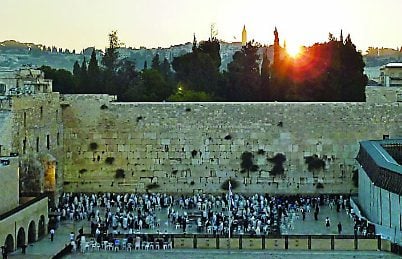
Shavuot, which belongs to every Jew, focuses on the young. But possessing the requisite energy to pull all-nighters is not the reason. Rather, the young are deemed the guarantors of the Torah.
And the revelation of the Torah at Mt. Sinai long ago is what Shavuot commemorates and celebrates.
The Intermountain Jewish News did not limit this piece to youth, yet this year’s edition gives them a primary voice.

Respondents’ answers indicate that their level of Jewish awareness shaped their initial reaction to the Wall, and the meaning of that encounter might evolve over time.
I first saw the Wall during my inaugural IJN assignment to Israel in 1994. I arrived as an explorer, not a searcher, because I’d cast off my Judaism years ago.
After interviewing people and filing stories, I took solo trips all over Jerusalem. On one of those baby-steps, I came face-to-face with the Western Wall.
I held back as the crowd swayed in rhythmic intensity. What were they saying, and why? But I gradually moved up closer and closer, until I touched the cold stone with my hands.
All I could think of were four lines from a Tennyson poem: “But what am I? An infant crying in the night. An infant crying for the light. And with no language but a cry.”
I didn’t cry. I woke up — to my long journey back home.
Read what the Wall means to Samuel Rheins, Elaine Asarch, Yoni Buckman, Sam Tessler and Alyssa Zimmerman. Regardless of age or attitude, you might find yourself among them.
Samuel Rheins, rabbinical student, HUC-JIR
Walking through the maze of the Old City to the Western Wall was quite an adventure for a 10-year-old. I remember descending the seemingly endless, slippery steps that led from the Jewish Quarter to the Kotel (Western Wall) Plaza, how my family and I bobbed and weaved our way through crowds of pious looking Jews.
Once we were past security, I could finally see the Wall! Having heard from family, friends, and teachers about THE Wall, I was surprised to see — a wall.
Sure, it was beautiful at night. Strategically placed lights created wonderful golden glows and shadows. I remember people were pressed up against the wall, deeply engaged in silent prayer, their quickly moving lips grazing the stone. I understood that people found the Wall meaningful and important, but to me it was just another ancient stone wall. I couldn’t understand why it was so special. After all, it was just a remnant of a retaining wall for the Temple Mount, and the Second Temple stood 2,000 years ago.
Three years ago on Shavuot, my opinion of the Wall changed. After staying up all night attending various Torah lectures, my friend convinced me to go with him for a sunrise service at the Wall.
Deliriously tired, we searched for a minyan where we could sit. I didn’t even have a prayer book. I sat with my friend in the minyan and watched the sun rise over the Wall. Thousands of people surrounding me were deep in prayer. For some reason, all those people chose to daven at at 5:30 in the morning.
While I was sitting and taking in the sights and sounds, the Wall assumed a new meaning for me. The Wall symbolized a common Jewish dream. How many generations of Jews dreamed about traveling to Israel or praying at the Wall but were unable to? I felt fortunate that I was in Israel at the Western Wall, during a festival and surrounded by all these people.
To me the Wall is special because it represents the Jewish dream of coming home to Israel. It connects me to Jews of every generation who could only dream about being here, and to Jews worldwide who direct their prayers to where I physically stood.
Elaine Asarch, community activist and volunteer
My first visit to the Kotel was when I was in my early 30s, and the mother of young children. I remember being in awe of the ancient symbol of Jewish survival and the sanctity of the remnants of the once vibrant Temple that had become a place for religious Jews to pray.
However, it was an experience removed from a personal memory or relationship.
I have traveled to Israel many times since then and revisited the Western Wall. Each time I became more aware of the significance of prayer and of this holy space.
Two years ago, our children Brynn, Jonathan and their children Zev and Mischa accompanied my husband Richard and I to Israel. We were with our guide Noam Dahary when I felt the overwhelming power of the Wall.
Tears flowed as I looked at my precious daughter-in-law and granddaughter, and the personal meaning of the Kotel became clear for me:
The values and beliefs that have been passed down from generation to generation give deeper meaning and guidance to our lives every day, and will continue to give strength to future generations.
Yoni Buckman, online engagement, Temple Sinai
One of my earliest memories of the Kotel was just prior to celebrating my Bar Mitzvah. It was at the Kotel where I first wrapped myself in my own tallit and tefilin. Until then, I used my dad’s set to practice the ritual of swooping the tallit over my shoulders, methodically winding the tefilin around my arm and over my head, reciting blessings with each movement. The joy of having my very own set of tefilin was that they were fitted to my adolescent head and didn’t fall off.

Figuratively — and quite literally — my tefilin don’t fit me anymore. In disuse, they sit in a box of their own, an artifact preserved. Their straps don’t bind; I never broke in their leather rigidity; and the scripture they hold no longer reflects my values.
I don’t visit the Kotel anymore. I do visit Israel, though. I just have new favorite places: visiting my parents in their Jerusalem home, grabbing a beer with my brother who lives in Be’er Sheva, spending time on the beaches of the Mediterranean, enjoying the summer wine festival in the gardens of the Israel Museum, eating gluttonous amounts of gluten from any bakery I pass by . . . The list goes on, but the Kotel is not on it.
There seems to be two types of perceived holiness in the world: that which is holy, and that which is made holy. From a close Biblical reading, perhaps only G-d was understood as intrinsically holy, while everything else is made holy through our actions.
Rabbi Abraham Joshua Heschel explained that the Bible identifies three categories of things made holy. First, G-d sanctifies time by making Shabbat holy. Second, G-d sanctifies people, by making the people of Israel holy. Third, G-d sanctifies space by making the Tabernacle holy.
The Kotel was first introduced to me as intrinsically and immutably holy. That made sense for a while. But as I grew older, I discovered my youthful understanding of the Kotel to be incomplete, if not woefully unsound. Not only is the Wall structurally different from what I thought — it was part of the foundation’s retaining wall, not a wall of the Temple itself — but I eventually realized that its holiness is fundamentally different from what I once perceived.
The Kotel today functions more as a symbol than a structure — a place made holy, representing a very singular, specific Judaism. We preserved the Kotel and sanctified it above even the people whose Jewishness it is said to stand for. In doing so, we have misconstrued its holiness. For me, this realization shattered my connection to the place, and my reverence for it crumbled.
But just as others have made the Kotel holy, I have spent my adult life creating holiness in other places, in other relationships, and in other moments. We all have the power to create holiness. The brilliance of Shabbat’s sanctity is that, having no marker in time or space, only through our actions is Shabbat created and made holy. So too, the relationships in our lives, biological or chosen, are made holy through our continual actions and efforts. Even spaces and objects are holy because we intentionally make them so.
My favorite place to be on Shavuot is in Jerusalem. When I have the opportunity, I spend the whole night walking from class to class, offered in homes and institutions around the clock until daybreak. The next time I’m able to go to Israel on Shavuot, I will excitedly create that holiness — with my parents and my brother, with renowned teachers and perfect strangers.
But the Kotel is one place I won’t likely visit.
Sam Tessler, student, Community College of Denver
During my freshman year of high school at Denver Academy of Torah, I had the great opportunity to go on a class trip to Israel for around two weeks. During our visit, we went to many places and had great experiences — but my trip to the Kotel resonated most of all.
As we spent time in Jerusalem, I developed a feeling I could only describe as multi-sensory. Something was affecting me both from within and without that I had never felt before. There was some type of emotional and physical connection that was new yet somehow familiar.
Normally, being surrounded by hundreds of people in a new environment would make me nervous, yet I found myself in awe and at peace. Visiting the Kotel allowed me to feel the history of the land at my feet, around me, and within me.
What does the Kotel mean to me? It is my connection to the past, and the future.
Alyssa Zimmerman, graduating senior, Denver Jewish Day School
I was nine years old when I first visited the Western Wall. I had listened to the stories of how it had withstood our turbulent history and became a symbol for the Jewish people. I kept these stories in mind as I approached the Wall.
However, I soon came to realize there is a missing aspect to every story and fact that I ever heard about the Wall — the feeling of holiness and contentment it emanates as people approach it.
At that time, it was difficult for me to comprehend the emotions I was experiencing. I felt something that I wasn’t able to put into words. When I was in front of the Kotel, everything else seemed to disappear. The Kotel connects us, because it is the heart of Israel and the heart of the Jewish people.
I realized that it isn’t just a symbol, but proof that our nation can overcome any hardship we face, and that we will continue to overcome them for generations to come.
As I placed my note into one of the crevices of the wall, I felt as though I became one with my history and my ancestors.
The last time I visited the Wall was two years ago. I was with my grade on a class trip to Israel and we went on a tour of the tunnels underneath the Kotel. By the end of the tour, we were all exhausted and cold and just wanted to go back to the hostel where we were staying.
As we exited the tunnels and it started to rain, I glanced over at the Wall. Its power and majesty made me feel the same way as when I saw it six years ago. It made me feel warm even in the freezing cold. It made me feel safe even in the darkness of night.
Most importantly, it made me feel holy, despite the exhaustion and weakness that overwhelmed me from that eventful day. As I looked at the Wall, I was humbled.
The Western Wall is greater than us all, and its holiness will emanate through the crevices and from the blessed ground it stands on for the rest of time.
Copyright © 2021 by the Intermountain Jewish News