
Last summer, Brig.-Gen. (ret.) Dr. Robert ‘Enz’ Enzenauer learned what life has been like for travelers in and out of Israel.

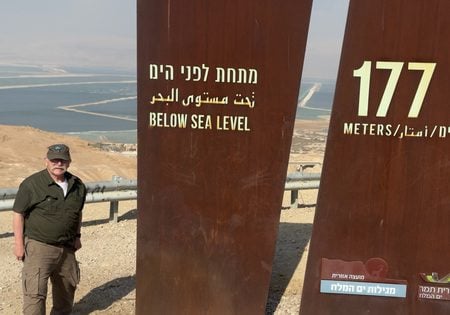
The Denver pediatric ophthalmologist was finishing a volunteer trip to Israel. Over the course of 10 days at Soroka Hospital in Beersheba, he saw hundreds of patients and estimates he performed between 24 and 32 surgeries. He was ready to return to his family in Denver with a flight scheduled for Aug. 1, 2024. A friend from Haifa who had taken him on a whirlwind tour of the country dropped him off back at his hotel. “So I go to bed fat, dumb and happy,” he recounts. “Well, that’s when [Israel] killed [Hamas leader Ismail Haniyeh] in Iran, and then bada bing, bada boom, Delta and United cancelled all their flights.”
After five days, Enzenauer got on a flight to Paris — the middle seat. He had a 10-hour layover there, flew to Reykjavik, Iceland, another 10-hour layover, then finally back home to Denver.
Did we mention that Enzenauer isn’t Jewish, his wife wasn’t keen on him flying into a war zone in the first place — and it was his first time in Israel?
Not everyone will carve out 10 days from a non-stop schedule to travel to a war zone voluntarily. By the way, Enzenauer says with a chuckle, it was 106ºF on a “good day.”
Indeed there is nothing typical about Enzenauer. Unique is a better descriptor. Download his CV and you’ll rifle through 20-plus pages of published researched papers, multiple higher degrees and professional recognitions. His accomplishments aren’t something one would pick up on when first meeting Dr. Enzenauer. His straight-shooting Army vibe doesn’t leave much room for hot air.
About a half year before he landed in Israel, a note went out on a pediatric listserv he belongs to. Soroka Hospital was looking to recruit ophthalmologists; the hospital had a backlog of some 200 cases.
“I’m not saying this to offend anyone,” he says. “But to me, it would be like telling people in New York and Chicago and LA, we really need you in Meridian, Mississippi.” Enzenauer’s gut tells him that not many physicians would hop on a flight, deep in the summer, to volunteer in the Deep South.
“People don’t wake up and say, ‘I want to go to Beersheba.’ It’s a great medical center, but it’s in the desert. And it’s hot.
“I’m proud to say I was the only non-Jewish” doctor who went, though he knows the others who also volunteered. Pediatric ophthalmology is a small circle, according to Enzenauer.
Even putting aside the unpredictable return portion of Dr. Enzenauer’s trip, it wasn’t an easy commitment to make. His work schedule goes out six months in advance and his department at Children’s Hospital in Aurora was bringing in a brand-new hire. Not only that, his wife was concerned about him making the trip.
“Pediatric ophthalmology really is a labor of love. We all know each other and there aren’t enough of us. The money is in LASIK and Botox . . . It’s harder to get people to want to do our specialty because 50% or more of what I do is Medicaid.”
While in Israel, a fellow pediatric ophthalmologist took Enzenauer on a short but wide-ranging tour of the country. They visited Mitzpe Ramon, the crater in the Negev Desert, Masada and the Old City of Jerusalem, including the Church of the Holy Sepulchre.
As a military man — and a history buff — Enzenauer had other must-sees: Mt. Herzl and the grave of Yoni Netanyahu, the only casualty of the 1976 Entebbe rescue operation. He also took note of two other graves in the paratroopers’ section, those of Hannah Senesh and Haviva Reik, both European-born women who parachuted into Nazi-occupied Europe as part of the resistance and who were killed during WW II.
Another stop: Moshe Dayan’s grave, “on a kibbutz way up north, really about as far as north I could go,” and Ben Gurion’s grave, which is in Israel’s south. He also visited the site of the Nova music festival that was brutally attacked on Oct. 7, 2023.
“I visited the kibbutz [Re’im] that was trashed. Let me tell you, that’s five clicks away [from Gaza] . . . every, every building is burnt out. There’s nobody there.”
Israel at war didn’t faze Enzenauer.
He served in Afghanistan from 2002 to 2003 and Iraq from 2003 to 2004 as a “flight surgeon.” He explains the term for non-military folk; essentially, a flight surgeon manages the surgical staff.
In a version of Jewish/Army geography, he recounts being in Kabul and getting a call from Dr. Frank Butler, the hospital commander in Bagram, the largest US air base in Afghanistan. They needed an ophthalmologist. The commander was one of Enzenauer’s “bestest buddies,” a Jewish cadet who graduated West Point two years after Enzenauer.
So Enzenauer, the self-described “recovering pediatrician,” found himself in Bagram doing surgery with his buddy.
One surgery involved a pre-teen Afghan boy who lost most of his eyelid when another child stepped on a mine left over from the Soviet-Afghan war.
The child who stepped on the mine died immediately, but “What’s amazing is [that the other child’s] eyeball was OK.” But if the eyelid isn’t fixed, “you’ll lose your eye because you can’t blink.
“So I had my Jewish surgeon do a circumcision and I grafted foreskin on [the child’s] eyelid. It saves his eye.”
The military isn’t confined to providing medical service to military personnel.
“The military will do surgery for life, limb or eyesight on anybody that walks in the door,” he explains. “That was true in Korea. It was true in Vietnam.”
He recounts an incident where a father told Enzenauer that his son had brought in an unexploded bomb and it blew up, leaving the child blind in one eye. From the father’s injuries, “It was no question. He was probably building the bomb . . . We figured out as physicians that [his] story is baloney.
“I took care of both of them,” though he adds the father was transferred into military custody when he was released by the medical team.
Enzenauer did a full residency in pediatrics, which left him feeling “eminently qualified” for the Army. “Soldiers are basically just adolescents that get ankle sprains and venereal disease,” he jokes.
Enzenauer grew up in the St. Louis area in a farming family. His father served in WW II, but when Enzenauer announced his interest in West Point, his father “was not a happy soldier,” Ezenauer recounts.
“When I went to West Point, he said, ‘If you don’t like it, just let me know, and there’ll be a plane ticket for the way home.’ I also had an appointment to the Coast Guard Academy, which sounded like a safer deal.” It was 1970-1971, and “We all thought we were going to Vietnam. My mother was grief stricken.”
He came to Denver in 1986, stationed at Fitzsimons, “hoping to never leave.”
His wife, also a surgeon (they met in medical school), worked at Rose, and they lived in the Mayfair neighborhood. Dr. Enzenauer remembers jogging on Sixth Avenue Parkway with his young children in their strollers.
“I tell everybody she married the Army and I married her student loans,” though she herself did a seven-year stint in the military.
Then came BRAC — Base Realignment and Closure — at the end of the Cold War.
“They closed all the nice places,” he bemoans, “Fort Sheridan, Lowry, Fitzsimons.” As that hospital’s chief of ophthalmology at the time, Enzenauer opted for military retirement.
But it wasn’t long before Enzenauer was back in uniform, first with the Illinois National Guard and then back to Colorado in 1996. Today, in addition to his work with the Army National Guard, he practices at Children’s Hospital — on the very grounds once home to Fitzsimons Hospital. It’s a symmetry that the historic-minded Enzenauer doesn’t fail to appreciate.
Enzenauer is a trove of the friendships, colleagues and information he has picked up over his long career that’s taken him across the world; Coloradans and Jews hold a special place.
He speaks fondly of beloved Denver ophthalmologist Dr. Joel Goldstein and praises the late Dr. Max Kaplan, a Denver pediatric ophthalmologist, whom Enzenauer credits as being the first one in the specialty.
But there’s another aspect of Kaplan that captures Enzenauer. During WW II, Kaplan was deployed in the field as a communicable disease specialist — there wasn’t a need for pediatricians in combat support hospitals. When Kaplan returned to civilian life, he added ophthalmology to his expertise.
Kaplan’s military-medical overlap speaks to Enzenauer’s sensibilities.
He is enthralled by — and deeply knowledgeable about — Jewish WW II heroes Mickey Marcus and Gen. Maurice Rose.
For this neophyte, Enzenauer delivers a five-minute mini lecture on Marcus — his trajectory from West Point to attorney to New York City Mayor LaGuardia pal to Israel War of Independence hero.
“WW II happens, and he’s biting at the bit to get in . . . he’s on Eisenhower’s staff for the invasion . . . he’s never gone to airborne school, but he tells division commander Jumpin’ Joe Gavin ‘I’m jumping.’”
At some point, “Eisenhower goes, ‘Where’s Col. Marcus?’ And somebody says, ‘He jumped into Normandy.’ It took a month to get Marcus back.”
After the war ended, in the waning months of the British Mandate for Palestine, Marcus was taken to Israel under an assumed name and passport.
“The reason Israel is probably free is because of Mickey Marcus,” says Enzenauer. “I believe that with all my heart. He was just a super organizer. He had all the regulations in his head. He organized the IDF.”
To this day, Enzenauer visits Marcus’ grave at West Point when back on campus. Last December he even took a friend, a Jewish Vietnam veteran who’d never visited the academy, to visit Marcus’ grave.
Enzenauer’s connections with Colorado Jews aren’t limited to the past or the medical field.
Rabbi Yerachmiel Gorelik, a chaplain with the Army National Guard, credits Enzenauer with helping him achieve that role.
Among Enzenauer’s patients are Gorelik’s children. “We struck up a friendship,” says the Australian-born Gorelik, speaking to the IJN coincidentally during his annual training at Buckley. “He’s come up to some of my events up here in Fort Collins.” More importantly, maybe, he gave Gorelik his first pair of Army boots.
Following the synagogue shootings in Pittsburgh and Poway, Gorelik, who leads Chabad of Northern Colorado, found himself ministering to a community struggling with rising anti-Semitism. His message: Increasing light is the best way to combat darkness. “I was encouraging the community to volunteer, to do more mitzvahs,” he says. “I was also struggling, wondering what I could do.”
Various members of his family had served in the military, in both World Wars and in Israel. It struck me, “These were true soldiers of Hashem as well as soldiers for their army.” At some point he shared with Enzenauer that he’d been looking at the Army and Air Force Reserves, but Enzenauer steered him to the Colorado National Guard.
“We just started talking about it,” says Enzenauer. “[The Army and Air Force Reserves] are not very helpful and I said, ‘Have you talked to the Guard?’ I don’t mince words.”
Says Gorelik: “At the time, to be honest, I didn’t even know what [the Guard] was.”
Enzenauer introduced Gorelik to the Guard’s Chaplain David Nagel and “before you know it I was having meetings with them and they liked me and I liked them.”
Gorelik says both Enzenauer and Nagel are “wonderful people” who love the Jewish people.
“You get a lot of that in the Army. It’s a personal great comfort to go to the Army . . . These are not armchair philosophers . . . These are people who have faced evil and know the difference.
“They’re just incredibly supportive of Israel and the Jewish people,” says Gorelik.
While Enzenauer wasn’t able to attend Gorelik’s commission, he sent Gorelik a pair of Army boots he no longer needed. “He was excited to play a role in getting me into the military,” says the rabbi, who, according to Enzenauer, is only one of two Jewish chaplains in the Army National Guard.
“[Enzenauer] is wonderful man and kept in close contact when he went to Israel,” says Gorelik.
“He went to help. He’s always been so passionate about Israel and he really operates at the highest levels of ophthalmology. His experience is as a trauma surgeon in combat zones . . . He really wanted to help.”
Back to the medicine — the primary reason Enzenauer was in Israel.
It wasn’t Israel’s top tier medicine or medical entrepreneurship that impressed him the most, impressed as he was. It was the diversity of Beersheba’s medical staff.
On one of the days he operated, the entire OR staff was from Russia.
“Every doctor I worked with spoke English, Hebrew and Arabic,” he says. “Most of the immigrants spoke Lithuanian or Russian or Albanian . . . a fourth or a fifth language. It was just amazing.”
When it came to religious demography, half of the doctors he worked with Arab and half were Jewish, “pretty much right down the middle,” he says. “But the patients were a third Israeli Arab, a third Israeli Jewish and a third Bedouin.
“As an eye doctor, it’s fascinating because there’s a lot of genetic stuff,” he says, referencing the Bedouin community. “When you have kind of a limited community, you can see certain patterns or certain diseases.”
That type of knowledge is amassed from years of experience and being one of the few who is board-certified in pediatrics and ophthalmology.
But it’s also instinctual inquisitiveness — no experience for Enzenauer is limited to the description on the label. Just recently he presented a paper on the injuries he saw at Soroka, but not on his own — he was mentoring a medical student and eye resident at Soroka. They had come to him for help with publishing a paper. His response: “Sure. But we’re not going to just publish it. We’re going to present it.”
The same way this reporter has since received Ted Berkman’s Cast a Giant Shadow — the book about Mickey Marcus — and the DVD of the movie of the same name starring Kirk Douglas, the same way Chaplain Yaakov Gorelik receives books on subjects Enzenauer knows will capture the chaplain’s interests, for Enzenauer, it isn’t over when it’s over.
Enzenauer has presented the Soroka paper twice and has polished the manuscript to get it ready for submission. In the world of academia, where publishing is king, Enzenauer’s hands on support makes a difference.
It tracks for the non-Jewish surgeon who voluntarily flew to Israel during wartime to donate his services — a trip that “ends up being a big expense,” he says, not least because he ended up covering his own airfare — and the extra days he spent when he was grounded.
“Both of my rabbi patients and my Jewish friends have convinced me, and I believe it,” says Enzenauer, “that my trip was a great mitzvah.
“It was life-changing.”
© IJN 2025