
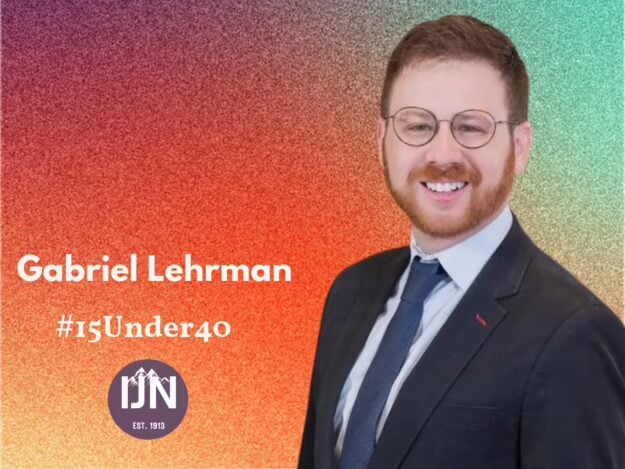
Cantor Gabriel Lehrman, 33, is the new assistant cantor at Temple Emanuel, his first job after being ordained at HUC in New York in the spring of 2026.
At this time, Lehrman is the only ordained cantor serving a Denver-area congregation on a full-time basis. (Rabbi Elizabeth Sacks of Temple Emanuel, ordained as cantor, is now co-senior rabbi there; Eitan Kantor, musical director at HEA, is pursuing cantorial ordination.)
Born in Kalamazoo, Mich., Lehrman grew up in the San Francisco Bay Area, where he developed much of his Jewish life at Congregation Beth Am in Palo Alto.
Lehrman earned a double BA in music and religion at the University of Puget Sound in Tacoma, Wash.
Which came first, your love of music or your love of Judaism?
It is really impossible to separate my love for Judaism from my love for music, since some of my first singing memories were in services, making harmonies to the music alongside my mom.
I started taking voice lessons in high school and pursued it in college, where I continued to focus on voice. In college, I was deeply involved in Jewish life alongside my studies.
Before I went to cantorial school, I found myself teaching outdoor education to Jewish day schools across the Northeast at the Isabella Freedman Jewish Retreat Center in Connecticut. It was there where I learned to love prayer and got a deeper sense of structure and flow of traditional and non-traditional prayer.
It was also where I found that my prayer and Jewish life were inextricable from my values, since the lessons that I taught to these day school kids went hand-in-hand with our morning prayers.
How much of the cantorial coursework dovetails with the rabbinical program at HUC?
Within the Reform movement, being a cantor vs. being a rabbi is mostly a matter of emphasis or focus. There was a lot of overlap in the education.
They are both five-year programs for most people, starting in Jerusalem for an opportunity to get to know Israel better and learn conversational Hebrew.
From there, the cantorial program is in New York and is organized by different liturgical cycles — first year on daily prayers, second year on Shabbat, third year on Shalosh Regalim, fourth year on High Holidays, with other subjects peppered throughout.
In your fifth and final year, there is no liturgical cycle. You write an essay (mine was on how culture is impacted by the sonic choices made by different synagogues) and then you present a correlated musical presentation as a capstone.
Students are also involved with internships and learning outside the core classes the fifth year.
At Temple Emanuel, do you see yourself as a shaliach tzibur or a song leader?
I am a full member of the clergy team, alongside Steve Brodsky and all of the rabbis. We, as a team, each take responsibility for teaching Torah, giving sermons, teaching in our religious school and thinking through the music and prayer at Temple Emanuel. My main focus is on music, but it is with that larger framework in mind that I think about the music.
Music plays a major role in prayer services. I am proud of the music that we lead here at Emanuel. I think that being a shaliach tzibur is to think about the people who we are serving, the history of the congregation, and how we are praying in relation to other congregations across the Reform Jewish world.
I’m involved in all lifecycle events from brit milah to burials and I am here to provide pastoral support.
I am also involved in our social justice committee, where we do our best to take care of our neighbors with a particular eye towards those in fear of immigration crackdowns and who are low income.
Is synagogue music evolving?
We are currently in a new Golden Age of Jewish music, with incredible Jewish music being created every year across all denominations and many different musical genres. Here in Colorado, I am impressed by how many examples we have of that.
As a cantor at Temple Emanuel, I see my role as twofold: 1) helping to shape the culture of the space through musical liturgical choices, and 2) holding and teaching the richness of the tradition.
Organizing the music in a service is always a balance of helping a community feel seen in its identity and keeping the service feeling dynamic and new. I love the traditional melodies and I love the new music.
For the traditional melodies, we try to keep them feeling relevant by thinking about how we arrange them. For new music we try to introduce it slowly with the goal that no one should walk into the service and not recognize themselves in any of the music.
Your thoughts on Colorado?
Colorado is great. It’s a beautiful state, and the more I look into it, the more incredible things it has to offer. I love getting into the mountains as often as possible —tentatively taking up skiing — and I am amazed with how much new and exciting music is in and around Denver.
There’s not a lot of spare time, but I have been working on my cooking and my guitar playing. Don’t ask for any meals yet, but I’m proud of my challah for now and am developing a repertoire of dishes.
Most recent movie? Book?
“Come See Me in the Good Light,” a documentary on the late Colorado State Poet Laureate, Andrea Gibson. Incredible and very sad movie to watch as it documents Gibson’s battle with cancer.
I am currently reading Inventing Jewish Ritual by Vanessa Ochs, which (believe it or not) is relaxing for me. For fiction, I am slowly making my way through The Adventure of Kavalier & Clay by Michael Chabon.
© IJN 2026