
Esther Mizrachi, MD, wanted to become a physician from the time she was in kindergarten.
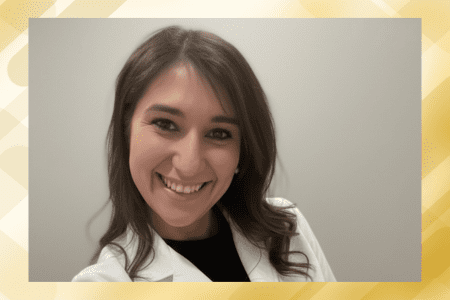
She grew up in a medical family. Her father was a physician at the famed Mayo Clinic in Minnesota.
“I was inundated with medicine. When other kids were coloring Winnie the Pooh coloring books, my dad got me a Netter’s Anatomy Coloring Book. I always knew I wanted to be a physician,” she recalls.
Mizrachi went to medical school with plans of becoming a pediatrician. “I really loved babies and I loved kids.”
But during medical school she started to observe her aging grandmother. “I really enjoy spending time with my grandparents and with other older adults. I realized that while I felt tremendous respect for them when I was in medical training, I saw that same level of respect didn’t seem to exist in healthcare — that feeling that older adults were elders, more knowledgeable
“I enjoyed taking care of adults and very close to the end of medical school I shifted my plan and decided to go into emergency medicine because I loved kids and I loved older adults, and I didn’t want to give up either of them. I decided, ‘I’ll take care of everybody.’”
Mizrachi says that during her residency training, she spent a couple of months in pediatrics and the rest of the time in general emergency medicine, but there was no dedicated geriatric training during residency.
“There are so many physiological changes that happen in the elderly. They have so many specific needs, and you don’t get that dedicated attention in your training to learn what you need to be doing, how you should be augmenting their medications, how you should be treating them differently.”
Geriatrics — the medical discipline focusing on the needs of elderly people — is a relatively new specialty with its formal recognition and board certification occurring in the latter half of the 20th century.
Actually, Mizrachi says, the concept of aging is relatively new. “Historically, people didn’t live into their 80s, or if they did, it was very rare.
“When we look at the origins of medicine, most of it was focused on infection prevention and childbirth — things that would kill off younger people. As we progressed, we realized we now have this aging population, which is a very new concept.”
After graduating from Albert Einstein College of Medicine in New York, Mizrachi completed her emergency medical residency at Northwell Health, a leading provider of emergency geriatric medicine. From there, she dove into improving senior care at Mount Sinai Hospital, where she served as core teaching faculty in the home of the first geriatric emergency department in New York City.
During the COVID pandemic, Mizrachi and her husband Jaques Clapauch, moved to Denver, where they started their family — now three children, ages five, three-and-a-half and four months — and Mizrachi started her own senior medical practice, based on her experiences in geriatric emergency department cases.
Her practice, SilverCare, is focused on preventing unnecessary ER visits. “Perhaps the most effective way to improve emergency care for seniors is to improve their odds of not have to go to an ER in the first place.”
Mizrachi operates on a subscription or concierge model, providing home evaluations to establish a baseline understanding of each patient’s health and lifestyle.
When a patient experiences an urgent medical need, Mizrachi provides house calls, armed with diagnostic tools and equipment.
“I have an ultrasound machine, an EKG machine and basic respiratory testing. I can do COVID and flu testing, and urine testing to check for urinary tract infection and dehydration.”
She also travels with basic blood testing so she can test kidney function, liver function, electrolytes and cholesterol.
She can diagnose infections, musculoskeletal injuries, cardiac and pulmonary problems.
Her limitation is that she cannot manage acute time-sensitive conditions like a heart attack or stroke.
Mizrachi considers SilverCare “more than an urgent care center, but less than an emergency department,” all in the comfort and convenience of the patient’s home.
She keeps her finger on the pulse of emergency medicine, working clinically one day a week at St. Joseph Hospital.
Mizrachi is cognizant that everyone ages differently.
“A lot of our life choices and genetics interplay with determining how we age. One 60-year-old is not the same as another 60-year-old. And one 80-year-old is not the same as another. There are people in their 90s who are running races and very active, and there are people in their 70s who have multiple medical morbidities or are bedbound. There are 64-year-olds who might need someone like me, and there are 90-year-olds who do not.”
Mizrachi explains that people experience many physiological changes as they age, resulting in the need to dose medications accordingly:
“As we age, changes in kidney function and altered distribution of fat, muscle and water will augment both the intensity of the body’s response to medications and the amount of time a medication remains active in the body.”
In other words, when it comes to medications and age, one size does not fit all.
Mizrachi speaks about the sensory changes, such as eyesight and hearing, that occur as people age.
“Reading becomes difficult, especially if you don’t have reading glasses. Hearing can become difficult and sometimes, excessive stimulation can cause confusion.”
The emergency department, Mizrachi says, has all these obstacles, such as fine print everywhere, bright lights, overstimulation of sounds, and lots of people, lots of faces, lots of names.
“It’s very confusing to the elderly population and I don’t think everyone in the healthcare system is fully cognizant of that.”
If any of her SilverCare patients must go to the emergency department, Mizrachi will accompany them and serve as their advocate if needed.
Mizrachi says the vast majority of her private practice patients take their healthcare seriously and try to take good care of themselves.
“When I work in the emergency department and see the general population, that’s not quite as much the case. Some people just don’t want to think about it, while some really make their healthcare a focus.
“Being healthy is what allows you to interact with your world as you get older, so coming to terms with that is important as we age.”
Mizrachi is aware that some seniors experience medical ageism in they way they are treated by some in the medical establishment. This can manifest itself as being dismissive of complaints or challenges, just labelling them as part of aging.
“Ageism is definitely incredibly prevalent, not just in medicine, but in every aspect of our society. It’s fed by multiple sources — the media, TV portrayals of older adults. They’re usually made to be often very confused or very silly, or very unknowledgeable or very angry and mean. There are very few shows where you see the kind, caring and wise older adult where they are shown with dignity.
“I think that has contributed to a prejudice against the elderly in which we see physicians not wanting to give time, not giving respect to older patients, not validating certain complaints, just attributing them to old age.
Mizrachi says that certain physiological changes are expected in the majority of people as they age, including arthritis, vision changes and hearing changes.
Are these changes “normal?”
“I think ‘normal’ is a difficult word to use because these changes limit your ability to enjoy your life and to enjoy the world. We need to recognize them, treat them and use whatever assistive devises or medications it takes to minimize those symptoms and their disruption into life. So, saying it’s normal does not mean to dismiss it. It cannot be dismissed, but it can be reassuring — patients need the reassurance that this is typical.”’
Mizrachi sees the circle of life to be truly a circle.
“Babies come into this world with no ability to care for themselves, with lots of sensory disturbances. They can’t see well when they are born, they can’t eat. They can’t move well. They can’t control their bodies. They can’t communicate.
“But what do they have when they’re born?
“They have unconditional love from their parents, from siblings, from lots of family. We are very happy because we love to support them and take care of them until they are self-sufficient.”
Mizrachi says when we age, we reach the other side of that circle:
“We start to lose our sensory faculties. We don’t see as well — again; we don’t hear as well; we can’t communicate with the world as well. Sometimes people cannot control their bodies as well as they used to.
“But what’s missing there is what is there at the beginning: that unconditional love, and I think that needs to come back. We need to appreciate that we have a responsibility to our elders, not just to our children.
“We need to support elderly individuals the same way by giving them unconditional love and providing them with the resources they need.”
Mizrachi’s sentiments are rooted in the Torah, where respect for elders is referenced more than once:
“Honor your father and your mother, so that your days will be lengthened upon the land that Hashem, your G-d, gives you.”— Exodus 20:12 (fifth of the Ten Commandments)
“Do not cast me off in time of old age; when my strength fails; forsake me not.” — Psalms 71:9
Mizrachi says, “You have to respect your elders and honor your parents, not just when you are a child, but also when you are a parent yourself.
“We need to recognize the words of the Torah and to honor our parents which is not just visiting them and calling them once a week. It’s truly being there and providing for their needs as they age, taking care of them and listening and hearing.
“That same obligation we have to our babies as they begin life, we have to our parents and grandparents as they get closer to the exit of life.”
Dr. Esther Mizrachi practices what she preaches — and what the Torah preaches:
“I really appreciate and love taking care of this population because not only am I able to care for them and honor the Torah by honoring our elders, I feel that I actually learn from them — how they’ve lived, and they remember things from history. Learning about their lives helps me to guide my own.
“I am one of the lucky physicians who learns as much or more from my patients as they learn from me.”
© IJN 2025