
HAVE YOU ever been in a house with a walk-in closet so large that you jokingly remarked, “I could live in this closet?”
For a growing number of people, that huge walk-in closet may contain more square footage than their new “tiny house.”
What is a tiny house? The tiny house movement? Tiny living?
It is a social movement in which people are choosing to downsize – sometimes drastically.
The typical American home is around 2,600 square feet, while the typical small or tiny house is between 100 and 400 square feet. Tiny houses come in all shapes, sizes and forms, but they enable simpler living in a smaller, and some say, more efficient space.
People are joining this movement for many reasons, but the most popular include environmental concerns, financial concerns, and the desire for more time and freedom.
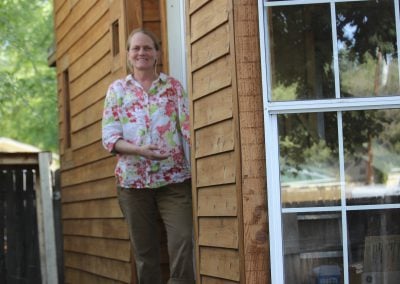
DENVERITE MARIE Cardin’s reasons for building a tiny house are deep-seated.
Cardin grew up for the most part homeless with a mother of seven children. “I never really had a sense of stability, and I felt that as an adult one of my goals was to own my own home. This was my way of asserting myself to meet my needs, as far as healing goes,” she explains.
Cardin, a teacher at Stanley British Primary school, now lives in a beautiful home in Hilltop with her husband Steve and daughters Sophie, 16, and Talia, 12. Her 30-year-old daughter Danielle is an attorney in Baltimore.
Early in their marriage Marie and Steve Cardin lived in a 900-square-foot cabin in Alma, Colo., with their oldest daughter Danielle. They liked the coziness of the cabin, but it was too small a space in which to raise a growing child, plus the school choices were minimal. They moved to their Denver Hilltop home in 1997 before their younger two daughters were born.
While she loves her family home, Cardin’s dream has been to purchase a home with her own money. The tiny house concept appeals to Cardin on several levels and has enabled her to realize that dream. The tiny house was not built to serve as her primary residence, but as a project which will provide possibilities for the future for those she loves or perhaps herself.
“I feel this is an empowering lesson for our daughters: ‘Mom is building her own house,’” she says.
Just last weekend, Cardin put the finishing touches on her 262-square-foot house that sits atop a 20-foot trailer.
“I was fascinated with the houses. I knew it was something I could do financially with my own income. That was a personal challenge for me.”
“It ended up being a real mitzvah because at the same time that I started to contemplate building this tiny house about a year-and-a-half ago, my 43-year-old nephew, who lives in Florence, Colo., was diagnosed with Parkinson’s disease. He’s a carpenter, and had to take a leave from his work. He’s accustomed to building large homes, and he was no longer able to use the tools safely until he got his Parkinson’s under control.
“All of sudden, he had no income. I had this need, and he needed an income. I told him, ‘Let me pay you to help me build my tiny house. That way my dream comes true and you can continue to pay your bills and have an income.’”
Cardin and her nephew started researching the latest in designs for tiny houses.
“I wanted to have certain elements in my tiny house, including two lofts — a bigger loft to serve as a master bedroom, and a smaller one for my youngest daughter. We built it in a way that it has a bed beneath that loft for my 16-year-old.
“We really didn’t draw blueprints because he is such an experienced carpenter; we just sort of went for it. He drew a rough sketch of it and I purchased the materials.”
Besides The Home Depot, many materials came from the Habitat for Humanity resale store. Cardin also used a beetle-kill wood for decorative purposes to be mindful of the environment, and she shopped on Craigslist to keep the price down.
She bought a used trailer, which she and her nephew refurbished.
“Some of these tiny houses can end up costing $100,000 if you let it. I’ve put about $18,000 into it.”
Cardin and her nephew worked on the tiny house together. Because Cardin works full time during the week and her family honors Shabbat, the only days she could make the two-and-a-half hour drive to Florence where it was being constructed were Sundays.
This past Sunday was the final day of construction; she just added the final trim on the interior.
TYPICALLY, TINY houses have the front door at the end, but Cardin had a bay window built on the end, so that an extra bed could fit in the space created by the bay. The bed stows away and becomes living room seating with storage underneath.
Cardin put French doors on the side to allow more light into the house.
The house has a staircase leading to the larger loft. A ladder serves the smaller loft. The space under the stairs provides storage, covered by cabinet doors.
Cardin’s tiny house has relatively large windows, which were repurposed. The bay window on the end has a cover that can be easily attached when the tiny house is being transported. The covers protect the windows from stones and debris on the road.
The same is true with the French doors on the side. The deck in front of the doors can be pulled up with a cable and fastened flush with the door to protect it during transport.
The tiny house is built of cedar with a hickory floor and a metal roof.
“In my kitchen, I had to have an oven because I bake challah every Friday for Shabbat.”
The kitchen, although only about two-and-a-half feet wide, includes what she feels is adequate storage for her one set of kosher vegetarian dishes, and only essential cooking and baking utensils.
The kitchen has a propane stove with two burners, and a small refrigerator.
In the back of the house, there is a utility closet for two propane tanks to run the stove and a boat heater, which will provide plenty of heat for the well-insulated tiny house, Cardin says.
For the bathroom, Cardin purchased a new galvanized horse trough for a bathtub, and a compostable toilet. An on-demand water heater, connected to one of the propane tanks, is mounted on the bathroom wall.
The house actually has a walk-in closet, albeit small.
“I’ve been practicing my mindset regarding my clothing for the past year-and-a -half. I have a small guest room with a tiny closet with room for maybe 36 hangers and three shelves. I’ve been using that closet, and that’s all the clothing I own at this point. I may someday be living permanently in the tiny house in retirement, but I may not.”
CARDIN’S IMMEDIATE goal is to secure a location in Denver where she can park her tiny house. For a future location, Cardin’s family in Bellingham, Wash., has land at the base of the Cascade Mountains and they have already chiseled out a spot for her. The zoning is approved.
She will use a three-quarter ton truck to pull the tiny house.
“I would first like to share it and integrate it into the learning at Stanley. It would be very valuable for them to see what is possible.”
Cardin’s long-term plans for the tiny house are up in the air. She is considering it as a possible home for her mother to retire to.
“It may end up being a place that my either of my younger daughters may want to live in it as they go through college,” she adds.
MANY PEOPLE would not want to live in only 262 square feet, including two lofts. Marie Cardin appreciates cozy spaces and a simple lifestyle.
“I was raised in very tight situations, space-wise. It’s something I value. It’s something I practice with my children. The more you own, the more you have to manage. I’m always trying to simplify our lives so that we have more time for our relationships, Shabbat dinners and friends, and trips.
“We’re in a society where it’s so easy for our teenagers to think they’re defined by possessions, and I really want my children to know themselves. This is one of the reasons I wanted to build a tiny house.
“Steve and I both love the intimacy of having our family all in one room, so you don’ t have to text your children, Come down for dinner.”
Cardin’s mother-in-law is Baltimore philanthropist and national Jewish community leader Shoshana Cardin. Her sister-in-law, Rabbi Nina Beth Cardin, has been inspired by Marie’s tiny house to build one of her own. “Now we’re working together to design her tiny house.”
Marie Cardin’s tiny house has gone from fulfilling a personal desire for home ownership to a multi-pronged act of kindness –— for Cardin’s nephew, who was able to earn money building it, to her sister-in-law, who was inspired to enjoy her own tiny house and to her daughters who are learning a valuable life lesson in self-sufficiency.
Copyright © 2016 by the Intermountain Jewish News