
ROSH HASHANAH 5785 • L’CHAIM®
A terrorizing thought . . . Yes, you can do something
In 23 years, so much has changed — and not changed.
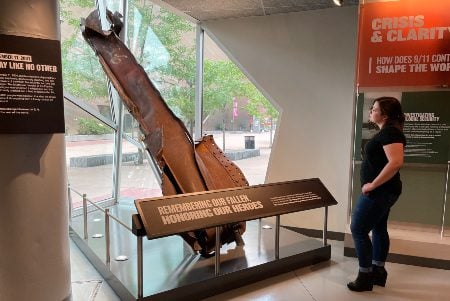
Almost anyone alive today who was cognizant on Sept. 11, 2001, remembers exactly where they were when they heard the news, though in the early minutes the news was unclear — was it an accident? — until millions, watching live, saw the deliberate attack on the second World Trade Center Tower. Then came the Pentagon . . . then Flight 93, over a Pennsylvania field. On that fateful day, a day many argue marked the beginning of the chaotic and fraught era we currently live in, 2,977 were murdered.
But the death toll continues, as first responders continue to die from 9/11-related illnesses; so many heroes — first responder and civilian — did whatever they could to try to help those caught in the terrorists’ flames.
Though not on the same scale, all of these nuances and realities — hijackings, mass murder of civilians, infiltration, suicide glorification — were long known to Israel and other countries facing terrorism. But for the US, indeed for the global community, an attack on the scale of 9/11 against a superpower was unprecedented.
So unprecedented that a local foundation decided it deserved a museum of its own, a place that would tell the story of the event itself, and also explore how the event impacted humanity and what lessons could be gleaned from it.
The latter goal is a central focus of the newly renovated permanent exhibition at the Counterterrorism Education Learning Lab — The CELL — the museum that the Mizel Institute brought to life 16 years ago.
Despite the two-plus decades since 9/11, the museum’s tools and lessons remain extremely relevant.
In a strange twist of fate, even though I visited The CELL a few months ago, I sit down to write this article on September 11, 2024. Coincidence — or, possibly, subconsciously intentional.
Since Sept. 11, 2001, terrorism has become a fact of life. But for Israel and the Jewish community, for which terrorism was reality long before 9/11, Oct. 7, 2023 marking a turning turning point. When Hamas invaded southern Israel on Shabbat Simchat Torah, murdering at least 1,200 and taking over 250 hostage, many called it Israel’s 9/11.
This is the current state of geopolitics that The CELL faces as it reopened its doors in May after a years-long renovation, most of which, coincidentally, paralleled the coronavirus pandemic.
Having a 16-year vantage point has allowed The CELL to evolve in its goals. While the events of 9/11 still form the core historical exhibition, the museum now takes the visitor through the terrorism lifespan. The aim is that visitors leave understanding what terrorism is, its inception and evolution, and how it impacts not only society but individuals.
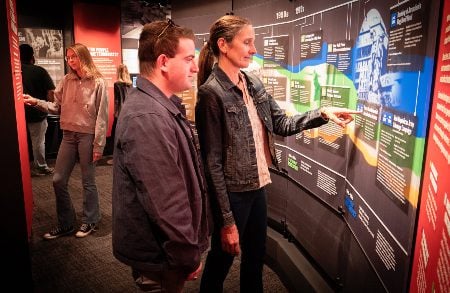
To achieve that, the museum uses a variety of tools. One is an impressive timeline of terrorism, spanning conflicts, including the Catholic-Protestant divide in Ireland. At each juncture on the timeline, visitors have the option of going deeper into the exhibit, often through new, digital tools.
The museum calls these “Lesson pathways,” feeding into another goal of the museum, says James Hippensteel, manager of education and programs, “to empower people to take action.” For example, against hate speech. Through its exhibit, the CELL aims to show how hateful speech can evolve into terrorist acts.
It does this through a stark — and disturbing — visual and aural montage as one exits the 9/11 exhibit. In a sort of anteroom before the new, central exhibit, lights are dim and photos of events associated with hate fill the walls. Sound comes on — snippets of infamous hateful rhetoric, such as from the segregationist George Wallace. It’s difficult to hear, but that’s what makes it important, say Hippensteel and Caitlyn Lauchner, education and outreach coordinator.
They both see hate speech as a potential first step toward something deadly. Listening and seeing this montage may spur the visitor to continue on the journey the museum is laying out, specifically, “What can I do?”
To counter terrorism, both educators say, requires going back, well before a deadly act occurs. To ask oneself: “How does it start?”
If an Islamist imam delivers a sermon calling Jews pigs, or a white supremacist says black people are inferior, it has the potential to spur someone to act against the stigmatized group.
The CELL’s counterattack is to inspire people to stand up against such language, not to ignore it, even though that might be easier or more comfortable.
One specific demographic the museum works with are young people; the montage may make them consider whether the language they hear on school grounds or elsewhere may be problematic.
The exhibit is rated for 14-year-olds and above but The CELL recognizes that some of the material may be too difficult or traumatic for some people, especially if a student may have direct experience with terrorism. The staff works with teachers and may bypass certain parts of the exhibit or even move to a breakout room to process. The goal is not to traumatize, say Hippensteel and Lauchner, but to educate.
When school groups are asked what they think of when they hear the word terrorism, “They connect it to school shootings,” says Hippensteel, who uses such responses to open a conversation about what constitutes terrorism. Interactive stations allow visitors to see how a terrorist act sows chaos and disruption, a key aspect of most definitions of terrorism.
The digital aspect of the new exhibition is that it allows staff to update its content as events occur, such as the Oct. 7 Hamas attack on Israel.
The exhibit is not only about the negative. Inherent in any collective trauma is a message included in The CELL’s introductory film about 9/11: it showed the worst, but it also showed the best of humanity, something Israelis and Jews have also experienced since Oct. 7.
As the exhibit takes one through modern-day examples of terrorism — including Oct. 7, which is given a prominent spotlight in the first section of the museum — the visitor encounters concrete tools to help prevent terrorism, such as reporting mechanisms or situational training. As this journey continues, the room itself slowly changes, with the lighting getting brighter and brighter, a subliminal message that a more optimistic future lies ahead.
That fits with Hippensteel’s stated goal of visitors leaving feeling empowered, which culminates in the final portion of the exhibit, dedicated to civics. Through interactive stations, visitors can engage with thorny topics such as freedom of speech versus hate speech. Visitors can then vote on which side they agree with, and see how their point of view lines up with that of other visitors.
As many lament a loss of civil discourse in today’s world, this section of the museum reminds visitors not only that information and knowledge is needed to form an educated opinion, but also that it is still possible — and important — to discuss topics with those with whom you may think you disagree.
That final stage of the exhibition is a counterpoint to an earlier one that explores how people can be radicalized within echo chambers. An antidote, The CELL believes, is dialogue and debate.
Both Hippensteel and Lauchner come from education backgrounds, so it’s no surprise that both value the kind of discussion that topics like privacy and biometrics can provoke. In a polarized world, The CELL attempts to remove the politics and instead explore the impact of terrorism on humanity as a whole and what power may lie with individuals to promote kindness instead of hate.
“When they leave,” says Hippensteel, “I want visitors to have a sense of solidarity.”
The CELL is open to the public on Saturday and Sundays, and open to groups on Tuesday and Thursdays.
© IJN 2024