
When Hollywood shut down during Covid and productions went dark, special effects coordinator Steve Wolf — who had worked with stars such as Tom Cruise and Tom Hanks — suddenly found himself out of work. Instead of waiting for studios to reopen, Wolf went back to a patent design he’d started meddling with a decade earlier. That pivot could end up reshaping one of the least innovative yet most dangerous fields in America today — wildland firefighting. And wouldn’t you know it, special effects from Hollywood played a role.
Today, Wolf is the founder of Team Wildfire, a Boulder-based startup building what he calls “the first jet-engine-powered wildfire suppression system in the world.”
His machine looks like a science-fiction prototype. But the goal is ancient: stop fires before they become catastrophes. Firefighters who have tested Wolf’s machines across the country say they may finally offer a path forward.
The need has only grown more urgent. Since 2020, Colorado has endured four of its largest and most destructive fires — the Cameron Peak Fire, the East Troublesome Fire, the Marshall Fire, and this year’s Lee Fire. Approximately a quarter million acres have already burned in Colorado this year alone, the state’s worst fire season since 2020 and its fifth worst in recorded history.
Across North America, the pattern mirrors Colorado’s: vast stretches of Canada have burned, and major US cities like New York have been shrouded in drifting wildfire smoke.
My eight-year old son and I visited Wolf together with an IDF representative over the summer. When we got the opportunity to operate their ATV machine nicknamed “Storm Cell,” it quickly became a more exciting trip for my son than his first visit to a fire station.
To understand the novelty of Team Wildfire’s idea, it is important to realize that, despite their name, firefighters rarely fight fires in forested areas. “Mostly they’re engaged in containment, which is basically high-speed gardening,” Wolf says. Wildland firefighters today rely on two kinds of tools: hoses that shoot narrow, rifle-like streams of water, and hand tools — axes, shovels, and picks — that aren’t so different from what firefighters carried hundreds of years ago. “You’re digging fire lines, removing vegetation. These are Stone Age tools,” Wolf says.
Even hoses — the “modern” part of a firefighter’s toolkit — have their own limitations. A standard fire engine hose can reach about 60 meters with a straight stream — effective for targeted suppression, but nearly useless against fast-moving walls of flame. That narrow stream cools only a tiny 50-centimeter patch at a time.
Wolf remembers this firsthand from his time as a volunteer firefighter decades ago, when he and his colleagues were dispatched with nothing more than picks, shovels and axes. The primitive gear startled him even then. “Our tools were medieval,” he recalls. Firefighters themselves joked that firefighting represented “200 years of tradition unimpeded by progress.”
When Wolf asked seasoned firefighters how they planned to confront massive wildland blazes, they half-jokingly replied: “We pray for rain or a change in the wind.” When he pressed them on what it would really take to overpower a major fire, they answered, “A hurricane.” Years later, Wolf would build something he now calls exactly that.
Instead of pushing water through a hose, Wolf’s machines force water into the exhaust of a jet engine, which is mounted on a military-size truck, a contraption he calls the “Hurricane.”
For my son, whose favorite part of our trip to Denver was the airplane flights, getting to climb into the Hurricane’s driver’s seat — literally climb, as the door was about 14 feet off the ground! — was quite the highlight.
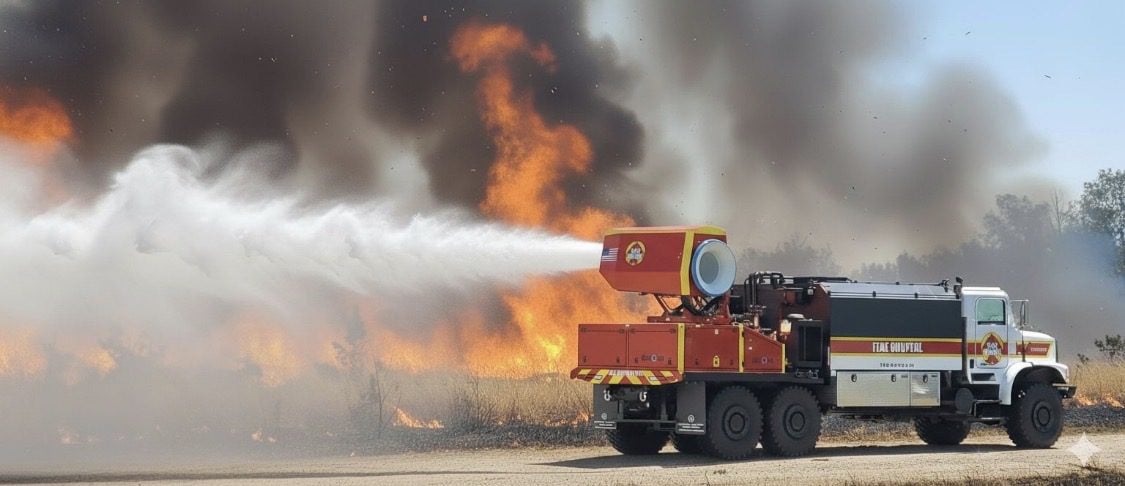
The jet engine’s thrust atomizes the water into a massive mist cloud — what Wolf describes as a “shotgun” instead of a “rifle.”
A standard jet engine shoots a 200- to 300-meter-long stream, spreading a 15 to 25-meter-wide mist across a fire line. The effect is dramatic. Instead of cooling a tiny patch, the mist creates thousands of times more surface area than a traditional hose stream, delivers up to 10 times more suppression per gallon of water, and generates temperature drops of 300 degrees due to rapid evaporative cooling, while also providing coverage of up to 10 acres per minute, depending on the model.
Or, simply put, a 100-gallon tank on Wolf’s smaller prototype, the “Storm Cell,” performs the equivalent work of a 1,000-gallon fire engine.
His larger model carries 2,000 gallons and delivers 50 times the thrust.
Most critically, the Storm Cell can impact where fire trucks cannot: steep inclines, off-road terrain, and wilderness areas that firefighters normally reach only by hiking in with hand tools.
To change a fire you need to change the weather. Wind direction and humidity — those two things determine how a fire spreads. This is the first technology that lets firefighters take control of the weather at the scene,” Wolf explains.
Wolf proceeds to give me a crash course on the science behind fighting fires. The weather-altering force is only part of the design.
A fire needs four elements to keep burning — heat, oxygen, fuel and chemical reactions. The Hurricane and Storm Cell systems are engineered to attack all four.
A cylindrical “mist injection chamber” sits in front of the engine, lined with micro-nozzles that inject water-based suppressants into the jet exhaust.
When this mixture meets open flame, the suppressant flashes to steam, starving the fire of oxygen.
Evaporative cooling strips away heat.
The thrust from the exhaust blows aside leaves, underbrush and other fuels, and additional chemical agents interrupt the fire’s combustion reactions.
When Covid shut down Wolf’s regular work, he used the downtime to complete his first patent application, something he began in 2009. He then recruited a small team of top special-effects fabricators from Los Angeles.
He gave them no blueprints — just a sketch on a blackboard.
“A week later,” Wolf recalls with a grin, “we had a working machine.”
Through corporate channels, he notes, it would’ve taken three years.
Investors took notice — including local entrepreneur Brett Kingstone, who read about Wolf’s invention a few years back and is now interim CEO of Team Wildfire.
While Steve Wolf brings decades of special-effects engineering to the project, his brother James Wolf provides another aspect: industrial design. James, who studied product design in college and built a long career in the field, focuses on the one thing that can’t be reverse-engineered in a lab — the way humans actually use a machine under stress.
“What’s important is the interface,” he says. “Hard things, soft things, everything has to work intuitively so nobody gets confused in a dangerous situation.”
After James tells me he is based in Texas, I ask if he’s currently visiting Steve in Boulder. “Visiting? No, I visit home,” he laughs, explaining that he spends most of the year on the road, moving between fire departments across the country with the three coordinated vehicles that make up the Team Wildfire system.
In other words, James’ home has become wherever the next fire crew is willing to test a prototype. They’ll call a fire chief a couple hours in advance: “Do you want to see the world’s first jet-engine-powered wildfire suppression system?”
The response is “Yes!”
That road-testing process has become the backbone of the company’s development cycle. Firefighters climb into the driver’s seat, take the controls, and immediately begin imagining scenarios where the machine fills a gap in their existing toolbox. The feedback is positive, says James, because the vehicles do something no current equipment can do: travel quickly off-road and reach fires that trucks and hoses can’t. Today, when lightning strikes a ridge, crews often park on the highway and hike up with rakes and hand tools. Team Wildfire’s machines make that kind of high-risk, slow-moving response obsolete.
The team has incorporated feedback from the fire departments and James says they’re now ready to take orders.
“It’s niche,” he says. “But it fills the exact niche that firefighters keep telling us they don’t have anything for.”
Fire departments identify uses such as firebreak creation, direct attack on flames and asset protection for insured properties. The last category has also caught the eye of private insurance companies, which routinely hire private fire crews to defend high-value homes during fire season. Wolf’s technology could shift the balance for such companies from protecting individual homes to protecting whole neighborhoods. “After all,” Steve notes, “how well can you protect a mansion when the whole neighborhood around it is on fire?”
Wolf grew up in Larchmont, NY, in a Conservative Jewish household. “My parents weren’t particularly observant,” he admits, “but there was this girl in fifth grade — she was so cute. I found out she went to Hebrew school, so I said, ‘I’m going to Hebrew school, too.’”
He laughs at the memory, but says the Jewish mindset has shaped his work.
“Jews tend to look at problems through the lens of solutions,” he says. “We show up for our neighbors. We come together to brainstorm ideas for the betterment of humanity. Israel is the startup nation, right?”
After the massive Marshall Fire devastated Boulder County, Jewish community leaders there became among the earliest supporters of Team Wildfire’s work.
The Talmud (Yevamot 79) teaches that Jews are distinguished by three characteristics: compassion, gentility and acts of kindness. My interview with the Wolfs gave me a clear window into the first two characteristics. The entire project is grounded in compassion, a desire to save lives, save homes and improve the climate. Their gentility shone through as well, as soft-spoken individuals who shied away from talking about themselves, preferring that I see and appreciate the life-saving nature of their technology.
Acts of kindness weren’t something our brief encounter was conducive to, but it was clearly G-d’s will for me to directly learn how the Wolfs exemplify this. You see, I visited their warehouse with an expensive and sentimental piece of jewelry in my pocket (bad idea, I know). When I got home, the jewelry box was nowhere to be found. Steve Wolf was one of a few people I contacted that night, asking to keep an eye out for a small, purple jewelry box. He sent James the next morning to look, but James didnfind it. James called me, asked some questions to help guide his search and, thank G-d, called back a few hours later with the good news that he found it.
What struck me was that James didn’t put in a cursory effort typical of any good-hearted person helping a virtual stranger. He looked as if it were his own loss. He stopped to think about where and when it would most likely have been lost, he went back and looked again even after finding nothing, and he even went as far as to pull up seat covers in the process! An act of kindness, indeed.
Among numerous other grants received in recent years, Team Wildfire was awarded a grant from the Dept. of Defense this year to develop autonomous versions of its technology. The military wants vehicles that can detect fires on bombing ranges — areas too dangerous for human crews because of unexploded ordnance — that can suppress them and then return to base on their own.
“We’re trying to turn firefighting from a labor-intensive process into one where technology does the work,” Wolf says. “Not enough people want to do this dangerous job. So let’s build machines that can.”
His vision is large-scale: every US military base, every state fire agency, every major insurance company. And eventually: every region facing annual wildfire threats — including Israel, where the IDF, the government and investors are already exploring partnerships.
The stakes are enormous: US wildfires cause an estimated $350 billion in damage each year and pump billions of tons of CO2 into the atmosphere.
A mere 10% reduction in wildfire severity would cut emissions equivalent to taking roughly 170 million cars off the road.
Team Wildfire is going full steam ahead. In just the few short months since I operated the Storm Cell, the Wolfs have filed three new patents, had the Hurricane patent accepted by additional countries internationally and made their first sales.
With their firefighting technology being put to the test, please G-d 2026 will be a much safer and less destructive wildfire season than this past year.
© IJN 2025