
Walk around the room at any medium-to-large event in Denver’s Jewish community and you are likely to hear someone speaking English in that unmistakable melodic South African accent, a mixture of British and Southern accents.
While there’s never been a census taken of South African Jews in Colorado, anecdotally there appears to be quite a few transplants from that faraway land in the Southern Hemisphere, forming a cape at the bottom of the African continent, surrounded on three sides by the Atlantic and Indian Oceans.
A number of South African Jews occupy leadership positions in local Jewish organizations and congregations. Examples include Dr. Herzl Melmed, the chair of ActionIsrael; Dr. Jonathan Fishman, president of Young Israel of Denver, and Mark Raphaely, past president of Young Israel of Denver, formerly known as DAT Minyan.
Jews from South Africa are certainly are woven into the tapestry that is the Colorado Jewish community.
Curious about why and how so seemingly many South African Jews came to call Colorado home, the IJN sat down with three longtime members of the community, Michael Brittan and Drs. Joan and Bennie Bub, to learn their back stories and the journeys that brought them here.
The Bubs
The Bubs have lived in Denver since 1976. Both Joan and Bennie were born and raised in Cape Town. Joan’s maternal grandmother was born in South Africa, but her other three grandparents came to South Africa from Lithuania between 1902 and 1905.
The vast majority of South African Jews have Lithuanian roots, their ancestors having fled persecution and the threat of pogroms in that country around the turn of the 20th century. A tour guide in Lithuania told Joan and Bennie that the Union Castle commercial shipping line from Britain to South Africa was trying to increase the white population in South Africa and offered discounted tickets.
Lithuanian Jews were also drawn to South Africa because diamonds and gold were discovered there in 1866 and 1886, respectively.
Bennie’s family arrived in South Africa from Lithuania in 1930, just before WW II. His grandfather was the only one of 10 siblings in Lithuania to survive. “With his family, he managed to get to South Africa and earned a reasonable living,” Bennie says.
Bennie and Joan grew up just a couple of blocks from each other, but did not know each other then. Bennie attended medical school in Cape Town and received further training in England and in Boston to become a neurosurgeon.
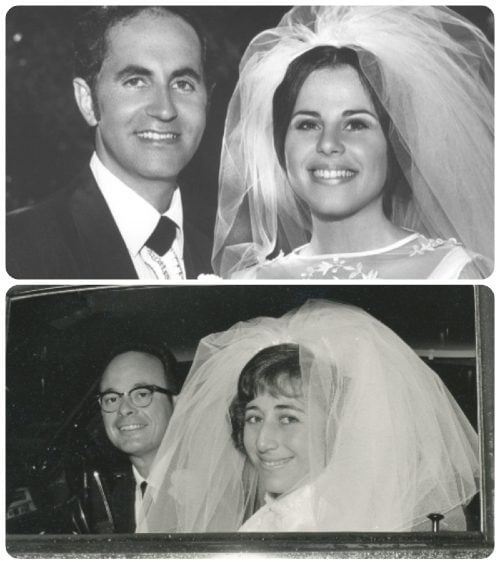
“I went back to work in Cape Town, and that’s where I met Joan and married in 1969.”
Joan, too, had gone to medical school and became an anesthesiologist.
The Bubs had three children in South Africa. “Once we had the third child, we needed either a bigger house or a new country,” Bennie quips.
In the early to mid-1970s, life in South Africa was becoming stressful, exacerbated by the civil war in nearby Angola which threatened to involve South Africa.
“Things were bad enough in South Africa that Joan particularly wanted to leave the country rather than start making a new home for our growing family, so we left in 1976 and landed up in Florida.”
Bennie had to professionally retrain because he could not get a job as a neurosurgeon in the US at the time, so he did another residency in anesthesia — his third residency.
The Bubs moved to Denver and practiced anesthesiology. They are now retired.
The Brittans
Michael Brittan and his wife Elizabeth came to Denver from Johannesburg in 1986. Their families, too, came to South Africa from Lithuania, except for Elizabeth’s father who escaped from Germany in the 1930s.
“The reason our families left Lithuania were exactly what we heard they were. While it was part of the Pale of Settlement, there were pogroms under the tsar. The tsar would send his henchmen out and they would attack the Jews, so it the late 19th century my maternal grandparents came out of the Kovno district to South Africa,” Michael says.
Elizabeth Brittan’s maternal grandparents also came to South Africa in the late 1800s. Her grandfather fought on the side of the British in the Boer War, which took place from 1899 to 1902.
Both Michael and Elizabeth grew up in Johannesburg. Michael studied chemical engineering and was offered a scholarship to study at Yale University in 1963. He spent three-and-a-half years in US while earned his master’s and PhD in chemical engineering. Within a month of returning to South Africa, he met Elizabeth, and they were married a year later, in 1968.
Elizabeth is a practicing psychologist, having earned degrees at universities in Cape Town and Johannesburg. Michael worked his entire career in the mining industry as a chemical engineer until 2014, when he left full-time employment and started his own consulting company.
In 1986, Michael had been working with a large mining conglomerate in South Africa for 19 years when he was offered a job in Denver.
“There was a lot of unrest in South Africa. You heard about what was happening under the apartheid system? It looked like the system that had been enforced for a long time would not be able to control what was going on indefinitely,” Michael says.
In 1980, after 77 years of neutrality, South Africa’s National Congress of the Jewish Board of Deputies passed a resolution urging “all concerned [people] and, in particular, members of our community to cooperate in securing the immediate amelioration and ultimate removal of all unjust discriminatory laws and practices based on race, creed, or colour.”
This inspired some Jews to intensify their anti-apartheid activism, but the bulk of the community either emigrated or avoided public conflict with the National Party government.
“It wasn’t only a South African situation. The Soviets had gotten involved in neighboring countries after the fall of colonialism. One of the very last wars of the Cold War was right on the border in Namibia and very close to home. We lived in places where our neighbors and people we knew were sent off to fight.
“We decided that the future in South Africa, especially for our children who were teenagers at the time, would be better somewhere else.”
The Threat of War
The threat of war had also been a factor in the Bubs leaving South Africa. “We had also felt the pressures coming from the north, and young kids were having to leave high school to serve in the army. We didn’t know if there’d be a civil war in South Africa when they were trying to overthrow apartheid,” says Bennie.
Terrorism was starting, Joan recalls.
“We were not different from anybody else in South Africa,” Bennie says. “Every family was affected the way we were.”
And as a result, the South African Jewish community which, at one time was 120,000-strong, began to shrink. “In a very short time it lost a whole lot of Jewish families.” About 52,000 Jewish people remain in South Africa today.
“I had a very good life in South Africa,” says Joan Bub. “From the Jewish point of view, we were totally free to join whichever synagogue we wanted, or join clubs.
Most of the South African Jews were nominally Orthodox, which Joan and Bennie liken to “Modern Orthodox” here in the US. Joan grew up Reform, but Bennie was raised Orthodox, walking to synagogue on Shabbat and holidays and keeping kosher.
Michael Brittan also grew up Orthodox in Johannesburg. “The shul was the communal focus. The community was very tight-knit. My children in South Africa went to a Jewish day school.”
South Africa and Anti-Semitism
The Bubs and Brittan experienced anti-Semitism in South Africa. “I felt a lot of anti-Semitism when I was growing up,” says Bennie. “We lived in parts of town in suburbs that were anti-Semitic, very clearly.
Joan says she didn’t personally encounter much anti-Semitism, but she does recall an experience when she was a teenager on a school trip to an Afrikaner farm. “We stayed in the farmhouse with the farmer and his wife and kids, and the grandparents who were the original farmers, also lived there. They would say grace before meals, and I didn’t say it. The grandfather said, in Afrikaans, ‘What’s the matter with you? Why didn’t you say that?’ So I told him, ‘I’m Jewish and he replied with a slur, which basically meant, ‘You people are crooks.’”
She also heard that line from an Afrikaner surgeon who was teaching in her medical school during the 1967 Six Day War.
Joan thinks her father, an academic, experienced anti-Semitism regarding promotions in the workplace.
Michael says that there were a fair number Jewish students at his government high school. “Occasionally, you’d get some anti-Semitism from some of the other students and there were a couple of teachers who were anti-Semitic and would make nasty remarks.
“It wasn’t good, but that’s why we Jews were so cohesive.”
It is disconcerting for South African ex-pat Jews to hear critics of Israel denounce it as an “apartheid” state, referring to policies regarding Palestinians in the West Bank.
“I don’t think Israel is an apartheid state,” says Joan.
“Absolutely not,” says Michael. “It’s part of a cunning propaganda campaign being waged against Israel.”
Bennie adds: “For anyone who has lived in the apartheid system, no.”
South Africa and Israel
South Africa’s attitude toward Israel is also disturbing. “The South African government is officially anti-Israel and pro-Palestinian,” Joan says, “and they are allowing Russia and China to do exercises in the waters outside of Cape Town near Simon’s Town.”
“Remember, this is only a continuation of what happened around the Second World War period when they had Brown Shirts supporting the Germans,” Bennie adds.
Michael opines, “The anti-Israel forces in the world have recognized that they have to undermine the support of the US for Israel. That has to be their target now in South Africa.
“What happened when the US eventually pulled the plug on supporting the South Africans in Angola was pretty much the end of white rule in South Africa . . . so the forces arraigned against Israel now recognize that there’s huge US support for Israel. They try to undermine that, starting on the college campuses by using a term that is repugnant to Americans — apartheid — because of the racial history in the US.”
Michael says anti-Israel rhetoric is treated slightly differently in Europe because of European guilt about colonialism. “They pitch this anti-Israel thing differently in different parts of the world, but it’s a very insidious thing.”
The Price of Emigration
While there are a number visible, active South African Jews in the Denver community, the Bubs and Brittans are unable to put a number on it.
They do socialize with each other, and Bennie recalls an aborted effort a number of years ago to organize the South African Jewish community. He declined to be part of that effort. “I’d rather be part of the wider community.”
Joan says she and her husband seem to be drawn socially to other immigrants, be they from Russia, Israel or South Africa.
There are quite a few doctors among the South African Jews here, and that is likely to the ease of moving that profession from South Africa to the US.
Not so with lawyers because South Africa’s legal system is based on Roman Dutch law, a completely different system that the US.
The immigrants, while coming to the US for a better future for themselves and their children, did not come without making sacrifices. Notably, South Africans were limited on the amount of cash they could take out of the country.
“The maximum you could bring out was 30,000 rand, which was equivalent to the same amount in US dollars at the time,” Joan recalls. “And in order to get the $30,000 out, you had to have 60,000 or more [in the bank].”
There was no limit on material items that could be brought, so many people sunk their financial assets into furniture and clothing, rather than leave them behind.
People who had done well in their professions had to start over financially. “You lost 15, 20 years of career by coming here,” Bennie says.
The Beauty of South Africa
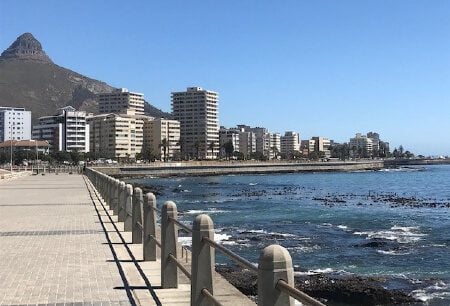
The Bubs and Brittans miss the physical beauty of their native land. “Cape Town is probably the most beautiful place in the world, and I do miss that,” says Joan.
Michael says: “There’s so much beauty in South Africa and they have unusual things which you can’t get here, like the game reserves, the nature reserves, which are just amazing places to visit.”
He also stresses, “Our families owe South Africa a debt of gratitude for taking in our parents and grandparents so they they could escape persecution — if not death — and establish new lives for themselves and their descendants.”
Bennie misses the personal and professional connections he had in South Africa. “To have to start again in middle age to create a new life, it’s very hard, and that took a long time to get over.”
“I know of people who came here and stayed, five years, 10 years, and have gone back. Not everybody has managed or been happy here. They may have made it economically, but were not happy.”
There are things the Bubs and Brittans do not miss about South Africa: “The infrastructure there is terrible,” says Joan. “Anything that is run by the government is terrible. It’s gone, crumbling.
“But the Jewish community has taken under its wing to have an ambulance service and security service in Johannesburg and Cape Town and probably elsewhere because they can’t rely on the police or the ambulance service.”
Despite missing the natural beauty of South Africa, these people are glad they moved their families to this country. The Bubs have three children and seven grandchildren, all living in Denver. The Brittans have two children and four grandchildren, also all living in Denver.
“This is something very special to us,” says Joan, “as had we remained in South Africa, chances are that at least one, if not all of our children, would have left South Africa. Some of our friends and family in South Africa have children who are spread out, each living in a different country.”
Bennie adds, “Given the beauty of South Africa and the loss of friends and family, the benefits in a country like this for our kids and for us too are enough to overcome all that we left behind.”
Copyright © 2023 by the Intermountain Jewish News