
Judaism • Education • Community • Israel • Advocacy

What is your philosophy?
As with the other Chabad centers around the world, the Santa Fe Chabad is built on the vision and urgent call of the Lubavitcher Rebbe, Rabbi Menachem Mendel Schneerson, to reach every single Jew and include them in our beautiful 3,000-year heritage.
We have been reaching out to Jews from all walks of life, in the rarest of places. The Rebbe encouraged people not only to be available for those who seek to be connected, but to find and connect Jews who may not be “interested” at first and ignite their spark with a mitzvah that touches their soul.
There’s Maria who works in a restaurant in downtown Santa Fe. She doesn’t attend synagogue even on Rosh Hashana, but she knows that on Rosh Hashanah we will be coming by and sounding the shofar for her on this holy day.
Or Bruce who may not have known much about Sukkot but after having been to our Sukkah mobile and making a blessing out of love decided to come celebrate Simchat Torah.
Or the woman who was in jail for a horrific crime and then was sentenced to many years in prison but never forgot the seder that we prepared for her and the reading of the megillah in prison. When she was released, she pulled her life together.
What are Santa Fe’s Jewish demographics?
Santa Fe is a beautiful city up in the mountains at 7,000 feet altitude. It’s an artsy and creative town, hence the high percentage of Jewish population.
There are an estimated 4,000 Jews in Santa Fe out of a population of 100,000. We consider all the Jews of Santa Fe members.
The Torah is theirs, and our beautiful 3,000 year heritage is theirs to experience, each on their own level.
What’s an annual highlight?
Chanukah on the Plaza, which we’ve been doing for 25 years. It’s a beautiful celebration with a giant menorah on the historic Santa Fe Plaza. The menorah is there for the duration of the holiday. It is lit every night, with one or two major celebrations during the holiday.
At Chanukah on the Plaza we’re fortunate to have the governor, mayor, congressional representatives and the senator who come out to celebrate with the community. It’s a really important celebration for Jewish pride.
I have met many Jews for the first time at the Chanukah celebration.
Santa Fe has quite a bit of Jewish history which can be seen in the New Mexico History Musuem. We want to continue that story.
You often represent the Jewish community in the public sphere. How have you established relationships with lawmakers?
It takes time and effort over the years.
You’ve recently built a new center. How does it feel to be settled?
We have recently completed the renovation of a three-story 16,000 sq. ft. building in the heart of Santa Fe, near the Plaza. We feel that this is right in line with our mission of helping Jews stand proud as Jews and combating anti-Semitism.
A Jewish child who sees a giant chili menorah standing on the Plaza during Chanukah is likely to go home and kindle their own menorah and celebrate their Jewishness.
The same is with the building. Besides it helping us host many more community programs, it also helps people feel proud as Jews when they see their own center in such a prominent location. They can be proud to say, “This is my Jewish center!”
The purchase and the renovation of the building was a $6.5 million project. We are very pleased with the way it turned out. It has a very homey feel to it.
The sanctuary is adorned with beautiful pews, tables and bookcases, custom made in Israel. The eastern wall and ark are made of Jerusalem stone from Israel, modeled after the Kotel. There’s an uplifting, meditative, spiritual feeling when one sits in the sanctuary.
Many people share that it made them feel a sense of belonging and coming “home.”
What does the center have that’s new?
The state-of-the-art kosher kitchen is the only one of its kind in the state. Plus we have dairy and Passover kitchens. We also have a space for a kosher deli which we expect to open this summer.
There are hospitality suites for travelers who wish to observe Shabbat and enjoy community meals and prayer.
What are your aims with the new facility?
After the massacre on Oct. 7, the center became a hub of activity for the pro-Israel community. Being downtown, we were able to park and march to the Plaza as well as to the State Capitol and remind everyone about the hostages and pray for their freedom.
These days Jews want community and Judaism.
There’s lots of anti-Semitism around the world and online. We just experienced the cancellation of a Matisyahu concert at a prestigious venue due to a protest walk-out by their staff.
Many people walk into the center to pray, put on tefilin, study, join a community meal, a women’s circle event, or just chat with the rabbi.
The center couldn’t have come at a better time.
How collaborative is Santa Fe?
This coming Sunday [March 3], we are collaborating with many organizations in town to host a women’s mega challah bake for some 200 women, who will come together and make challah and pray for the hostages.
We have many more ideas of how to engage more Jews and expand the activities. The Rebbe had a vision of reaching every Jew, because deep down they yearn for Yiddishkeit, we hope to ignite these souls.■

Can you share a little about your background, both Jewishly and academically?
My education and my Jewishness have been intertwined.
I did my PhD in anthropology at Indiana University under the director of Prof. David Bidney, focusing on the anthropology of religion. I was his student assistant.
Prof. Bidney helped me understand the important theoretical constructs in the anthropology of religion and develop analytical skills to study that area of behavior.
His intellectual challenges throughout a decade of seminars, student assistantships, Shabbat dinners and research guidance at Indiana gave me an indelible model of the humanist scholar and an understanding of the linkages between religion and culture. He encouraged me to study the impact of religious behavior on intolerance on society.
In seminars at the University of Oxford Professors Robert Chazan, Jeremy Cohen and Anna Sapir Abulafia introduced me to the study of how the early church created the Christian sense of exclusivity and divine right, which led to the “othering” of Jews and the emergence of anti-Semitism.
I have been active in the Jewish community, serving on the board of the New Mexico Jewish Historical Society for many years, and much of that time I was the program director of the society. In 2014, I was given the Allan P. and Leona Hurst Award for contributions to Jewish history in New Mexico. I served on the board and was president of the board for both the Jewish Federation of New Mexico (now defunct) and the Northern New Mexico Jewish Community Council at different times.
What inspired the idea to have the Santa Fe Distinguished Lecture Series?
My wife, Gloria Abella Ballen, and I started a Jewish lecture series as a program with the federation in Oklahoma City in about 2004.
In 2005 we created the Institute for Tolerance Studies with Ira Schlezinger and established Gaon Books as a publishing arm for Jewish related books. We have published over 100 titles and continue that as Monographs on Religion and Tolerance.
When we moved to Santa Fe in 2008 we brought the Institute for Tolerance Studies with us and the idea of continuing a Jewish speaker series.
How long did it take to put the idea into action?
The initial speaker series in Oklahoma City took six months or so to organize and initiate. In Santa Fe we had an initial speaker series that focused on New Mexico Jewish authors from 2014 to 2018. After that it shifted to the Santa Fe Distinguished Lecture Series.
How do you choose your speakers?
We have a speaker selection committee that includes Gloria Abella Ballen, Bonnie Ellinger and me. Marcia Torobin is a regular consultant for speaker selection, and she is the director of the Santa Fe Jewish Film Festival. We regularly coordinate with her on the schedules and recommendations for speakers. We do invite recommendations for other people which is helpful.
Your speakers cross a wide range of communities, topics and interests. Is that the same for your audience?
Yes, we have a diverse audience from professionals in Jewish studies to academics in other fields and others interested in Jewish learning. Most, but not all, of our audience is Jewish.
Do you generally have the same audience, or do different people attend different lectures?
We do have a core audience that has high participation in our programs, but there are many others who attend programs according to their particular interests.
During the last year the registration for our programs has ranged between 300 and 400 people, and an equal number usually watch the recorded talks on the Jewish Learning Channel on YouTube, which is joint program of the Institute for Tolerance Studies.
What subject matters have you sensed the strongest interest in?
Israel is the strongest interest. Given the attacks of October 7 and the subsequent war, that has been a high interest. Anti-Semitism is a major concern, as is the Holocaust.
We are currently scheduling talks on Jewish contributions in the visual arts, literature and theater to bring these uplifting themes to people. We have dozens of films on the Jewish Learning Channel to allow us to add programs that go beyond what can be covered in the Lecture Series.
For example, we recently did a film on the Jewish merchants of Santa Fe in the 20th century. We have other films on topics such as the Jewish history of New Mexico, the crypto-Jewish experience, Sephardic Jews and Jewish life and religion in Morocco.
Has the series always been virtual? If not, how was the transition to a virtual-only series? Has your audience grown beyond Santa Fe?
In 2018 we shifted the speaker series from New Mexico Jewish authors to inviting Jewish speakers to Santa Fe for in-person lectures. Drs. Nurit and Yehuda Patt were instrumental in those years helping identify speakers, and they made major contributions to support bringing them to Santa Fe.
With the start of COVID we shifted to the webinar format, which allowed us to invited speakers not only from the US but also from the UK and Israel.
In that process our audience began to grow outside of Santa Fe. Now, instead of a few hundred people that were our audience in Santa Fe, we have close to 3,000 followers of the program from across the US, Canada, the UK and Israel.
Is there anything uniquely Santa Fe about the series?
The Jewish Learning Channel is our focus on the unique information about Santa Fe and New Mexico. We continue to do new films on Jewish lives, programs, and history in the city and state.
Anything I’ve forgotten to ask you?
The Distinguished Lecture Series is a program of the Institute for Tolerance Studies, which also includes the Jewish Learning Channel, a digital archive of texts on Jewish life and comparative religions, and a publishing arm that focuses on the series of monographs on religion and tolerance. So, the lecture series is one component of this larger set of programs focused on Jewish learning.■
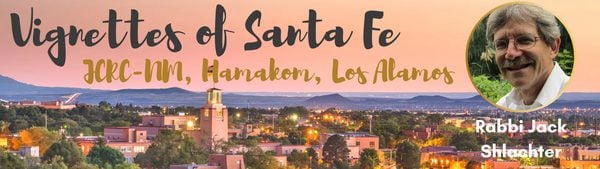
How did the Jewish Community Relations Coalition-New Mexico come about?
Some determined individuals, particularly Lonnie Zarum, wanted to take action after Oct. 7 and called various local leaders together for a meeting.
Is it intended to function as a federation?
Not really, though the implosion of the federation (in 2022) forced the creation of JCRC-NM, which would have logically developed through the federation had it still existed.
Please describe your activity.
I’m assisting on the education subcommittee trying to ensure that schools are addressing anti-Semitism appropriately. I’ve also been involved in some of the rallies and the meeting with the governor, Michelle Lujan Grisham.
Have you had any particular successes or achievements thus far?
I think we’ve raised awareness of the importance of standing with Israel during this war against Hamas.
What is progressive Judaism?
All Judaism is progressive. There is always a need to be Jewish in the present moment. We no longer have a Temple, we no longer sacrifice at an altar, and one cannot practice normative Judaism by reading an ancient text and following it in a prescriptive manner. Having said that, there is variability in the extent to which some Jews are willing to adapt to modern constraints. Progressive Jews tend to be on the more flexible end of the spectrum.
Describe HaMakom.
HaMakom was founded over twenty years ago by Rabbi Malka Drucker to address a perceived gap in the Santa Fe Jewish community with regard to traditional yet egalitarian worship and study. There are strong institutions which are aligned with the Reform movement and others which observe traditional, non-egalitarian practices. HaMakom fills in the space between these.
How collaborative is Santa Fe?
The establishment of the JCRC-NM is a good example of collaboration among the various groups in Santa Fe.
Just today, I participated in a meeting with the three other rabbis of Santa Fe congregations to address some concerns that the Jewish community has with burial practices and cemetery space at one of the local cemeteries.
Credit here to Doris Francis who has been amazingly effective in spanning the different congregations and their respective needs.
You are also the rabbi in Los Alamos. How did you land there?
I came to Los Alamos as a graduate student to work at the laboratory around the same time as the Second Temple was being built in Jerusalem. Well, maybe not quite that long ago. I was nominally supposed to spend a summer here, but it turned into a 40-year career as a physicist at Los Alamos National Laboratory.
How has the community changed in recent years?
The founding families had the foresight to build a building in the early 1960s, and the Los Alamos Jewish Center has been the focal point for Jewish activities in town ever since.
The laboratory is the primary employer in town. With hiring on steroids right now, there’s been a huge influx of new people.
There are now monthly activities for Jews in their 20s and 30s. I anticipate an increase in enrollment at the religious school. The newcomers have helped revitalize LAJC.
A nice thing about a small community is that each new person is a most welcome addition.
Many urban centers are transforming into “super” cities. Is that happening in Santa Fe?
Los Alamos and Santa Fe remain distinct though only 35 miles apart.
Los Alamos is still a “science” town, and Santa Fe is more eclectic. It’s great to have the cultural amenities of Santa Fe less than an hour away.
Let’s hope Santa Fe does not turn into a super city! We want it to retain its small town charm while offering broadly appealing cultural events not often associated with a town of its size.
What is your favorite Jewish volume?
I am a bibliophile with a personal library of 7,000 volumes, much of which is Judaica. They’re like children — I love them each the same though they are different from each other! But seriously, I love Torah study and am constantly finding commentators whose works open up new insights for me in what is an ancient text.■
Copyright © 2024 by the Intermountain Jewish News