
At least 176 people have died in US aviation incidents in 2025, according to the National Transportation Safety Board.
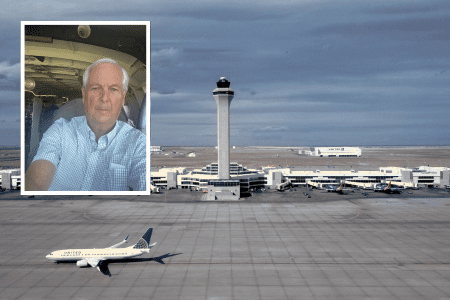
As if that’s not enough of a scare, American travelers have been bombarded by reports of near-miss collisions all over the country’s airports, with air traffic controllers confounded by random communications blackouts.
“Probably about half of the flights in the world originate or occur in the United States,” says Will Ris, a longtime governmental aviation expert who grew up in Denver.
“The US has by far the largest sort of aviation profile in the world, but it is mired in a really antiquated system of operating — the government is both the regulator and the overseer of safety, as well as the operator of the air traffic control system.
“The Federal Aviation Administration has to go year by year in expenses. If it doesn’t have enough money in one year, it just stops working on projects that are the so-called next gen projects that would improve technology
“So, the FAA just funds the existing system patchwork, and that’s a really bad situation.
“For almost the last 20 years, there’s an account at the FAA called the facilities and equipment account, which is supposed to fund new generation and new technology and also maintenance of the existing system.
“It has hovered at around $3 billion a year for 20 years, and when you look at that for inflation adjustment, it would be about $5 billion.
“The actual buying power of that amount of money has diminished over the years when the need for new technology has increased. It’s a real bad cycle. The kind of stuff that we’re seeing now given the deferred maintenance or not enough oversight.”
Ris grew up in Denver and attended graduated from George Washington High School and DU law school. His favorite faculty members at GW were Richard Jordan, who taught political science, Robert Rothstein, who taught journalism, and the principal, Sam Waldman.
“Each one encouraged critical thinking and all were stimulating and, at times, provocative,” remembers Ris.
“I vividly remember once saying to Sam Waldman something trite like ‘thank goodness not everyone is the same.’ He looked back at me with a glint in his eye and replied ‘I don’t know about that. If everyone was just like me, the world would be a much better place better place.’
“He was funny and he was right.”
Ris left his hometown in 1975 for a career in aviation safety, though that wasn’t his original plan.
“After graduating from DU Law, I had no particular interest in aviation,” Ris says. “However, I wanted to work in Washington, DC for the federal government.
“I interviewed at a number of agencies. The one that offered me a job with the best salary — a mind boggling enormous amount of $14,500 — was the Civil Aviation Board, which at that time regulated the routes, rates and consumer rules for the airline industry.”
That led to a job on Capitol Hill with the Senate Commerce Committee, which had aviation issues in its jurisdiction.
Ultimately, Ris landed a position with American Airlines where for 20 years he represented the company in Washington working with Congress, the Dept. of Transportation and the FAA. He has also been part of the Management Advisory Council for the FAA.
Still, Ris reiterates, “I came by my interest in aviation accidentally.”
A rare accident with a positive tale.
While working for American, Ris estimates he was on more than 1,000 flights between the airline’s headquarters at DFW Airport and Washington, DC. He is now retired, living at St. Simons Island in Georgia. He spends time occasionally in Denver to visit his brother and sister-in-law.
Despite being retired, Ris constantly monitors the airline industry.
“They’re doing much more triage of the existing system than investing in new technology,” says Ris. “That’s why we are where we are today because it’s been a question of underinvestment and the increasing cost of maintenance of the antiquated system.
“It’s a really broken deal.
“The current administration is proposing putting several billion more into creating new technology, but money alone is not going to get you where you need to go unless you fundamentally change the structure of how this is done, and allow the agency to invest in long-term plans and not have all of its resources devoted to just patching the existing system.”
How to fix the system? Ris suggests radical change.
“There’s so much political interference or oversight of aviation that isn’t particularly productive,” Ris says.
“Most countries have gone to a very different way of operating, which is to spin off the air traffic control function to a nonprofit corporation that will operate separately from the regulator,” Ris says.
“The whole notion of operating the air traffic control system is much more like a business than a government agency.
“Government doesn’t run things all that well. It oversees things well, but there needs to be an organization that is focused on providing the maximum amount of safety and efficiency.
“It also has to have the ability to do things like go to capital markets to get investment in the system, which it can’t do today with the FAA.”
Continued Ris: “This is a very big constituency, which is essentially the business aviation community, that actually doesn’t pay anything for the use of the system.
“All those corporate jets and everything flying around, they essentially fly around without paying for any of the use of our air traffic control system.
“The vast majority of the funds come from people like us who pay for tickets and that 7.5% ticket tax every time you fly that goes into a fund that essentially supports the air traffic control system.”
Ris doesn’t hesitate to jump on a plane, as he often still does. That said, he has concern for the state of air travel.
“It is discouraging and disappointing. But it hasn’t shaken me because the underlying conditions are ones that I’ve been aware of and concerned about for many, many years.”
© IJN 2025