
When he first got involved in politics, initially in the Larimer County Republican Party, Yaron (Ron) Weinberg’s main concern was what he regarded as excessive taxation.
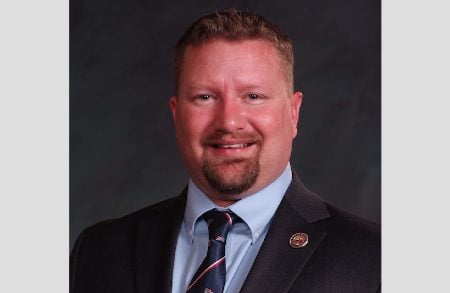
Today, just over a year after he was appointed to fill a seat in the Colorado House of Representatives, he says he had no idea that he would become a human lightning rod for the ongoing war between Israel and Hamas.
Weinberg’s path to the Colorado Legislature was, until a few weeks ago, a gradual and fairly routine one.
He rose through various party ranks until he was named the GOP’s Larimer County chairman until late 2022, when Rep. Hugh McKean, the previous District 51 representative and the party’s minority leader, passed away, days before the general election.
Somewhat reluctantly at first, he says, Weinberg accepted the party’s appointment to occupy McKean’s vacant seat from January, 2023 to January, 2025.
The Jewish resident of Loveland in northern Colorado learned the ropes of legislative work quickly and diligently, proving himself to be a hard worker and fast learner with a penchant for local grassroots issues. He wasted no time applying himself to a variety of tax relief and other measures. Along the way, he earned a reputation as a Republican who wasn’t afraid of bipartisanship.
It was in that spirit, and focusing on his interest in tax relief, as Weinberg was speaking in the State Capitol on Nov. 20 during a special session, when he was dragged unwillingly into the Gaza conflict.
Democratic Rep. Elisabeth Epps, a progressive legislator known for her anti-Israeli activism, interrupted Weinberg’s speech after repeatedly attempting to introduce an amendment to prohibit Colorado public funds from being spent on food products originating in the West Bank.
Epps later joined a group of sympathetic demonstrators in the House gallery, shouting out Weinberg, repeatedly calling for a Gaza ceasefire and accusing Israel of genocide.
The demonstration forced a prolonged recess, after which Weinberg, flanked by legislators, was finally able to finish his speech on the House floor.
The incident gained broad media attention, both locally and nationally, and drew charges of anti-Semitism against Epps, ultimately leading the House speaker to dismiss her from the House Judiciary Committee.
In the process, Weinberg transitioned from being a relatively unknown appointed representative to something of a political celebrity, as well as a symbol of the growing anti-Semitism ignited by the Gaza conflict.
The latter, he told the Intermountain Jewish News in a recent interview, is a mantle he would just as soon not wear.
A native of South Africa — and still speaking with a ghost of that accent — Weinberg immigrated to Los Angeles with his family in 2002, concerned about the civil unrest that was then plaguing that country.
In LA, he established himself professionally, founding a tech consulting business, 365 IT — Technology Solutions, and personally, starting a family.
He moved both the family and the company to Colorado seven years ago.
He resides in Loveland with his wife Carolyn, son Yonatan, 8, and daughter Heidi, 6, and describes his family’s Jewish orientation as moderately observant.
His political orientation, meanwhile, is mainstream conservative, Weinberg says. After immersing himself in northern Colorado civic groups, he joined the county GOP structure, initially setting for himself the goal of becoming chairman of the state Republican party.
His appointment to the House of Representatives was an unexpected diversion from that goal.
“I told somebody the other day that I would never try to go into something if I didn’t know what I was doing,” he says. “I’d never really been prepped even for what it is that a House representative does. I didn’t know anything about the position, and it was kind of scary at first.”
In the year that he’s been doing that job, however, Weinberg is starting to like it, describing the experience as “a very good session for me.”
He says that he’s receiving positive feedback, not only from Republicans but Independents and Democrats as well, which has led him to the decision to seek a actual election to the House this coming November.
“I wasn’t elected, right, I was appointed, so I need to have the question answered whether I’m electable or not. That’s honestly one of the biggest reasons I’m running for reelection. I need to see if the people even want me in this role.”
In the following interview, Weinberg discusses what he thinks his constituents want, his bipartisan approach to politics, his involvement in the northern Colorado Jewish community and his recent unintended brush with the Gaza conflict.
IJN: In the year that you have served so far, what have you learned about the greatest political concerns of your constituency?
The priorities for my district include property assessments. My district has a lot of people on fixed income. That’s a big one. I need to come up with a solution there.
Attainable housing, affordability, is a very big problem for Loveland. Things are just really expensive here and people are moving out. We’ve got to try and preserve our natives rather than push them out.
Public safety and education. The city of Loveland has an excellent schooling system but I need to work with the school board on how to fix some of the basic problems, like leaking roofs, air conditioning in our schools and air conditioning on our school buses. We have a lot of schools here that don’t have air conditioning, which is terrible. I get a lot of teacher complaints. I’ve seen the students sweating and suffering since my dad is actually a school bus driver for Thompson, which is our district.
So when I say education, it’s more air conditioning and fixing infrastructure.
Hands on issues, in other words.
Absolutely. I have roughly 15 bill ideas, and I’m going to leave it up to the public to give me their input. What do they want me to work on? And all my bills are going to be transparent.
They’re not going to be like most legislators where they keep them confidential and hidden. All my bills are going to be out in the open and the public will decide what bills they want me to focus on.
What are your feelings about Loveland — and much of the entire Front Range — essentially becoming a suburb within the “super city” of Denver?
It’s hard to grasp in the past few years the immense growth that’s happened just in that small time frame. I moved here for a small town, slow feel, right? I don’t think Loveland has lost it just yet. I think Loveland has been very responsible with its growth.
I’ve been working on the planning commission and I had a hand in the growth. I had to vote on growth and I’m very proud of how they’ve handled it, to be honest, the way that they take the water consumption into account. We’re building another reservoir.
We have really smart people that work for the city of Loveland. I’ve questioned them, I’ve tested them, and they’ve always proven strong with their answers. It’s sustainable but responsible growth.
You have spoken publicly about cooperating with Democrats in a bipartisan manner. How important do you think it is for that political approach to be taken by both parties?
It has to be taken seriously. If we’re walking into that room looking at each other as Democrats or Republicans we’re not doing a service to our communities. We have to look at each other first and foremost as people, and second, as statesmen and stateswomen. It’s very important that we understand that we were put there to fix problems.
Roads are not a Democrat or a Republican problem. Medical issues are not Democrat or Republican. It’s an all of us problem.
We have to be able to work together. What makes the best legislator? It’s listening to the constituents who bring forth ideas and knowledge. It’s listening to the doctors that talk to me, or the educators, or the professors, or the city council or the city manager. It’s what they bring to me from their professional standpoint that I wouldn’t have any idea on, and then I take that as a conduit to the State House.
Cities are different, which means we’re all going to have different solutions, but they’re all going to come from smart people. And I think with a collection of ideas, we can come up with the best answers.
How big a part of your life are Judaism and Jewish culture?
It’s huge. My dad’s side of the family were very, very proud Jews.
I’ve always been taught since I was very young that we are a proud people and that people have sought to destroy us, to annihilate us, for centuries. I take being Jewish very seriously, from saying the Shema every single day to teaching my kids to celebrating the High Holidays.
I want to continue with the traditions that this culture, my culture, has taught me.
Would you characterize yourself and your family as religious?
Yes, definitely religious — Reform to Conservative. I wouldn’t say Orthodox.
What are your connections to the northern Colorado Jewish community?
I did have a connection in the beginning, to Har Shalom. I loved the place. I got involved with all the boards. I was going to put my children in the school.
But I was the vice chair of the Republican Party at the time. George Floyd had just happened and COVID had just happened and all of a sudden it got political. Har Shalom is a very deeply rooted liberal synagogue and once it was known that I was a Republican and an elected official in the community, it got weird.
I mean, I sat on the COVID board there, I sat on the security team, I facilitated all the Zoom Shabbats and services through my company for no charge. I redid their IT infrastructure because it was lacking. I got invested with Har Shalom really quick and tried to just have it as a religious institute. And it didn’t turn out that way. It was terrible for me because I rightly thought I had found my community.
After what happened with Rep. Epps and everything, a lot of people in the Jewish community have reached out to me, in Denver and Boulder specifically. So I’m kind of excited that I’m going to be finding a new community, probably in Boulder, pretty soon.
What would you like to say about the confrontation between you and Rep. Elisabeth Epps on Nov. 20?
I found that I had more friends than enemies.
And I learned another lesson, which was that evil and hatred exists and that we have a choice. I had two choices, right? I had two options that day. I could turn it into a negative or I could be positive. Being positive, being loving, bringing more of a unification approach and ignoring the nonsense was better than being sucked into being negative.
That’s when Rep. Epps and her posse — who came with her, it was all organized — left the gallery, when they knew that I wasn’t going to fight back negatively. The Democratic leadership came out to me, as did the Republican leadership, and they’re like, ’s just let her do her thing. Talk to your members. As a Jewish member of the caucus, they’ll listen to you.’ And so I did. I went to all the caucus members and said, ‘Look, leave her alone, just ignore this.’
But sure enough, her speech just got worse and worse. It became disgusting.
Do you feel that what Epps and her posse, as you call it, was saying was anti-Semitic, not just anti-Zionist or not just political?
I did feel that it was anti-Semitic, yes, as were the lies afterwards, all of her stuff on Twitter, which again I didn’t respond to. I wanted to take that moment and show the House, the legislature and the people of Colorado one stupidly simple thing: That anti-Semitism is not a Democratic or Republican problem, it’s an all of us problem.
And you don’t have to be a Democrat or a Republican to fight something that’s so blatantly wrong. Rather, you can turn it into how we can now work together as people in Colorado, and as legislators in Colorado, and ignore the hatred and the negative.
Do you feel that House Speaker McCluskie was right to remove Epps from the Judiciary Committee?
It’s funny that you ask that. I don’t really know why they removed her. That was a shock to me, really. I didn’t understand the reason. Everything that I’ve done in my life in America has been towards the Constitution, learning the Constitution, understanding the Constitution and studying it. So for me, I don’t like censorship, I don’t like expulsions, I don’t like removals. I don’t like that sort of action.
What does it say about political discourse when one side of an issue doesn’t only disagree with the other side, but strives to silence those views that don’t align with their own?
You’re saying when I was trying to speak and they were shouting me down? Exactly.
You know the teachings of the Torah, right? Just because something is being done to you doesn’t mean it’s right to do the same to another. It just shows the character of people, where they come from in their background and what they’re willing to allow. It’s so hypocritical. It degrades and tarnishes their own character . . . when a member of the House thinks that it’s OK to shut people up. It’s political theater. It’s taking something and making it political.
You have to be a statesman. At first, I didn’t know what that meant. I had to look that up and figure it out.
Being a statesman is being somebody who will be above the negativity and being more of a leader and an example for the community. You don’t lead or be an example for a community by being negative and blatantly racist. You lead by being a positive example for the community.
How have these recent political tempests affected your feelings about continuing to pursue a political career?
That question is better left to the people. I have to know, first of all, that people want me as a house representative. That will ultimately tell me my future in politics.
Quite frankly, I have a very good life outside of politics. I have great kids. I love my wife. My mom and dad are here. My brother is my best friend. I have very good friendships here in Loveland with community leaders.
So I’m going to wait for November to tell me what it’s going to be, what it is. I’m not going to rush off to a congressional seat, like I quickly want to climb the ladder. I’ll stay in this seat for as long as the people want me there. I have no political aspirations without the backing of the people.
Chris Leppek may be reached at IJNews@aol.com.
Copyright © 2024 by the Intermountain Jewish News