
There’s nothing like meeting people with whom you’ve been in touch for years. We all learned the priceless value of face-to-face contact during the pandemic. What’s especially fun, though, is when the in-person meshes perfectly with perception. It’s actually quite incredible how much you can suss out from emails.
Michael Atlas-Acuña — a passionate, down-to-earth, committed Jew and steward of Pueblo’s Temple Emanuel.
Rabbi Berel Levertov — a joyful entrepreneur who can drum up a conversation with just about anyone.
Rabbi Jack Shlachter and Beverly Post — welcoming, knowledgeable, avid readers and adventurous Jews. And Rabbi Jack — a Renaissance man.
Over the years, I’ve been in regular touch with all four of these people — sharing the activities and accomplishments of their communities with the IJN readership, and relying on them for what’s happening in Pueblo, Santa Fe and Los Alamos.
It’s in the name: Intermountain Jewish News. Especially since the pandemic and then Oct. 7, 2023, we have expanded our coverage of our intermountain readers, who are accomplishing great things.
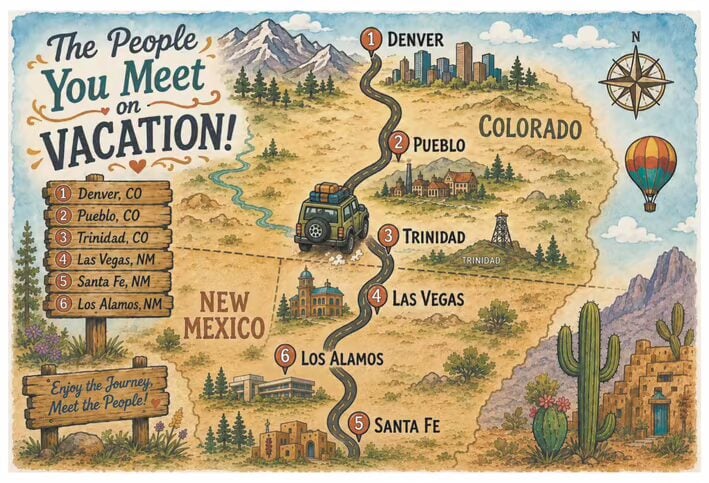
This summer, together with my husband, we hit the road south, to finally put faces to names.
PUEBLO
Michael Atlas-Acuña is a one-man president, executive director and preservationist when it comes to Pueblo Jewry and Temple Emanuel specifically. For years I’ve heard about “The Little Jewelbox.”

Let me tell you, all the pictures in the world — including the outstanding ones by Marc Schuman featured in the IJN — cannot do this sanctuary justice.
Built of red sandstone in the Queen Anne style, the temple is located at the crest of Grand and 14th, a few minutes off the interstate. A stone staircase adds to the feeling of elevation, a small detail that reflects the holiness of the building’s purpose. Even from the outside, you can tell this will be something special, but most exciting for me was seeing Michael waiting at the top of those stairs. It was a pleasure to meet this person who I think of as a friend.
Entering the temple I was beyond wowed. Stunning original leaded windows — created in and shipped from New York City — in the late 19th century style of John La Farge, a rival of Louis Comfort Tiffany. The Colorado sun shining through the colors and motifs creates an environment that inspires worship. The pews are something to behold — simple wood seats and backs affixed to the floor by gorgeous Victorian style wrought iron. The ark is unlike any I’ve seen — a simple wooden structure that includes design details that hint at the Art Deco movement that was just on the horizon. It houses Temple Emanuel’s three Torah scrolls, including one rescued from the ashes of the Holocaust.
One of the front vestibules includes an exhibit of Pueblo Jewry, with pictures and artifacts. The other houses a library, custom built for the space. It includes the collection of and is named for Rabbi Abraham Raich, the Pueblo native son who later in life became a rabbi and served both of Pueblo’s Jewish congregations, Temple Emanuel and United Hebrew Center. The neat thing about this library is that it looks like it’s original to the building — but it’s not. It was custom built by a local carpenter to reflect the style of the building and the purpose of the space. That kind of care reflects the kind of stewardship Michael embodies. Meticulous — and meaningful.
The neighboring social hall is also built in a specific historical style, that of mid-century, Percival Goodman’s style, of which Temple Emanuel in Denver is an excellent example. Recently ravaged by a criminal fire, the freshly-painted and redone social hall is where congregants gather for meals, religious school and other activities.
The social hall also houses an incredible scrapbook that Michael has been keeping for decades, a testament for the generations that will follow. A testament to Michael and his family — his wife Helen’s parents were Holocaust survivors who settled in Pueblo — and a testament to the continuity of Jewish life in what was once Colorado’s second city.
TWO PIT STOPS
En route to Santa Fe, our end destination for the day, we made quick stops in two cities that are also home to turn-of-the-last-century synagogues.
Trinidad, Colorado is home to the Moorish Revival style Temple Aaron, which we had toured on our previous to New Mexico in 2019. My great-great-grandfather, John Harris, first lived in Trinidad when he moved to Colorado, so when it came to historic synagogues, this was top of the list. At least one of his children was married in the temple’s sanctuary shortly after it was built in 1893. This road trip, Trinidad was a coffee break.
We also stopped in Las Vegas, New Mexico home to Temple Montefiore, in New Mexico’s first Jewish community. It was only recently was re-acquired by the Jewish community from the Catholic diocese. While Las Vegas no longer has a permanent Jewish community, Montefiore opens its doors regularly for services and events, including an annual Chanukah party. It is stewarded in large part by members of the Terr family, which originally lived in Las Vegas.

If not for Temple Montefiore, people in Las Vegas would likely not come into contact with many Jews. By reclaiming and maintaining its Jewish community and synagogue building, Montefiore is ensuring that Las Vegans know what a synagogue is.
On our next road trip, we’ll have to arrange a tour to see the interior of the building.
SANTA FE
In a total coincidence — or divine hand — our hotel in Santa Fe was two blocks from the Chabad Jewish Center. Because of Santa Fe’s strict zoning and building ordinances, the city hadn’t changed — outwardly at least — all that much since we had last seen it. Some people believe that high altitude deserts have a special aura, and if you’ve been to Santa Fe or Sedona, Ariz., it’s hard to argue with that.
A 1957 ordinance states that all new houses and buildings in Santa Fe must be built or remodeled in the Spanish Territorial or Pueblo style of architecture, what most of us call “adobe.” This does not seem to apply to the newer parts of the city, mostly to the south, but it does mean that the city’s central area is dominated by this style — including the relatively new Chabad building. It tops out at three floors (Santa Fe also has a height restriction), but is a large, spacious building with an airy sanctuary decorated with Jerusalem stone, classrooms, offices, social spaces and even accommodation.
Its newest offering is the Manhattan Ave. Deli, a kosher restaurant open for daytime hours. It’s where Rabbi Berel Levertov took us after his tour of the building.

Has he hit a winning formula! They say that the way to a man’s heart is through his stomach — that certainly holds true for Jews, and especially ones far from home. Santa Fe is a hub for retirees, and a good number of them are from the East Coast. As a vegetarian from Denver I can’t really comment, but it seems like a pastrami sandwich is something you never lose the taste for.
The menu, devised by Rabbi Shmuel Itkin, Rabbi Levertov’s son-in-law who manages the restaurant, is simple but hits all the classics. There is even a vegan option for people like us. Not only was the food excellent — herbaceous, crispy, freshly-fried falafel — the vibe is upbeat and friendly, just as I imagined Rabbi Levertov to be from our email communication. Snippets of conversation and life stories float by as Rabbis Levertov and Itkin chat with customers. Some are longtime Santa Fe residents whom Levertov is meeting for the first time — the pastrami was calling their name.
About once a month, the deli has a Sunday jazz brunch. With my husband being a jazz musician, I think I know what event we’ll make sure to be at on our next trip to New Mexico.
LOS ALAMOS
Our final stop on this Jewish intermountain road trip was Los Alamos, home of the atom bomb. Rabbi Jack Shlachter — the physics rabbi — worked at the Los Alamos National Laboratory for many years. He also found time to study for the rabbinate and lead the Los Alamos Jewish Center, having recently celebrated 30 years at the congregation and in the rabbinate. Today he is also the rabbi at Hamakom in Santa Fe. It’s around 45 minutes between the two cities, a well-trod road for Rabbi Shlachter and his wife Beverly Post.

They meet us in the center of town, at Fuller Lodge. Once this was the only permanent structure in Los Alamos. It was home to Los Alamos Ranch School, a boys’ school requisitioned by the US Army when Los Alamos was chosen as the site for the top secret Manhattan Project.
As Rabbi Shlachter led us through the historical compound, he provided a history of the project with a special focus on the many Jewish scientists who were recruited for it. I also learned more about the dual uranium versus plutonium bombs and the basics of how they were built and detonated. While I am a scientific-minded person, I’m not very good at the actual science, and pretty much everything I knew about plutonium came from “Back to the Future.” For example, I had no idea it is man-made.
Rabbi Shlachter is one of those people you can’t help but learn from. The best part is that he does it in an unfussy, grounded way. You know you’ve got a great guide when a random visitor starts shadowing your tour.
The four of us then walked down to the Los Alamos Jewish Center, a classic midcentury building nestled into the edge of a beautiful wood. Among its Torah scrolls is one from a Santa Fe WW II-era military chapel that was relocated to Los Alamos after the war, becoming a church. According to local lore, someone remembered there was a Torah scroll in the ark when the chapel was located in Santa Fe. They had a look and there it was!
Rabbi Jack became involved in the congregation while living in town working at the lab, lending his singing voice to services. Eventually, that evolved into training for the rabbinate. Today Beverly is also deeply involved as a lay leader, unearthing treasures from the synagogue’s storage and active in membership, maintenance and establishing an endowment.
The absolute highlight for me was visiting Rabbi Jack’s incredible Judaica library. It takes up a level-and-a-half of his and Beverly’s split level home. If Rabbi Levertov’s food is one way to the Jewish soul, books are another, especially for me. The library is organized by theme and among the gems is a section devoted to English translations of Hebrew-language novels. Another section is the same but for Yiddish-language books.
All of this is why I call Rabbi Jack a Renaissance man — he’s a physicist, a singer, a rabbi, a book collector, a reader and a traveler, leading High Holiday services in far off locations including Thailand and Guatemala.
A special aspect of being Jewish is that no matter where one finds oneself, one can walk into a shul and be at home. The liturgy or denomination might be different, but there is an unbreakable common bond. The same holds true for Jewish people. When I stopped in Pueblo, Santa Fe and, finally, in Los Alamos — located between the Jemez and Rocky Mountains, literally intermountain — I felt like I was visiting old friends.
© IJN 2026