
The countdown was on.
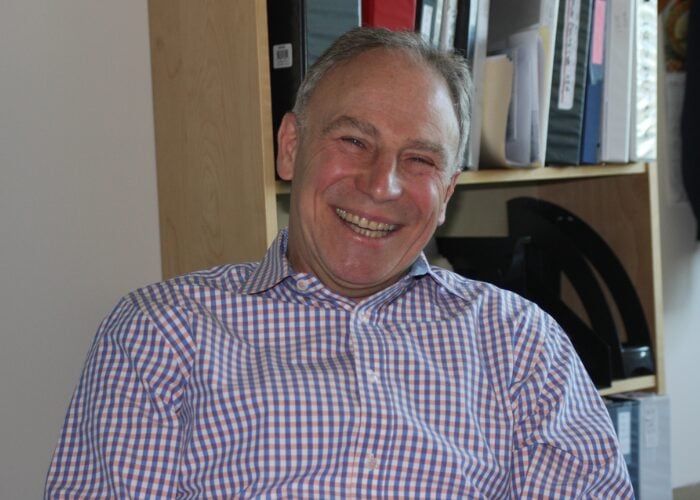
It’s less than two days before HEA’s big fundraiser, featuring Cantor Azi Schwartz in concert, and CEO Steve Levine is unrattled by the relentless demands on his time and attention.
“You know the story of the ducks,” Levine says, “where the duck that’s underwater is pedaling like crazy.
“But just above water, they look calm.
“Inside, right now, my mind is churning with everything I need to do.”
That steady demeanor served Levine well during his lengthy career as an attorney, and now, since September, 2024, in his leadership position at HEA.
“I’m the duck above water,” says Levine, “and I love it here.”
Levine’s career in legal risk management and crisis management was a big plus for the HEA board when it offered Levine — himself, a past board member — the CEO job.
Levine had worked for companies like Anthem Blue Cross, Whole Foods, Red Robin, SkyZone and the US Olympic Committee, assessing their safety risks and often litigating for those clients. A number of those entities were, as Levine says, “in transition.”
“A lot of my career, I’ve been the guy recruited during transitional periods, which is why this board tapped me to take on this job, since we went through some transition here.
“I don’t operate as an attorney here, but I think part of the cost savings of me being in this job is it saves a lot because I can review things without having to go to outside counsel and just make the decision pretty quickly.”
Levine, 61, seems unflappable. He politely interrupts a visit in his office to rush a birthday cake he picked up on the way to work for one of HEA’s preschool directors. In the hallway on his way back to his office, congregant Bob Epstein intercepts Levine to talk about the legal do’s and don’ts of transporting congregants in a van to and from events at HEA. Levine wears a walkie talkie attached to his belt; at times he might be needed quickly to complete a minyan.
“It’s the hardest job I’ve ever had, by the way,” says Levine, “and I’ve had jobs where I’ve had to work till two in the morning as an attorney. This is by far the most challenging.
“When I get to describe to my kids what I do, I say that I get up every morning and figure out ways to make people happy. Like with Bob Epstein, he asks me some questions and I say, ‘Bob, let’s figure it out together. Let’s work this out so that we can do something good for the community.’”
The only time Levine is untethered from HEA is 5:30-7 p.m. That’s workout time with his wife, Leslie.
“Yeah, it’s 24-7 here,” Levine says. “I probably don’t spend as much time with her as she would like, but she’s OK. She gets it. She calls herself the rebbetzin.
“When people ask her about that, she will be the first to say that she likes seeing that I’m happy.
“I also think it is this innate feeling of Judaism and the continuity of Judaism that has led me to this path. I recognize where I stand humbly.”
Levine arrived at HEA on the tail end of some tumult. Rabbi Salomon Gruenwald severed his relationship with HEA, and Rabbi Sarah Shulman was elevated to head rabbi. Rabbi Shulman assumed more CEO-type duties to work hand-in-hand with Levine.
“I’m a very practical person,” says Levine.
“I’m the business functionality of this shul, and Rabbi Shulman is the face of this shul. I’m there to support her and to make sure that she has every resource necessary so that she can facilitate the role of engaging our membership.
“I’m smart enough to know what I don’t know, and smart enough to know when I need to reach out to people, and I tap into those people as much as I can.”
That said, Levine has distinct goals for his congregation.
“My profitability statement is predicated on how happy the members are. We are one of the few Conservative synagogues in the nation growing.
“I believe there is a place in the Jewish community for everyone and I am happy that there are so many attractive options in the Jewish community of Denver to meet everyone’s needs.
“HEA is striving to be a welcoming, egalitarian environment where people will be engaged in music, education and community while also meeting their liturgical and spiritual needs.
“While we recognize we can’t be everything to everyone, we want to present ourselves as being accepting to all and attempt to meet the needs of our congregants.
“If we are unable to do so, I’m happy to know there are other viable options throughout the Denver community for people to maintain their Judaic spirit.
“I also believe that Denver is unique from the northeast, where I originate. Mainly, in the northeast, where communities are geographically contiguous, there is often a synagogue designated for each city. Synagogue hopping is not common, unlike in Denver where people seem to explore various options. This, in my opinion, creates a competitive division rather than unity within our own Judaic identities.
“I’d like to see us more supportive of one another — aggregating resources and finding ways to support each other’s functions. This happens organically and I just appreciate any involvement in synagogue life, regardless of denomination.”
Later in the morning, with the big fundraiser in the offing, Levine heads to the pre-school, fist-bumping with some four-year-olds. Levine grew up on the South Shore of Massachusetts, near Boston, in a family of teachers; now he is surrounded by them at HEA.
“I’ve never led a preschool,” says Levine. “Now I lead a preschool. I’m the black sheep in my family who didn’t become a teacher. In this case, part of the challenge for me is that I have to rely more on my subject matter experts.
“We have to make people happy, first and foremost, and make sure they feel that they’re getting a value proposition, even though in this case there’s not a concrete value proposition. I’m not selling a widget. I’m not selling Starbucks coffee. I’m selling happiness.
“So we are always asking ourselves, ‘How many events are we offering? How many people are showing up? How many opportunities do you have to get involved?’
“There are ways to track those things, but it is really more of an anecdotal or qualitative assessment as to just smiles and faces.
“And yeah, what I’m striving for is happiness.”
More from “Professionally Speaking”:
- Jay Siegel, Mount Nebo
- Ilene Rosen, BMH-BJ
- Susan Rona, Mountain States ADL
© IJN 2026