

This article was originally published in the 2017 L’Chaim© magazine supplement to the Rosh Hashanah edition.
When Frank Goldman speaks of his grandfather and namesake, he invariably uses the affectionate nickname long used by his forebear’s loved ones — “Papa Frank.”
Although Goldman never met Papa Frank, who died a decade before his own birth in 1975, he most definitely knows him — maybe even better than his grandfather’s own contemporaries did.
He grew up in a household that revered Papa Frank and spoke of him and his accomplishments frequently.
When he came of age, Goldman went beyond family lore, delving into histories, biographies and correspondence to pin down and elaborate upon what the elder Goldman accomplished during his busy and dedicated life
Those accomplishments are considerable, highlighted by a leading role in realizing the Zionist dream of creating a homeland for the Jewish people.
Papa Frank rubbed shoulders, conferred extensively — and occasionally sipped bourbon — with the historical figures who brought that dream to reality, including US President Harry Truman, Truman’s lifelong friend Eddie Jacobson from Kansas City and Israel’s first president, Chaim Weizmann, the towering Zionist visionary who convinced Truman to confer American recognition on the nascent Israel in 1948.
It is a story that Goldman has been telling in public presentations in recent years, in Denver and elsewhere, under the compelling title, “President Truman, my grandfather and a bottle of bourbon,” which he hopes one day to write as a book.
“I heard about him from my earliest memories,” Goldman says of his grandfather.
“There was always this story — and it became more developed as I grew older — about him and Israel. I didn’t really understand it; it was just kind of out there. My dad didn’t really like to talk about it. He believed it was sort of bragging about something. I told him that the whole point was not to bask in glory but to let people know the history of our people, to let people know what happened.”
During his college years and the early part of his legal career, Goldman began researching his grandfather’s role in the complex and contentious process by which the US made the decision to recognize Israel.
One of the things he discovered in his research was that Papa Frank’s role has been “downplayed significantly” in some historical accounts, and actually denied in one or two others. He also found, however, plenty of other accounts — including one written by Truman himself — which corroborated his family’s version of the story.
Goldman says his research has been thorough and exacting in terms of accuracy and attribution, standards which he says were not always observed by others who have written about the subject. He has read the memoirs and correspondence of Truman and Eddie Jacobson (Truman’s lifelong Jewish friend, one-time business partner and fellow WW I veteran who played a central role in the recognition process) and of Jacobson’s children and many others.
“With each bit of research I do with articles and primary sources, it becomes more apparent what happened,” he says, “and I believe the story that I tell to be 100% accurate.”
Goldman, 42, has lived in Denver with his wife Margo and two young children for the past three years. Born and raised in Fort Lee, NJ, he grew up in a Jewish family.
“I was proud to be Jewish,” he says, “but we were very secular. We were a liberal family. We were always very Zionistic. In our home it was always Israel, Israel, Israel. The concept of the State of Israel was always very important to us and we grew up knowing that my family played some part in the history of it.”
Educated at Cornell and Northwestern, Goldman worked as a defense attorney in New York before joining the Securities Exchange Commission’s Chicago office, where he worked for nine years. After transferring to the SEC’s Denver office, he has specialized in investigating and litigating securities fraud and market abuse cases.
He is active in the Denver Jewish community, most notably with B’nai B’rith which he currently serves as board member and vice president of membership.
Papa Frank, like his grandson, was an attorney.
One of seven children, he was born in Boston in 1890 and spent most of his life in Lowell, Mass. where he had a successful law practice and served as a district attorney. He was an active and enthusiastic supporter of both civic and Jewish causes and — again like his grandson — and avid B’nai B’rith leader.
“Papa Frank, from everything I’ve heard, was a very rational guy,” Goldman says. “His view of life was this: What’s the point of life if not to use your life for the betterment of others? He got involved, while maintaining a law practice and serving as a DA in Middlesex County, Mass., with all these different organizations.
“But he wasn’t a guy who just put his name on an organization. When he was involved, he did things, he made things happen.”
The circumstantial evidence also suggests that Papa Frank was less interested in promoting his own brand than in getting things done, which could explain why his historical legacy might seem less obvious than others who contributed to the US recognition of Israel in the 1940s.
Not everyone, however, has forgotten what he did.
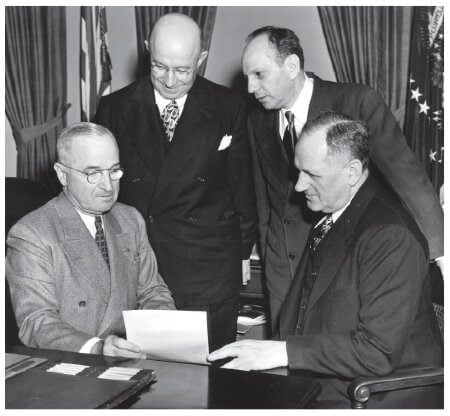
When Goldman made his first trip to Israel for his honeymoon in 2014, he paid a visit to the Foreign Ministry headquarters, where he was given a tour. He saw an exhibit there which included an old photograph of Papa Frank, Harry Truman, Eddie Jacobson and Maurice Bisgyer, the B’nai B’rith national secretary in 1948, when the photo was taken.
The men are gathered around a document which Truman had just signed — the US de jure recognition of the recently-declared State of Israel.
Included in the Foreign Ministry exhibit was a fountain pen — one of three which Truman used to sign the document — and which Papa Frank had, years later, donated to the Israeli government.
“It was pretty surreal to see him sitting there in a picture with these notable figures,” Goldman says. “It hit home. I was awestruck and honored.”
In terms of history, Papa Frank was in the right place at the right time — but the burden that circumstances placed on his shoulders was not an easy one. In the early 1930s, he was president of the Lowell-based District 1 of B’nai B’rith, a chapter that he himself had founded. He was a fast riser. By the early 40s, Papa Frank was one of B’nai B’rith International’s three vice presidents. As WW II wound to its close, the organization was busy trying to assist the many displaced Jews of Europe who had survived the Holocaust.
On May 14, 1947, 10 days after the death of B’nai B’rith International president Henry Monsky, Papa Frank was unanimously elected to take his place. The next day, he publicly called for the unrestricted immigration of European Jewish refugees into British-held Palestine.
It was, for its time, a radical move, the first openly pro-Zionist stance that B’nai B’rith had ever taken.
Despite its inherently Jewish character, and its huge humanitarian work on behalf of Holocaust survivors, the organization had been hesitant to support the movement to create a Jewish state in Palestine.
“He took the first openly Zionist position that B’nai B’rith had ever taken,” Goldman says. “That actually caused quite a bit of controversy. They lost a lot of members, and at the time B’nai B’rith was really the only show in town.”
Coming out strongly in favor of Zionism was also controversial generally. Great Britain opposed unrestricted Jewish immigration to Palestine, lest it trigger unrest among the region’s Arab population and negatively impact its lucrative relationships with Arab oil interests.
For its part, the US State Department at the time was doing its best to quell the rising call for a Jewish state, arguing that allowing the creation of Israel would alienate its Arab neighbors and push them into the orbit of the Soviet Union.
Historians have frequently described the State Dept.’s motivation in darker terms — as Arabist at best and anti-Semitic at worst.
As these debates were raging, and as the still-new United Nations was struggling to find consensus, US President Harry Truman was sitting on the proverbial fence.
Papa Frank was convinced that getting the president on board was the crucial step in securing American backing for a Jewish state in the Middle East. He was also aware that Truman had wearied of being endlessly lobbied on the issue and had stopped seeing Jewish visitors who wanted to discuss it. According to historians, he had even forbidden the subject from being discussed in his office.
Papa Frank considered it his responsibility to find a way around these formidable obstacles.
He found precisely that in the form of a B’nai B’rith member from Kansas City, Eddie Jacobson, who served alongside Truman in WW I and was later his business partner in a Kansas City haberdashery.
Truman and Jacobson considered themselves the best of friends.
Through a mutual acquaintance, Papa Frank set up a meeting with Jacobson in Kansas City in June, 1947, accompanied by B’nai B’rith secretary Maurice Bisgyer.
“The purpose of the meeting was to talk to him about intervening on their behalf to either set up a meeting between Truman and Papa Frank or for Jacobson to speak to Truman about the immigration of the Jews,” Goldman says. “At that point, they still weren’t really talking about statehood, they were talking about getting people out of the camps.”
Papa Frank and Bisgyer were initially disappointed in Jacobson. Truman’s buddy told them that he wasn’t particularly supportive of Zionism and that he knew little about Jewish history, including the Holocaust.
No problem, Papa Frank told him. He and Bisgyer would prep him thoroughly, providing all the necessary political, historical and social background he would need to effectively approach Truman.
“In the end,” Goldman says, “they convinced him. As recounted by Jacobson’s daughter, Papa Frank and Maurice flew to Kansas City frequently, sat in the parlor and educated him. And Eddie was such good friends with the president that he could, at a moment’s notice, show up and was often led in unannounced — a very hard thing to do at the White House.”
The ultimate goal of what would become an arduous and sustained process of persuasion was to convince Truman to meet with Zionist leader Chaim Weizmann. This would be what Goldman calls “the critical meeting” that ultimately led to US recognition of Israel, a crucial cornerstone in the creation of the Jewish state.
There were several meetings, some between Truman and Jacobson alone, others in which Papa Frank and Bisgyer were included.
“Over that period of time . . . Papa Frank went several times to the White House, some documented, some not — more than five, probably less than 10, between late 1947 and early 1949, when de jure recognition was given,” Goldman says.
The meetings, he adds, were invariably accompanied by glasses of bourbon. Truman, reportedly so fond of the spirit that he took a daily shot before his morning constitutional walks, considered it an essential accompaniment to presidential discussion.
On the part of Truman, Goldman says, there was an inherent sense of support for Israel, in spite of the political tangles that he was forced to navigate.
“We have to take Truman at his word, and that of others around him, including Jacobson and what I know of my grandfather, that the plight of the Jews in the camps was a matter of deep personal concern to him.
He recounted in his memoirs that it was the greatest challenge to Western civilization — the horrors that had just happened . . . hundreds of thousands of people in the very camps where they had been burned alive.”
Truman, however, told his Jewish visitors that he was conflicted on the issue, painfully aware of the instability that partition — the idea of dividing British Palestine into separate Jewish and Arab states — would bring to the Middle East, and of the international effects that it was likely to have.
“It was in that vein that my grandfather had to appeal to him through the conduit of Jacobson and ultimately the main character in the story, Chaim Weizmann,” Goldman says. “He knew that this was something that Truman would be remembered for in history and that it was important to ease the suffering of these people who had just gone through the most horrific event in the history of mankind.”
Nonetheless, by late 1947, despite growing support for unrestricted immigration and Jewish statehood in the US Congress and the American Jewish community, the resistance from the UK and State Department seemed to influence Truman the most. Ideas other than full Jewish sovereignty over a part of Palestine were being touted and advanced.
“It was a hard fight by that point,” Goldman says, “and by early 1948, the US position had completely swayed away.”
After Truman initially seemed to be supporting partition, he then seemed to be coming down against it.
The situation wasn’t improved when American Jews, in speeches, statements and press reports, began taking a decidedly anti-Truman stance, which angered the president.
“Truman took it to heart,” Goldman says, and Jacobson said the president “was beside himself” in the face of such criticism. “He didn’t like being so disliked.
“As time went on, the doors became closed to just about everyone, including my grandfather, because Truman got so sick of the daily attacks. It was said by Jacobson and others that Truman didn’t even want to hear the word Palestine. He wanted nothing to do with it anymore. The concept of having anyone come in there and lobby for immigration or statehood would make him blow up.”
Despite that, Jacobson persisted, gently but firmly, in encouraging Truman to meet with Weizmann.
“There’s no doubt that Ed Jacobson played the most crucial role in the world, even though he wasn’t a political guy and he wasn’t up on Jewish history and he didn’t want to get involved,” Goldman says. “He always said the last thing he wanted to do was to ask favors of his dear friend and drinking buddy.”
The tide turned in March of 1948 when Truman reluctantly agreed to meet with Weizmann, who was already in New York, patiently awaiting his chance to argue for Jewish statehood.
“The heroes are the people who sat in on that meeting, and rightly so,” Goldman says. “Chaim Weizmann is the hero because he is ultimately the person who says to Truman, ‘You have to do this,’ but it was Papa Frank who got Weizmann into the White House.”
The circumstances leading up to what might be called the meeting between Truman and Weizmann are, for the most part, thoroughly documented and by now are part of Israel’s history.
One unconfirmed detail, Goldman says, was whether Papa Frank was present at the meeting.
“The oral history passed down to me is that my grandfather was at the meeting,” he says, “but I’ve seen no record of that. I tell people that it doesn’t matter whether my grandfather was there or not. The most important point is that Weizmann and Truman met.”
In March, an increasingly impatient Papa Frank urged Jacobson to set up yet another meeting with Truman. Jacobson reluctantly agreed, writing a letter to the president requesting one more get-together.
Several days later, Truman wrote back, agreeing to meet, but expressing pessimism.
“I don’t think this a solvable problem,” Goldman paraphrases the president. “The Jews are just too emotional, the Arabs are too difficult and the British are uncooperative.”
But the meeting finally took place on March 13, when Jacobson brought up the taboo subject of partition.
He compared Weizmann to Andrew Jackson, whom Truman greatly admired, and said that Truman’s admiration should also extend to the Zionist leader.
Angry again, Truman lashed out at Jacobson, who stubbornly held his ground.
At last, the president swiveled around in his chair and looked his friend in the eye.
“Okay, you bald-headed son-of-a-bitch, I’ll meet with him,” the president is reported to have said.
“And with that one little thing, the history of the world changed,” Goldman says.
“My grandfather said that he knew there was one person in the world who could convince Truman to defy the State Department, to defy the British, and that was Chaim Weizmann.”
The American Zionists were fully convinced that Weizmann — erudite, sociable, elegant and personable — could win just about anybody over.
Jacobson and the others who participated in the meeting immediately went to New York, brought Weizmann back to Washington, and prepared for the meeting with the president, which took place on March 18.
It worked. Weizmann was successful.
By the end of the meeting between the leaders, Truman gave Weizmann his word that the US would unequivocally support partition, hence the soon-to-be born State of Israel.
Characteristically, Truman was true to his word.
On May 14, 1948, a year to the day after Papa Frank became B’nai B’rith president, and 10 minutes after the independent republic of Israel declared itself a new state under the UN partition plan, Truman recognized the new country.
It would be the following January before that recognition became fully de jure — legal — at a ceremony in which Papa Frank participated.
After the documents were signed, according to family accounts, Truman put his arm around Papa Frank and told him, “Frank, I like the cut of your jib.”
Says his grandson: “That one comment meant everything to my grandfather.”
Papa Frank had other notable experiences and achievements, both during his tenure as BB president, which ended in 1950, and thereafter, when he continued his civic and Jewish involvement.
He worked on German war reparations for Holocaust survivors and met such luminaries as David Ben Gurion, Israel’s first prime minister, and Otto Frank, Anne Frank’s father.
His grandson expresses regret that Papa Frank died a decade before his own birth. Goldman would love to have met him and says he would have had “millions of questions” for him.
“For my entire life, I wished that I had been afforded the opportunity to meet Papa Frank.
“The stories passed down to me from my dad, mom, uncle, and others depicted a man who was larger than life, and likely based on those mythic characterizations, from my early childhood I emulated this man who I never met.”
Goldman would ask Papa Frank about growing up the son of immigrants, what motivated him to succeed, his father’s childhood and — as one who chose law as his own calling — “about his love for the law, including his storied career from a district attorney to arguing a case that went to the Supreme Court.
“I would just want to have a relaxing chat with him (perhaps over a glass of bourbon) and get to know this man who unknowingly shaped my life. Obviously, I would want to ask him about the events shaping the recognition of the State of Israel, and to put flesh on the bones of many of the stories that were passed down to me as oral history.
“I have always wanted to know what President Truman said to him personally behind closed doors. I would want to know what drove him to persevere, even when the odds were against him and the Jewish people.”
The grandson wishes he had the opportunity to tell his grandfather how proud he is of his accomplishments, “how much his legacy has meant to me,” Goldman says.
“And finally, I would ask him the ever-important question whether he is proud of his grandson and namesake, for whatever it is that I have done with my life.”
Chris Leppek may be reached at IJNEWS@aol.com.
Copyright © 2022 by the Intermountain Jewish News