
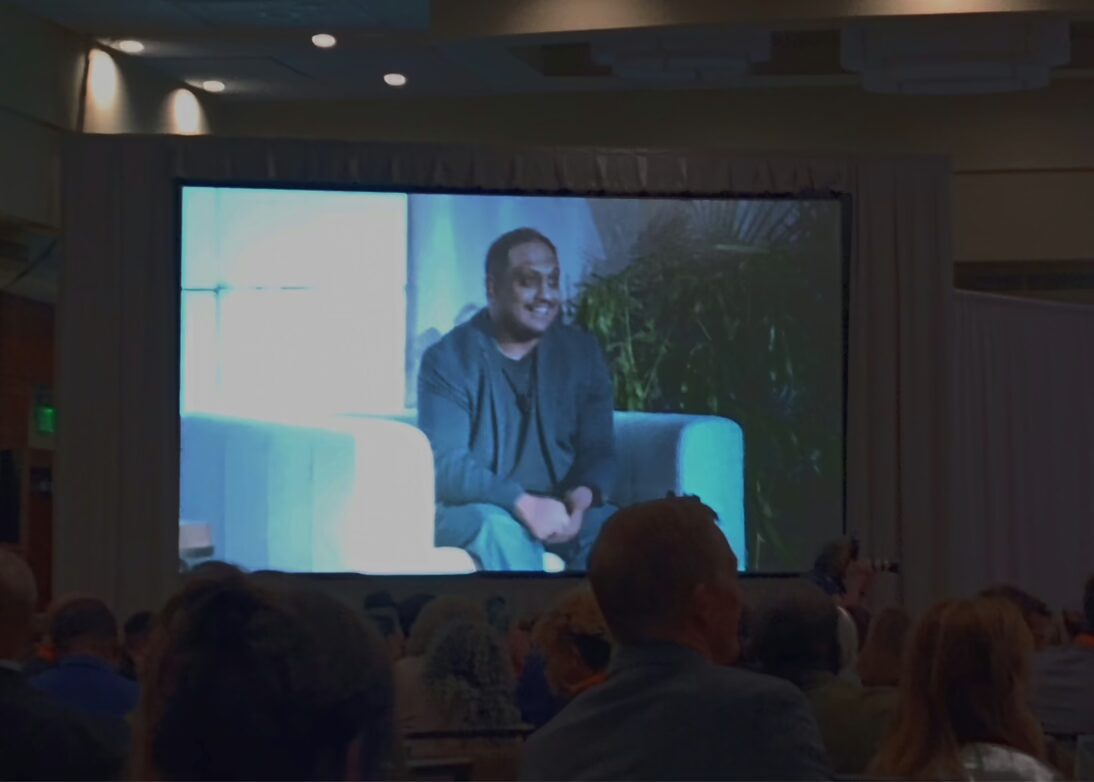
A Yemeni-American Muslim took center stage Monday night in Downtown Denver to address the topic, “How do we move beyond hate?”
The setting was the inaugural “Together at the Crossroads: A Congress for Allyship & Unity,” organized by the Denver-based David Merage Foundation for Confronting Antisemitism.
Held Oct. 19-20, the two-day intensive workshop aimed to educate participants about effective approaches and opportunities to rebuild civic trust and a shared vision for their communities and the US.
That was the focus of Mohammed Al Samawi’s comments in his conversation with Sabrina Naim Merage, daughter of David and Laura Merage and founder of Evoke Media.
Al Samawi recounted his journey from an idyllic childhood in Yemen brutally disrupted in 2015 by the Yemen-Saudi war, which is ongoing. He described fleeing from the capital Sanaa to Aden, only to come under fire there.
By then Al Samawi had become involved in interfaith work. He reached out to friends in Europe and the US who were able to extract him from Yemen.
Because of his work, there is a fatwa against Al Samawi and he is unable to return to his homeland. In the interim, he has become a proud US citizen.
The theme of his talk reflected that of the conference — how to connect with people and ideas outside of one’s “box,” to use Al Samawi’s word. The audience reflected that. According to the conference organizers, over half of the participants were not Jewish. Following Al Samawi’s words a San Antonio pastor, Terrin Phillips, closed the evening.
Israeli-Palestinian social media influence Nuseir Yassin, aka NasDaily, was scheduled to speak the following day.
A religious Muslim, Al Samawi says that children in Yemen are educated to hate Jews and Israelis. A British teacher set Al Samawi on a different course. He began reading the Bible and was confused. The people he was reading about didn’t match what he had been told. His curiosity awakened, he started to reach out to Jews and Israelis via Facebook.
He also attended an interfaith conference in Bosnia, where he countered Muslims who did not speak Arabic or look like him. His world was broadening. By the time the war broke out, his interfaith network had grown and ultimately saved his life.
Al Samawi’s interfaith work is driven by a deep faith. Born with a disability, he used to ask him mother, Why did G-d do this to me? She answered him that every person has a purpose, and that Al Samawi would have to find his.
Al Samawi is motivated by love and compassion, which he believes is the antidote to the kind of extremism that has devastated his country by Iran-backed Houthi rebels, and to the rise in hate generally.
“Do I want to create my own hell?” he asks; “or do I want to create my own heaven?” He chooses the latter.
His words are reminiscent of those of Yosef Ohana, a freed Hamas hostage who spoke in Greenwood Village on Oct. 7 about how love is what propels him forward in the aftermath of trauma. Al Samawi talks about how he doesn’t want his trauma to define him, to be mired in the hatred it can summon.
Finding refuge in the US, Al Samawi put his ideals into reality. He founded the Abrahamic House, a co-living space in Washington, DC for people of different faiths and backgrounds.
Inspired by the audience in Denver, he charged the participants to try and connect with someone different from them; not superficially, but truly to hear the other’s story.
A passionate advocate against anti-Semitism, he also charged the Jewish community with speaking out against hate if it arises in its own space. Justice, he says, can only be achieved if it’s mutual.
Denverites David and Laura Merage, who fled anti-Jewish persecution in Iran as young adults, founded David Merage Foundation in 2024 in response to anti-Semitism rising across the US. The June 1, 2025 firebombing of Run For Their Lives in Boulder convinced the couple that the response could not come from only the Jewish community.
“I grew up hiding my Star of David. I never imagined my granddaughter would feel she had to hide hers in America,” said Laura Merage. “Boulder showed us that hate doesn’t stay aimed at one community. It tests all of us.
“We can’t solve this by talking only to ourselves. The people who will turn this around are the neighbors, teachers and faith leaders who decide hate has no place in their town. This Congress is for them.”
David, Laura and Sabrina Merage, and Mohammad Al Samawi, spoke to the Intermountain Jewish News and Denver Gazette following the public event. Below is an edited version of that conversation.
How did this foundation come about?
David Merage:
October 7 was a shock, because I have lived in this country for 60 years, and I have never, ever heard anything like what was happening.
Within a month, I said to Laura, “It is time for us to practice never again. We have said never again for so many years, and now it is time for us to follow that.”
Sabrina Merage:
This foundation is a reaction to the anti-Semitism that came very quickly on the heels of October 7 in the United States.
David Merage:
My mother was the one who started the path that we have followed. Her path was, we need to help those who need help. And the more you have, the more you have to give back.
For 30 years, we have been very involved in doing projects in Israel. We have also been very involved in early child care and education, where today we have about 140,000 children we support.
What is different about the foundation from others working on similar issues?
Laura Merage:
We are looking for allies to stand up by us during time of difficulty and speak out.
This conference was more than 70% non-Jews. I don’t think that has happened before. This is the main reason that this gathering is different than the others.
How did that happen?
Laura Merage:
We had 450 people in the room, all by invitation.
It was through learning about leaders in different communities and what everybody’s doing, talking to a handful of people. You should know so-and-so. You should know this person . . .
We talked to hundreds of people. It is an amazing group of people who came together.
David Merage:
The idea was bringing people together and sharing that we are all human beings, many different faiths, different beliefs, but we are all the same.
Sabrina Merage:
We’re all brothers and sisters, cousins.
Mohammad Al Samawi:
I attend a lot of conferences, and a lot of conferences to fight anti-Semitism. I’ve never seen something like this at all.
Never seen what?
An audience that’s not only Jewish to come and actually speak and participate. I was in a training today, and the woman who did the training, she’s not even Jewish. You can see that there is a true allyship happening.
I’ve never seen this before.
Sabrina Merage:
In the planning of this there was an inkling of concern: Do we have allies that will show up for something like this? Do they care? Does it matter to them in the same way that it matters to us? Our hope was to maybe get 300 people in the room.
We had 450 plus a wait list, which shows that this is not a Jewish problem, and it’s not a Jewish problem to solve.
There are people all over the country and all over the world who recognize [anti-Semitism] as a rot, a decay in our society that will threaten many others, and that there is a very real connection between the rise of anti-Semitism and the rise of a lot of other kinds of prejudices and bigotry that we’re faced with, and that we all have a responsibility to face it together.
David Merage:
A major goal is to fight for those who want to bring the US down and bring our democracy down. We see it, and we see it in other countries, in other societies, in other times, that with some events, democracies were trampled on. And we need to fight.
We are American. We live in this country, and we chose to live in this country.
What is great about this country is the democracy and the freedom that people have. And it becomes crucial for us to fight for this.
Do Americans have a unique role in trying to bring all these different peoples and religions together?
David Merage:
Humanity has to stand up and say we will not let [a minority of people who promote fundamentalist ideologies] take over and change our way of life, change our freedom. Can we actually do that? I believe so.
Laura Merage:
The loud minority who are spewing hatred are the loudest. But we know that just over 70% of people in the United States disagree with this hatred. But they’re the silent majority.
Oftentimes the loud minority will take root in the presence of silence. The tipping point comes at a certain time that the minority will take over and hate grows and the majority can’t do much about it. That’s why I feel it’s a crucial moment now that the majority needs to stand up.
Is the foundation’s idea to connect with allies who have some kind of influence on the silent majority?
Laura Merage:
We have already developed cohorts. For the past six months we’ve been working with cohorts who are gaining the tools they need to know how to speak to the issue.
They don’t need to be leaders who stand in front of congregations, or politicians. Oftentimes I hear neighbors getting together and they hear a comment from a friend, an acquaintance, a neighbor. They don’t know what to say.
Hate has become normalized. It’s been OK even in small gatherings. We need to stop that.
Each of us has the power to do that. I don’t think it’s that complicated. I really don’t. In fact, we need to simplify everything. We need to go back to the days where spewing hate was socially unacceptable.
We do not allow this for any other group of people. We need to remember that and not allow it when we hear Jew hatred.
Mohammed Al Sawami:
[Laura] started opening the conference by a memory of her childhood and why she had to leave Iran, and how she left Iran and came to the United States.
Yesterday I had a conversation with David and he started telling me about his memory when he was a teenager in Iran.
We are here in the United States [because] we don’t have another place. This is our country. We don’t want to make the same mistakes that happened in our home countries.
We don’t need to have our kids, the next generation, also to escape to find another place.
This is the only place we want to live in and we want to fight for it.
Laura Merage:
That’s right. This is the country that accepted us for who we are. For the first time in my life at the age of 15 when I came to the United States to go to school, I felt true freedom.
I have never taken that for granted. I have never become complacent about that privilege and how important it is. And I will fight for it until my last breath.
It’s a very easy decision to make.
Because I have experienced hatred, I know what it feels like. I know what it looks like before it becomes obvious.
David Merage:
All Americans are immigrants. Immigrants made this country great.
We haven’t seen in recent times a backlash that the Jewish people are seeing.
It happened in 1900 against the Irish, against the British, against the Germans. But this is not that time.
We are in the 21st century. We should understand that to isolate one community — it doesn’t matter if it is Jew or Muslim or whatever — that it is not OK.
We should stop that.
You really don’t need a loud voice. You need the masses. And even if they whisper, it becomes so, so loud.
Sabrina Merage:
I have a good friend who has a donut company. He’s black and Mexican; he’s not Jewish.
He wants to do a Chanukah-inspired donut. He sent me his mascot with the Star of David on the shirt and asked me what I thought about it.
I said, “I love it. I want you to prepare to get some anti-Semitic responses.”
This is the moment that we’re facing right now, that my friend, who is not even Jewish, wants to do something that has nothing to do with geopolitics, that should not be controversial, just to display something of pride and joy for a holiday — he needs to prepare to face anti-Semitism. That’s real. That’s what we’re faced with right now.
That is what we need to understand and what we need to stand up against.
© IJN 2026