
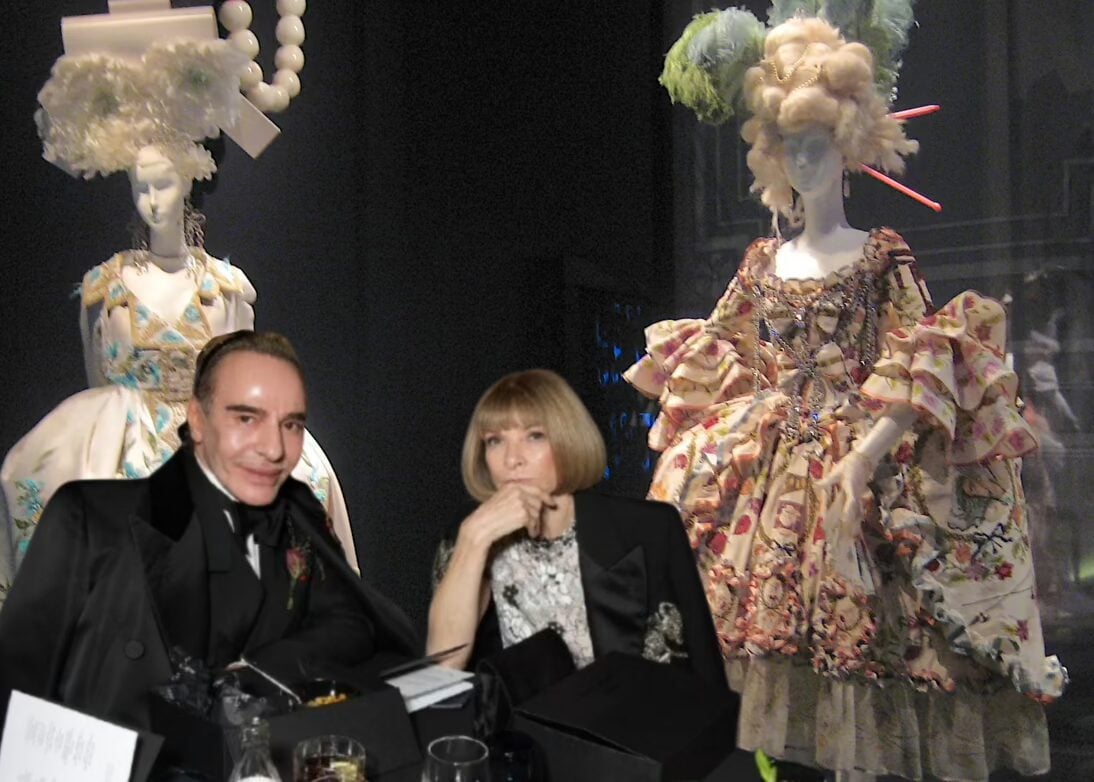
Before the Metropolitan Museum of Art announced that it would honor fashion designer John Galliano with a major Costume Institute exhibition next spring, the museum convened at least two unusual meetings: a face-to-face with Galliano and a number of prominent rabbis, and a larger meeting with the recently retired Vogue editor-in-chief Anna Wintour, museum officials and several prominent Jewish leaders.
The unusual collision of fashion and Judaism, first reported in The New York Times, reflected the challenge facing the Met as it prepares to celebrate one of fashion’s most influential designers who was also the perpetrator of one of its most notorious scandals.
The Met’s announcement also comes at a time when many Jews see a spike in anti-Semitism, ostensibly ignited by Israel’s war against Hamas but fanned by anti-Israel rhetoric that is often indistinguishable from anti-Semitism.
Accordingly, the debate over Galliano’s return to fashion — he recently signed a multi-year deal with the fashion brand Zara — touches on questions that Jewish tradition has wrestled with for centuries: how to repent, and when to forgive.
In 2011, a video surfaced online showing the designer, in a lengthy rant, praising Hitler and telling onlookers that they would have been killed by Nazis. Earlier that same year, a Jewish woman and an Asian man accused him of directing slurs at them during an altercation at the same café.
A French court later found Galliano guilty in the cafe incident of making public insults based on race, religion or ethnicity and levied a suspended fine.
Galliano, who was the head of Dior at the time, was fired by the esteemed fashion house. His reputation appeared destroyed.
Process of rehabilitation
But his story did not end there. After entering treatment for substance abuse, Galliano began a long process of rehabilitation.
He released a statement of regret, met with Jewish leaders and spoke publicly about confronting his own ignorance and prejudice.
In 2013, the ADL said it believed he had demonstrated “true contrition” and that people could change when they accepted responsibility and worked to understand the harm they had caused.
The late Abraham Foxman, then the national director of the ADL and perhaps the last Jewish leader who could unilaterally grant an accused anti-Semite absolution, met with Galliano. He arranged for the designer to study with a rabbi and visit Auschwitz, and felt Galliano’s amends were sufficient for him to ask retailers to again stock his designs.
“Mr. Galliano has worked arduously in changing his worldview and dedicated a significant amount of time to researching, reading, and learning about the evils of anti-Semitism and bigotry,” Foxman, who died last May, said at the time.
Jonathan Greenblatt, chief executive of the ADL, posted to X: “We believe John Galliano has genuinely worked through the issues that led to his antisemitic outburst years ago in Paris, and we have long since accepted his apology. His efforts to repair the damage his words caused and to learn from that incident should be applauded.”
Two of the rabbis who attended the May meeting (a third wasn’t named by participants or reporting on the meeting) also accepted the sincerity of Galliano’s contrition, even as they bluntly described to the exhibit organizers the climate in which the exhibit would be appearing.
Accomplishments — and failings
Rabbi Rick Jacobs, president of the Union for Reform Judaism, made clear to the Met team that the exhibit would be a missed opportunity if it didn’t forthrightly acknowledge the harm Galliano had caused.
Rabbi Joshua Davidson of the Reform Congregation Emanu-El in New York, also said at the May meeting that many Jews may reasonably find the tribute painful, given it comes amid a rise in anti-Semitic incidents and renewed anxiety about Jewish safety.
Like Jacobs, he also suggested that they include not just Galliano’s accomplishments but his failings.
The Met appeared to hear that message, and says it intends to make Galliano’s transgressions part of the exhibition rather than gloss over them.
In announcing the exhibition, Andrew Bolton, the Costume Institute’s curator in charge, said:
“It will directly address the rupture caused by his anti-Semitic, racist and anti-Asian conduct in 2010 and 2011, which resulted in his dismissal from Christian Dior and his eponymous label and his conviction by a Paris court for public insults based on race, religion, ethnicity or origin.
“It will also consider his subsequent treatment for substance addiction and his later public acknow- ledgment of his actions.”
‘Teshuvah is the work of humility’
Not everyone, however, is persuaded that Galliano’s rehabilitation — or the Met’s framing of it — satisfies the demands of teshuvah.
Hen Mazzig argued that the museum’s decision reflects a wider culture that has become inured to anti-Semitism and dismissive of the concerns of the Jewish community.
Noting that the Met abandoned plans to honor Galliano in 2024, Mazzig wrote on Substack this month that objections from Jewish donors and allies at the time were “a cost the Met was unwilling to pay.”
Two years later, he continued, the museum appears to have concluded that the “cost had fallen to roughly zero. That is a market read on how much anyone cares when Jews object.”
Rabbi Danya Ruttenberg, author of the 2022 book On Repentance and Repair, was unconvinced that Galliano has demonstrated the kind of transformation Jewish tradition demands.
She recalled finding Galliano’s original public apology and found it lacking. He had said he accepted that the accusations had “greatly shocked and upset people” and that “anti-Semitism and racism have no part in our society.”
“It didn’t appear very sincere or heartfelt or engaged with what he really had done,” she believes.
In Jewish tradition, Ruttenberg said, repentance is a multistage process that includes an apology to the harmed party, a sincere and forthright confession and a demonstration in words and deeds that the transgressor has changed for the better.
“The work of teshuvah is the work of humility and the work of care and the work of relationship,” she said. “That’s not what I’m seeing here.”
She also worries that powerful public figures — from President Donald Trump to the comedian Louis C.K. — increasingly earn public absolution in ways unavailable to the average person.
“Our society is delighted to give free passes to people who will give them access to wealth and power,” she said.
Jacobs said:
“I don’t think you have as many stories of people who were the absolute embodiment of anti-Semitic behavior and views, who really worked through and took accountability.
“For the Jewish community, I think it’s an underscoring that there’s not only power to teshuvah, but actually it can really bring someone back from a really dramatic fall from grace.”
Back in the fold
The fashion world, meanwhile, has already welcomed Galliano back to the literal and metaphorical front row. One of his pieces from his Spring/Summer 1993 Olivia and Filibuster collections is currently on display at the Denver Art Museum’s “Conversation Pieces: Stories from the Fashion Archives” exhibit, on through Feb. 7, 2027.
Wintour, perhaps the most influential figure in fashion, has been one of his strongest champions.
The annual Costume Institute exhibit opens with the Met Gala, a lavish red carpet extravaganza that is one of the highest-profile events in fashion and pop culture.
In his statement, Bolton, the curator, said that the show will demonstrate how as a designer for Givenchy and Dior, Galliano “has remapped the world through fashion and how his conduct, its consequences, and changing cultural values have reshaped our understanding of his work.”