
A few days shy of the anniversary of one of the most catastrophic events in Colorado history, the scene at the Oerman-Roche Trailhead in Superior spoke volumes. One year ago, scores of displaced homeowners rushed to the trailhead to get an overhead view of their decimated Sagamore neighborhood as a result of the Marshall Fire of Dec. 30, 2021.
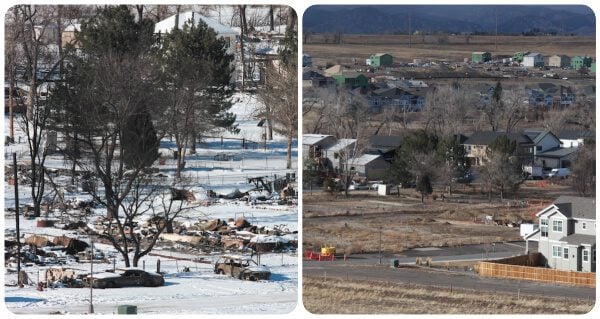
In our return to the trailhead one year later, there were four visitors. All were taking aerial photographs of the neighborhood that in many places is still charred from the fire. A small row of homes is under construction, but the neighborhood as a whole is years away from being totally rebuilt.
“Photos for the insurance company,” one of the photographers divulged.
Most striking on this day were the 35 mph winds whipping around the trailhead overlooking Superior Town Hall; not nearly as deadly as the 100 mph winds and fire that ripped through Superior and Louisville and swallowed up home after home in mere minutes, but a harrowing reminder nonetheless.
Those winds, on this day or any other, create nervous flashbacks for Igal Megory.
“To this day, it’s the thing that worries me the most,” says Megory.
“Strong winds.”
Megory got his first taste of Boulder in 1979 when he arrived from Israel to work on his PhD in mathematics at CU. He was not at his home in the Cornerstone subdivision of Louisville when the fire started, though his wife Rosalba Cohen and their two children were there and escaped ahead of the flames.
Like so many, Megory’s family lost everything in the Marshall Fire. It forced them into a rental condo near Boulder for five months and now they are renting a home in Louisville, waiting to determine where they will land permanently. They have signed a letter of intent to rebuild, but the timetable is not theirs to determine.
“The builder still does not want to commit to the final contract,” says Megory, who operates a business that provides software to mortgage companies.
“I think they are afraid of changes in the costs.”
Megory admits he flinched when, two weeks ago on Dec. 19, a fire hit nearby Sunshine Canyon. He says the worst sign of anything PTSD-related is manifested by his children, Aaron and Moshe.
“They are the ones who have all the emotional scars,” Megory says.
Three-hundred-and-sixty-five days after the Marshall Fire ravaged his home, Megory still fumes over the ineffectiveness of the area’s emergency notification system.
“An hour-and-a-half into the fire, and no one had been told to evacuate yet,” he says.
“That’s so insane, I can’t even describe it.”
Those winds that haunt Megory are also eerie reminders of the fire to Elayne Oligschlaeger, who lived adjacent to Coal Creek Golf Course in Louisville.
“I was just sitting at home, relaxing,” remembers Oligschlaeger. “I noticed the wind was getting pretty bad, so I started to bring in a few things that were outside.
“Then I started to notice that it was awfully smoky out there.”
Cue the discussion of the evacuation system:
“I got a call saying ‘evacuate,’ but it didn’t tell me where to go,” says Oligschlaeger.
“I called my neighbor, but they didn’t know either.
“My youngest son Jacob saw a report about the fire. He called me immediately and convinced me to drive to Denver.
“He talked me through it.”
Oligschlaeger frantically grabbed a few things — a coat, laptop, some jewelry and, most importantly, her shih tzu, Marshmallow — and sped out of the subdivision, passing Westminster Fire Dept. trucks on the way out.
The next day, upon comparing notes with her neighbors, Oligschlaeger estimates that she would have had a little more than an hour before the fire reached her home.
She finds irony in a rare few of the items that survived the fire: a few cooking tools (she sells “Pampered Kitchen” products) and some metal flowers outside the home.
Oligschlaeger has since purchased a home in Broomfield, and plans to build on her former site in Louisville. She says talking about the Marshall Fire and the loss of her home of 22 years “is sometimes healthy” to talk about.
“I’m really trying to look at all the positive things,” she says. “I think I’m OK, and my dog knows sometimes I’m not all OK.”
Of course, on the day we connected with Oligschlaeger, one of the first topics of discussion was how windy it was in Broomfield, one year later.
Nearby Oligschlaeger’s home was that of Alan and Julie Halpern. Alan was set to retire on Dec. 31, 2021, as executive director of Congregation Har HaShem in Boulder. He and Julie were returning from an out of town trip on the 30th and at a cousin’s house in Denver when he started receiving some jolting alerts on his phone.
“We started to get text messages that we needed to evacuate,” says Halpern. “We reached out to a couple of neighbors. One said, ‘things are crazy here.’ That’s the last I heard from her until the following afternoon.
“From the south side of Denver, I could see the smoke.”
The day after the fire was surreal.
“Crews were moving through the neighborhood, shutting off gas leaks and putting out remnants of the fire,” says Halpern. “It looked like Dresden after the bombing, except that there was more left in Dresden.
“We couldn’t tell what house ours was.
“It was hard to figure out which ashtray was yours.”
So, the Halperns are temporarily in Broomfield. They hope to build on their existing lot in Louisville, but are resigned to the prospect of a process that could take years.
“I’ve had to reconcile what to do about the fire versus what to do about life,” Halpern says.
“Along with everyone else, we lost our past.”
Welcome to retirement.
A few miles away sits Boulder JCC executive director Jonathan Lev. Immediately after the Marshall Fire concluded its destruction, Lev and his team jumped into action.
Lev’s main goal: to instill a feeling of hope.
“Each family and each person is in a very different place around this,” says Lev. “My hope is that the support they’re able to feel, whether that’s from direct services, financial or in any other way from the community, is providing some level of assurance to make sure they know they’re not alone.”
Most striking for the victims is that seemingly endless maze of unfinished business that comes when one’s life, in many ways, starts over. Add to that, this: for many, insurance claims for reimbursement of certain displacement expenses, ended on Dec. 30, 2022.
“Everyone is in a very different place currently in terms of the impact of how the fire impacted them as a family, and where they are in terms of temporary or permanent housing,” says Lev, who himself housed a family for a few months after the fire.
“There’s still so much that is unknown for people. At the same time, there is a cadence that’s present now in terms of ‘what I know and what I don’t know.’ They’re able to move through that a little bit more than they were before, but we’re only a year out.”
Lev, like Igal Megory and Elayne Oligschlaeger, gets nervous whenever it gets windy.
“I’ve heard so many stories of people who saw the fire and the fence behind their house and had two minutes to leave,” says Lev. “And within those few minutes, the house was on fire.
“The wind was that fast.
“Every person has a story, and I think there is a collective trauma and the collective piece of all of this. But every time it’s windy, there’s something of a reminder that comes up for so many people.
“It is very hard to grasp that it’s been an entire year since this has happened. So much has been done, and yet at the same time it is abundantly clear how much more still needs to happen.
“Recovery is going to take years, and it will continue to reshape our community.
“You think, it’s been a year and things should be falling into place, says Chany Scheiner, who with Rabbi Pesach Scheiner runs the Boulder County Center for Judaism.
“It seems that things are just starting to get into the process of rebuilding, though not that people are moving into finished homes,” Scheiner says. “These people are grappling with a lot.”
A sliver of a silver lining . . . the first blaze victim to rebuild on her previous site actually moved into her new home on Dec. 16, 2022, built exactly where her previous home stood in Louisville.
Nearby in Sagamore, which one year ago was only charred remains, the subdivision now has a handful of homes midway in construction.
In the midst of large parcels of dirt is a row of outdoor mailboxes, weathered but somehow not destroyed by the fire. They line a street directly across from one of the newer homes in the early stages of construction, not far from a large sign from one developer that says “Development Site Construction Starting 2023.”
About 50 yards away from the mailboxes, near Founder’s Park, is an American flag anchored onto a wire fence. It is torn, tattered, and in the gusts of wind appears quite vulnerable yet not willing to be discarded.
It serves as an unofficial visual welcome to those entering Sagamore.
The symbolism is powerful. If this bit of Old Glory can persevere, so can others.