
In August, 2023, about two dozen residents in the Westwood subdivision in Lakewood lined up along South Xavier St., as if waiting for a bus. The temperature was 98 degrees, with the sun in swelteringly full force. If the sweating souls stood in one place for too long, the soles of their shoes could have easily melded with the pavement.
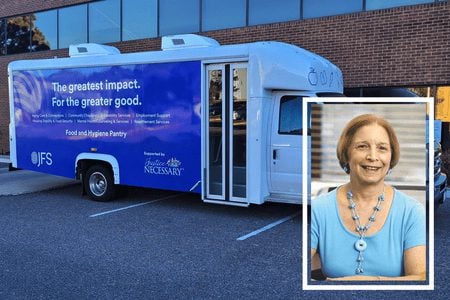
Relief arrived from around the corner. The JFS Mobile Food and Hygiene Pantry rolled up, as it did every two weeks that summer. Once opening the doors, the Westwood residents entered the air conditioned mobile pantry and were treated to varieties of meats and food for their families. Adjacent tents had fruits, vegetables and hygiene products, all for free.
“This is really nice, because times are hard,” one resident told the Intermountain Jewish News.
Who pays for this?
Jewish Family Service of Colorado.
For this special issue of Dollars & Sense, here’s a case study of how a nonprofit like JFS does it.
Like any business, Linda Foster’s JFS operates from pie charts, and, like any business — especially a nonprofit coming out of the COVID era — the slices of that pie get bigger or smaller, constantly.
“Every single program, everything we do,” says Foster, “has financial ramifications.”
For the fiscal year that ended September 30, 2024, JFS reported a total revenue of $21, 204,698. For a frame of reference, only six years earlier — when Foster became CEO of JFS — the annual revenue was $12 million.
The largest slice of last year’s pie, 30%, came from contributions. The next largest slice, 29%, came from foundations and grants. Twenty-eight percent came from federal grants and contracts.
The size of those slices, however, have become endangered.
“A lot of those grants, which started during COVID, are going away,” says Foster. “Right now our concern are grants from the American Relief Plan, which happened during COVID.
“We ask ourselves, ‘how are we going to keep going?’
“When we became dependent on those grants, our whole support system changed.
“Our food pantry (outside the JFS headquarters on S. Tamarac) before COVID served 40 to 45 households every day. Now it’s 150 to 180 households every pantry day.
“So how do we keep supporting the need for food when the grants that supported food during COVID are no longer? Those are the kinds of things that we’re constantly dealing with.”
JFS relies on multiple fundraising efforts throughout the year.
“We continue to be successful in terms of our fundraising initiatives,” says Foster.
“We have one during Passover, we have one related to the Holocaust, we have Colorado Gives Day, we have our Faces of JFS event, we have our end of year annual fund campaign.”
Foster has noticed a trend regarding individual donors.
“In the last six months we’ve raised more than we were even thinking we could, but it was from less number of donors,” says Foster. “I don’t know if that’s a trend that’s going to continue. Even though we have less donors, we have had much larger contributions.
“We’re very careful to strategically leverage these different resources.
“We’re also trying to position ourselves for future financial challenges so we can absolutely continue to deliver essential services to the community.”
Now, a look at JFS’ pie of expenditures, the $21,267,338, according to JFS’ 2024 annual report:
Seventy-five percent of income goes to direct services and programs. Of that, over half is used for community resources for stability, mental health services and aging care and connections.
Eighteen percent of expenditures goes to administration, and 7% to fundraising (yes, it costs $1,481,009 to raise contributions, sustain grants and employ others to manage other revenue streams).
Of that 75%, the largest bite in program expenses is for the community resources that JFS provides. This community resource accounts for 24% of the program expenses.
Regarding program services, there is somewhat of a tidal wave coming: The Baby Boomers.
“The population in Colorado of the boomers older adults is growing really quickly,” says Foster. “From 2020 to 2050, it is anticipated the number of adults over the age of 60 in Colorado will increase by 65%.
“So we know as that older adult population grows that the need for services, the need for support, for resources, for programming to mitigate the barriers that they have for healthy living, is going to grow.”
That said, Foster notes that the funding sources for older adult services have not increased since 2020.
Expenditures are also affected by the number of Holocaust survivors in the Denver area.
“One thing that I never would’ve anticipated or planned for,” says Foster, “was the number of Holocaust survivors that we are serving. I thought for sure that number would go down, but as the years went on since I’ve been here, there were about 80 survivors that we were serving. We’ve just added about 50 new Holocaust survivor clients who need support.
“To me, that was perplexing, but it’s because they are living longer. So that’s another challenge. There is a lot of in-home care needed.”
Last year, JFS provided close to 171,000 total services spread out to 22,143 clients.
Part of Foster’s job is monitoring political headlines, and there is no escaping the effect the new Trump administration could have on nonprofits like JFS.
“We suspect there will be new policies coming from the Trump administration and Project 2025,” says Foster, “which we think could also end up in significant cuts to government funding.
“Proposed tariffs could impact us greatly too, especially the expense for our food programs,” says Foster, “so we’re watching to see what happens there. And truthfully, tariffs could also result in more demand for our services.”
If you’ve followed the math during this tutorial, one would wonder about potential shortfalls when comparing revenue vs. expenses.
“Our operating budget does reflect a board approved deficit of over $1.3 million,” says Foster, “and that hasn’t been unusual for us for the last few years.”
Not to worry, Foster says.
“We have a new, four-year strategic plan, and we’re very committed to financial stability because we have to keep addressing the evolving needs of the community JFS serves,” says Foster.
“The two we’re focused on in that strategic framework is program optimization and financial stability.
“We’re always looking at streamlining our operations for efficiency, and we’re obviously very focused on cultivating and diversifying our revenue streams.”
Prior to arriving in Denver, Foster had a lengthy career as CEO of Solomon Schechter Day School in Chicago. The venture has uncovered some personal dividends.
“What really, what warms my heart is that we have our integration of services,” says Foster, “that we have so many programs and services that we can integrate to really meet the needs of the individuals and families.
“They might come and say they have needs for food, but then they also have other needs. What differentiates us even from other JFS’ around the country is we do not separate agencies here; for example, a separate agency for vocational services, to help with employment. We do all of that.That’s what warms my heart — seeing how we can really support people in one place.
“Then we can really, really support people in a holistic way.”
© IJN 2025