
More than 5.3 million Ukrainians have fled from their country in the wake of the Russian invasion that began February 24, according to the UN High Commissioner for Refugees.

They have to go somewhere.
A majority — at least 2.1 million — have jumped to neighboring Poland. Romania, Moldova and Hungary have absorbed a combined 1.2 million.
According to Israel’s Ministry of Immigration and Absorption, 8,800 Ukrainians have found refuge in Israel. That’s not counting 5,800 from Russia and 400 from Belarus, in the midst of a new debate:
Should Israel take in non-Jewish Ukrainian refugees? And, if so, how does Israel maintain its Jewish state?
The IJN posed this question to a number of community advocates for Israel.
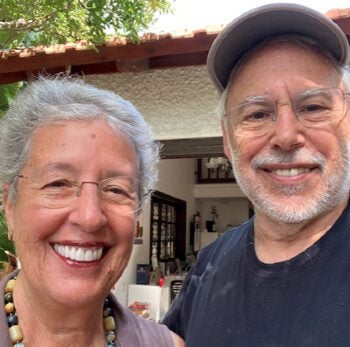
Since the onset of the COVID pandemic, former longtime Denver residents Dr. Susan and Bruce Heitler have made Israel their home. In their new residence in Ra’anana —20 km north of Tel Aviv — their neighborhood has just welcomed a Ukrainian refugee family.
The wife, Yanna, reports Susan Heitler, is Jewish, as is her three-year-old daughter. Both have no Jewish observance or knowledge. The husband, Stav, along with the husband’s mother, and his sister, are not Jewish.
“The refugees have been astounded at the kindness and generosity they have received from so many of us in our neighborhood,” says Susan. “The big-hearted woman who invited them to stay in her house also has helped the husband to find a full-time job, employment that will enable them shortly to rent their own apartment.
“Similar warm and generous welcomes for Ukrainian refugees have been happening throughout Israel,” Susan continues, “including for non-Jewish refugees who do not qualify for the usual benefits given to Jewish olim (newcomers).
“Both individual Israelis and the Israeli government have been assiduously trying to offer entry and support for as many Ukrainians as possible, keeping in mind at the same time the need to sustain the Jewish nature of the state.”
In early March, Israeli Interior Minister Ayelet Shaked estimated that 90% of the European refugees are not Jewish.
The complexity of the refugee issue is not a small one. The Israel Democracy Research Institute estimates that only 44% of all Israelis welcome supporting refugees regardless of religion.
“We are prepared and expect tens of thousands more new immigrants,” said Minister of Immigration and Absorption Pnina Temano Sheta on April 24, as reported by the Tazpit Press Service.
“Our Jewish experience during the Holocaust, when we were abandoned by the world, makes it important to be especially sensitive to Ukrainians who find themselves displaced from their homes through a brutal war,” says Dr. Herzl Melmed, chair of Denver’s pro-Israel advocacy group ActionIsrael and a former Israeli resident.
“Menachem Begin set an important precedent when he took in a boatload of Vietnamese refugees that no other country would accept. This was an exceptional action as the purpose of tiny Israel is the enormous task of being a refuge for all Jews.”
“We may ask how many non-Jewish refugees from Ukraine would choose to find refuge in Israel when they have the chance to remain in Europe. Those who seek refuge in Israel cannot be rejected out of hand.
“Israel will, however, need to decide on the limits within which she will accept non-Jewish refugees.”
The last portion of Melmed’s expression is an important disclaimer.
The complexity of the refugee issue is simple, according to Boaz Meir, director of Jewish National Fund Mountain States.
“First, we are not talking about an enormous quantity,” says Meir. “Second, they have not become citizens. Many of them would be interested in moving on, or going back to their homeland.
“Let’s do what’s right.”
Meir adds a historical perspective: “Jews were saved by gentiles throughout history. It was Abraham who welcomed three strangers and offered them shelter. We are lucky to be in a position to provide help.
“None of them is a danger to the Jewish state,” says Meir. “They are refugees. They ask for help. We should do what we can.”
Back in Ra’anana, the Heitlers — who were visiting their daughter in that town in 2020 and, due to abrupt and immediate travel restrictions between Israel and Denver, ended up staying in Israel and now enjoy dual Israeli-American citizenship. There is a palpable satisfaction in aiding a family displaced by Russian aggression.
“I feel great pride in the ability of the Jewish state and its citizens to think in terms of both opening the doors for at least some refugees whatever their religion,” Susan says, “and welcoming especially those who fulfill the mission of bringing Jews to the Jewish state.”
In at least this case, it doesn’t take a relative newcomer very long to appreciate the plight of another.
Less than two weeks ago, Temple Emanuel’s Rabbi Emily Hyatt was in Jaffa, Israel as a scholar in residence on a Jewish National Fund women’s philanthropy mission. There, Hyatt met a woman named Lena, who had fled Ukraine three weeks prior with her two children. Lena’s husband had to stay behind to fight for his country.
“They looked at each other,” Lena told Rabbi Hyatt, “and do not know when they are going to see each other again.”
Now back home in Denver, Hyatt reflects on meeting her new friend and the thousands of others fleeing to Israel. The rabbi believes Ukrainians should be admitted to Israel regardless of religion, and now tackles the question that follows: whether those refugees should be granted citizenship.
“I don’t think a Jewish state is defined by citizenship,” Hyatt says. “A Jewish state is defined by values. And if we’re working toward anything, it is actually living our Jewish values in the way that we live here or in Israel.
“It’s a system of values that teach us how to treat each other so that it turns out 4,000 years later, we still want to be together. It’s not an accident that we’re still here as a people; it’s a product of knowing what the work is that has to get done.
“If Israel is run by and guided by how one behaves according to those values, then the question of citizenship is an afterthought. It’s not an unimportant one, but whatever the rest of the questions are, we can figure them out.”
Steve Mark can be reached at steve@ijn.com.
Copyrigh © 2022 by the Intermountain Jewish News