
Most people hate asking other people for money.
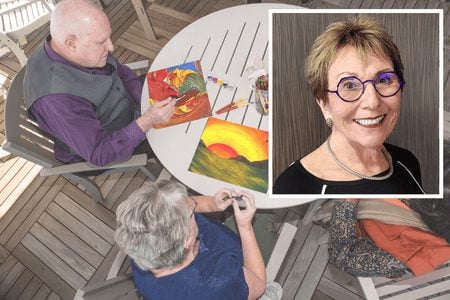
Not Gaile Weisbly Waldinger. The director of development for Kavod Senior Life has no problem asking people to — as she puts it — “invest in something that will make them proud and help other people.”
Because Waldinger’s enthusiasm for the community at Kavod Senior Life is so contagious, she has been successful.
“Enthusiasm” is perhaps the best descriptor for Gaile Weisbly Waldinger. Her big, upbeat personality is matched by her love of the Denver Jewish community and the desire to help others.
Both her upbeat demeanor and concern for the community come from Waldinger’s parents, the late David and Lillian Weisbly, who modeled compassion for others. Her father served on the board of Jewish Family Service and was active with that agency’s sheltered workshop. Both of her parents were involved with resettling Holocaust survivors in the years following WW II.
“The Jewish community has always been a part of my life,” Waldinger says.
The Weisblys were an established West Side family, but they moved to Denver’s East Side when Gaile was young. She started out at Cheltenham Elementary School, and then attended Hill Junior High after they moved. She graduated from George Washington High School.
From there, she earned a BA from the University of Houston and a master’s in gerontology from the University of Northern Colorado. She wanted to go into social work, but not generically; she wanted a specialized field within social work and gerontology made sense to her.
“This was the world of Ronald Reagan, and I thought this was such a cool idea because the country was starting to age — the baby boomers,” Waldinger recalls. The job market, however, did not concur.
Instead of finding a position in which she would use her gerontology background, Waldinger landed a job in workforce development with Jewish Family Service.
From there, Waldinger joined United Way as senior director of self-sufficiency, a position she held for 12 years.
“I was responsible for all of the United Way agencies that promoted safety net programs. It could have been anything, from homelessness and the rescue missions to helping with job development, to ensure that the community had the best services available.”
She is proud of the work she did at United Way with the Children’s Health Plan Plus program, which provided health insurance for children, largely of undocumented immigrants who were wary of participating in a government or social service program for fear of being deported.
Waldinger lobbied elected officials such as council members and county commissioners as well as leaders in the faith community and was instrumental in getting tens of thousands of children insured.
Waldinger[dropcap] was happily working at United Way in 2014 for 12 years when a business associate told her that Michael Klein, then-executive director (now president and CEO) of Kavod Senior Life was looking for a development director. The business associate told Klein to stop looking because she knew the perfect person for the position.
Waldinger sent Klein her resume at 10 a.m. one day and by 1 p.m. she had an interview. Shortly thereafter, she was the first director of development of Kavod Senior Life.
Kavod, which had recently been rebranded from its longtime identity as Allied Jewish Apartments, had never been a fundraising organization. Much of its funding came from the HUD subsidies for its low-income apartments, but now in a competitive environment, the time had come for Kavod to spread its wings and increase the scope of services and programming it needed to offer its residents. To do that, money from the Jewish community was needed.
“I saw Michael’s vision to change this place from a HUD apartment complex into a real community . . . and I was enchanted by the opportunity for the two of us to work together and make something happen that didn’t exist before,” said Waldinger.
“I didn’t have to walk into anyone’s shoes. Whatever I did, I looked like a genius, because no one had done it before!”
For that same reason, Waldinger had her work cut out for her. She needed to attract the attention and the fortune of community members, companies and foundations toward the work of Kavod, which was not so glamorous as other causes.
“When I first got here, we were the underbelly of the Jewish community. We weren’t fancy.
“Often people see aging as a drain, but there is so much talent here and so much history among the residents who live here and who have lived here, and they deserve to have quality of life. This is their home now, and they are still doing what they can to the best of their ability. It is our responsibility to maintain or increase their quality of life.”
Kavod has done that by providing a hundred programs each month to its 400 residents and to seniors in the community at-large through Kavod on the Road.
Kavod also provides healthcare services out of its wellness center on the top floor of its west building at 65 S. Adams St., in partnership with the UC Health gerontology department.
“Are we as fancy as [a high-end retirement community]? No. Do we provide services that are unmatched in this community? Absolutely!”
[dropcap]That is what Waldinger conveys when she meets with potential donors.
Waldinger doesn’t like “charity speak — ‘tired, poor, huddled masses.’
“I don’t even call it a solicitation. I’ll go out to lunch and find out what you’re interested in. If you’re interested in lifelong learning, we talk about that and our classes and other learning opportunities at Kavod.
“If you have the financial wherewithal to be helpful, I ask, ‘How can I help you invest in something that will make you proud of what you do and help other people? How is there a direct line of sight between your philanthropy and your interest, and the result of it?’
“I want a relationship between an individual’s philanthropy and what they see happens with it.”
When Waldinger came on board just over a decade ago, Kavod got into the annual event game. Not a fan of traditional sit-down fundraising dinners with speeches, Waldinger began to create events that were fun in and of themselves while shining the spotlight on the work of Kavod Senior Life.
On top of the credenza in Waldinger’s office are framed invitations to the annual events she has planned: food trucks, the Botanic Gardens, a brewery, the Forney Museum, the Sklar Brothers and even a drive-in movie night.
“First, I find the honoree. Then I try to find something that fits with who they are. And, I want it to be fun. I don’t do silent auctions. I don’t ask people for money. There’s never been an envelope on the table and I don’t have table captains. I keep the presentation down to 20 minutes to a half hour.”
Waldinger says she secures the financial support for the event and the proceeds thereof prior to the event. “I look to vendors, I look to community supporters, a variety of folks to sponsor the event. I do all of that in advance because when you come to the event, I want you to have a good time.”
Waldinger’s MO is working. More than $900,000 of Kavod’s budget comes from the fruits of her efforts.
She compares the financial structure at Kavod to a cake.
“The government, HUD, pays for the cake — the building, rent subsidies. My job is to provide the icing on the cake — the services and the programming.”
Gaile Weisbly Waldinger’s signature enthusiasm spills over to her life away from Kavod. She is an avid golfer and traveler.
“I love to play golf. My goal is to achieve mediocrity,” she quips. “And I’m almost there!
“I ride my bike; I swim and I walk every day. I have a dog, Maisie, and we try to get in at least three miles every day.
Her travels have taken her all over the world, often through Road Scholar, a travel group which curates educational experiences for people age 50 and over. She’s looking forward to a trip to Peru in March.
Her favorite trips, however, are those to see her twin sons Eric and Michael and their families.
Michael and his wife Allison are both attorneys living in Los Angeles. They met at Cardozo Law School in New York. They have two sons.
Eric, a business executive, and his wife Kate, an attorney, live in Chicago with their two sons, ages 13 and 17.
“Let’s just say I’m on an airplane about every eight weeks.”
Above all, Waldinger feels fortunate.
“I am a really lucky human. I have a wonderful family and I have a wonderful career. I feel like I’ve made a difference in the world. It feels like I’m making people’s lives better.
“Could I have done something in my life that would have been more financially lucrative? Yes, but it’s really nice to know that maybe my presence on earth is making a difference.”
© IJN 2025