
By Liza Schoenfein, The Forward
Considering its prosaic nature, the ordinary onion garners its share of poetic prose. Take this line from Mark Kurlansky’s ode to the allium, The Core of an Onion: “The onion is an extraordinary lily, certainly more talented than other lilies.”
Honeyed language indeed for a vegetable that will make you cry.
He continues: “Lilies generally do not know how to defend themselves. But if the bulb on an onion is attacked, it spits back with a ferocity unmatched by other plants.”
Perhaps Jews, as a people, find this quality relatable. Their affinity for onions goes way back — as does their penchant for a good kvetch. After G-d parted the Red Sea for them, the formerly enslaved Israelites, who had eaten onions in Egypt, couldn’t help but register a gripe about the new bill of fare — manna from Heaven.
“This was apparently an unenviable situation,” Kurlansky writes. The Hebrews complained to Moses that they missed garlic, leeks and onions, among other foodstuffs.
“They missed the whole onion family,” Kurlansky writes. “Moses was not pleased. If you free your people and give them food from G-d, you don’t expect them to complain, ‘But where’s the onions?’”
Onions have made it into all manner of Jewish victuals, including a notable variety of breads such as onion bagels, onion-and-poppy-flecked bialys and their predecessor, pletzel.
“In Bialystok these were called Bialystoken Tzibele Pletzel Kuchen, or Bialystock Onion Pletzel Cakes,” Joan Nathan writes in King Solomon’s Table. They later became bialys on the Lower East Side of New York.
There are Syrian stuffed onions called mechshi, Indian-Jewish stuffed onions called mahashais, onion kugels, eggs and onions, chopped liver enriched with caramelized onions, and soups and stews of every stripe embellished with that extraordinary lily.
“I don’t think there’s one Shabbat stew that doesn’t have onions,” cookbook author Adeena Sussman says.
“They’re essential in those long-cooked dishes because they bulk out the dish and add sweetness and caramelization. Think of the transformation of an onion from its raw form to its cooked form. It’s quite an evolution.”
The common round onion, allium cepa, is a perennial that farmers do not treat as such, because its bulb — which would otherwise remain in the ground to live another year — is picked before the plant has a chance to flower. To toughen the skin and make the vegetable long-lasting, it’s then cured in a warm, dry place. Then we eat it — though the cook is likely to suffer.
“The toxic spittle the vengeful onion sends into your eyes is low-molecular-weight substances with sulfur atoms,” Kurlansky explains. “The molecules dissolve into the water of the eyes and turn into sulfuric acid, a nasty little trick designed for defense.”
These compounds are unstable, which explains the alchemy that transforms the sharp flavor of the raw vegetable into something that sweetens as it sautés.
Sussman recalls that growing up, her mother’s go-to Sabbath chicken was baked on top of a big bed of onions.
“It was our Friday-night staple, the one my mother made almost weekly, but we never tired of it,” Sussman writes in Shabbat. She explains that her father and sister have somewhat different recollections of the dish. Perhaps there were carrots, or maybe celery.
“But I remember just onions,” Sussman writes, “and lots of them, which became schmaltzy as the chicken pieces roasted and released their juices right into the roasting pan.”
As in most Jewish cookbooks, onions show up everywhere in Shabbat.
“They’re so versatile, and because they’re shelf stable and inexpensive they’ve always been a staple in Jewish culture,” Sussman tells me.
“They can add a lot of sweetness, texture and body to a dish . . . in Ashkenazi cooking, where there was a limited spice palate, they were essential to the flavor of many dishes in raw and cooked forms.”
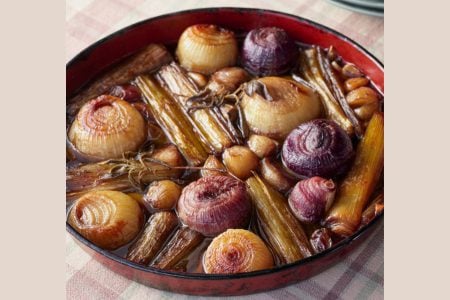
Perfect for Thanksgiving is her “allium extravaganza” recipe for Balsamic-Glazed Onions and Leeks, a combination that also includes shallots and garlic, all baked together until burnished and meltingly tender.
Tip: To avoid tears, try soaking the onions in ice water for 30 minutes before slicing.
Balsamic-Glazed Onions & Leeks
Ingredients
- 3 medium leeks
- 3-4 medium red onions
- 6 small-medium yellow onions
- 6-8 shallots
- 10-15 large garlic cloves
- 3-4 fresh sage oregano and/or thyme sprigs
- 1 1/2 cups vegetable broth
- 1/4 cup balsamic vinegar
- 1/4 cup olive oil, plus more for drizzling
- 2 Tbsp. pomegranate molasses, honey or maple syrup
- 1 tsp. kosher salt
- 1/2 tsp. freshly ground black pepper
Instructions
-
Preheat the oven to 425°F.
-
Bring a large pot of lightly salted water to a boil. Fill a large bowl halfway with ice, then add water to create an ice bath. Trim the root ends off the leeks as well as any tough dark green ends, then score them lengthwise halfway through with a paring knife; do not cut all the way through. Fan the leeks, rinse well with water, and cut into 3- or 4-inch lengths.
-
Peel the papery outer layers from the red and yellow onions, then trim 1/2 inch off both ends.
-
Place shallots in boiling water for 2 minutes; using a slotted spoon, remove them to the ice bath. Lower the onions into the boiling water for 5 minutes. Remove to ice bath; chill for 3 minutes.
-
Pop shallots out of their skins, and remove outer papery skins from the onions. With a paring knife, cut a 1-inch “x” into the bottoms of the onions. Stand the onions up in a 10- or 12-inch skillet or round baking dish, then wedge the leeks in and around the onions. Fit the shallots in (everything should be quite snug in the skillet, but if there’s a little space, that’s OK). Scatter the garlic and herb sprigs on top.
-
Whisk the remaining ingredients in a bowl. Pour it over the vegetables and drizzle more oil over the top. Seal tightly with foil and bake until the onions are tender and can very easily be pierced with a fork, 1 hour 30 minutes.
-
Uncover, reduce the heat to 400°F, and cook until everything is golden brown and the liquid in the pan thickens slightly, 35 to 40 minutes. Season with salt to taste, then serve the onions and leeks with their liquid.