
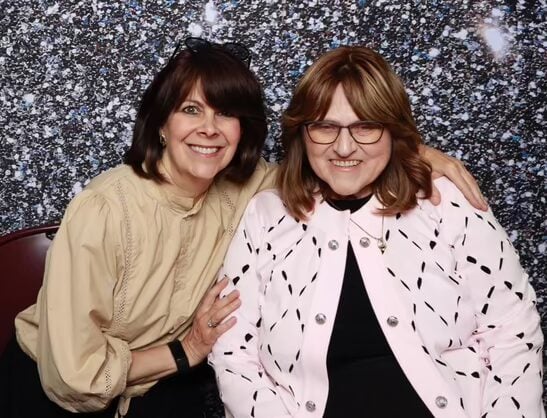
For 32 years, Esther Melamed has been the secular studies principal at Beth Jacob High School. That’s a lot of students she has seen and guided. Melamed estimates that over the years she has taught 800 to 900 graduates; a perfect background to bolster conversations about the 250th anniversary of the US and the future of America.
“They are more knowledgeable now about American Jewish history than in the past, not just Jewish history,” says Melamed, who has the unique perspective of talking to a multitude of students, past and present.
“Projects on this are much more important today than they used to be.”
While the internet is off limits during class, there is no shortage of awareness of world events, part of the curriculum Melamed takes pride in.
“I’ve been teaching history, Jewish history, world history, Holocaust studies and American government for college level credit. I definitely use a lot of current events in all my classes. I do this from the perspective of a Jewish person whose parents were both Holocaust survivors. My in-laws were both Holocaust survivors.
“I have a unique message in terms of current events and the current situation. I think that’s meaningful to our students. They care. They want to know the history so that they can apply it to their future and learn from it.”
‘We don’t necessarily vote for a party. We vote for the person’
From her perch at Beth Jacob, Melamed has noticed her students’ outlook of America’s future.
“In general, they are sheltered from seeing any of the worst of what’s going on, but they know what’s happening.
“I think they care deeply, deeply about anti-Semitism and they care deeply about Israel. Everyone here is impacted because every one of our families has family there.
“We don’t have internet access for them except under very limited conditions in school, and they’re not allowed to bring an iPhone. They can have a ‘kosher phone,’ which has no ability to tap into the internet.
“Some of our students are super-sheltered and others are more exposed. The gap is a little bit bigger than it used to be. Our kids are not on social media. I think to their benefit, they’re able to communicate more with each other, get together and have wholesome fun.”
Melamed’s mother-in-law, Irene Melamed, passed away three years ago. She left a special perspective that Esther has passed along to her students.
“She told my son that after 9-11, ‘The world will never be the same,’ and she was pretty anxious about it. But in general, she was a very positive person. She told my son, ‘I know that when Eisenhower, who was running for president, everyone was worried that the world was going to come to an end.’ And it didn’t.
“In America, you know, you vote every few years and new people come and she was optimistic that while the world may change somewhat, here in America she was going to be somewhat safe, as it was such a nurturing environment for them when they came here after the Holocaust.”
Melamed is asked whether current students express the need for a safe haven, given the trouble in the Middle East, and given that the current national discourse in the US can be inflammatory.
“I’m not hearing that from them,” says Melamed. “Most of them are going to Israel for a year of study. Everyone has a sibling or a relative of some sort in Israel, so it’s a big connection.
“We do a lot about voting, about going out to vote, about being knowledgeable, knowing about the lobbying community, knowing that Agudath Israel, Young Israel, Chabad have offices in Washington to help everyone know what’s going on, to be part of the process.
“In political science we spend a unit on getting involved and being active and being knowledgeable.
“We talk about the Jewish vote, and what is good for America, because if America is doing well, it will be easier and better for the Jews as well.
“I think that they respect, which is unusual, maybe, Mr. Trump, and they feel that he has been good to the Jews, even though they are aware that there’s really anti-Semitism on both sides.
“We don’t necessarily vote for a party. We vote for the person, we vote for the situation, and that they have to vote and be involved.
“One of the first things we do in class is a little genealogy thing, where you talk about where their families came from and what has happened to their families.
“We talk a lot about prejudice, about the use of propaganda, about being aware and about standing up for values and for what’s right. We talk about it openly.
“But I don’t see them yet extremely worried about the future, and I’m not hearing it from my staff.
“They really still seem to be pretty upbeat, in general.”
Personal connection
Melamed uses the word relevance when discussing her teaching methods.
“I personally have had some great teachers. So the messages I’m giving them and some of the values that I’m instilling are values that I got from great people.
“Some of them are authors and I love to read. I love to listen to podcasts and all kinds of history stuff.
“I always tell my teachers as well, it’s all about the relationship. The content is very important and you need to keep it relevant. But more important than that is to keep yourself relevant and have a relationship with the people around you.
“I think I have a good relationship with my students. They come to my house for study sessions, for tests — not just my own tests, but other people’s tests and finals. They call me. I come and help them with their papers. They have that kind of personal relationship.
“That personal connection and that relationship really helps them become more interested.
“We do a lot of projects, which is very different from years ago. It’s a lot more project-based learning.
“In my Jewish history class, we do projects where they work for a semester on showcasing their knowledge on a specific, important topic. And we showcase it to the whole school and sometimes to other schools. They learn a lot from those kinds of projects.
“We do a lot of debates, which maybe weren’t so popular in the past where they have a chance to look at issues from a variety of perspectives and look deeply at sources.
“Those are some of the changes, so classes are not so lecture-oriented. It’s more group oriented, with group projects and group presentations.
“A lot of our students do PowerPoint presentations or videos.
“Technology is much more part of our education, even though we are very careful with technology in our school. Nonetheless, they have more access to video clips that are based on primary sources. I certainly utilize some of that.
“They’re a little bit more wholesome and sheltered, and so maybe we’ve been able to protect them from some of the worst things that teenagers are exposed to.
“But they’re not 100% from being exposed. I remember my oldest daughter saying to me, ‘You’re so paranoid.’ I said, ‘It’s just my experience.’
“I was the kid who had stones thrown at her on the way to school and was called ‘the dirty Jew,’ so I was a lot more sensitive to that than my kids who grew up here and felt extremely secure.
“Now, I think even they are a little bit more worried, and a little bit concerned about the situation.”
Transylvania to Italy to Cleveland to Denver
In Esther Melamed’s case, 32 years can seem like a blip. Beth Jacob is in one of those inevitable periods that every school faces at some point.
“We have had a lot of teachers who have been with us for a long, long time,” Melamed says.
“We have very good longevity with our teachers, but more recently a couple of them have moved and retired, and these days it’s hard to find good teachers.
“This has been a summer of looking for teachers.”
Last year, Beth Jacob celebrated its 50th anniversary, spurring student reunions of all sorts.
“A lot of them keep in touch and a lot come to visit if they come to town,” says Melamed.
“A lot call, whether they are from different times, different years. I am in touch with a significant number of them.”
This includes Melamed’s first student.
“Chaya Meyer, with whom I worked for many years — she and I are colleagues, and she was my first student here in Denver.”
Now Mrs. Meyer is the school’s director of student activities and its learning specialist.
Melamed, who was born in Transylvania, a Hungarian-speaking region of Romania, is the mother of eight.
Esther and her family fled Romania when she was 10 years old, for religious reasons.
After a brief stay in Italy, the family emigrated in 1965 to Cleveland, Ohio, so Esther’s mother, Priva Berkowitz, a Holocaust survivor of Auschwitz, could be treated for the consequences of a stroke. Esther’s father, Yosef, was also a survivor of Auschwitz.
At the Hebrew Academy of Cleveland, Esther promptly learned English, the newest of her languages; she already knew Hungarian, Romanian, Italian, Yiddish and Hebrew!
The Melamed family moved to Denver in 1979 to work at Beth Jacob. In addition to teaching, she and her husband were also dorm parents for 14 years. As the years have passed, Esther has found added purpose, which has led to additional connections to the past.
You’ve heard of a full plate. Esther Melamed needs a second plate.
“I also do career counseling on the side, which I’ve done for many years for my students.
“Recently, someone had reached out to me. She’s already a grandmother and she wants to become a midwife. She asked if I would help her through the process.
“Some of my students keep in touch for that reason as well. They come because they’re changing careers or they want to do something different. When they come to town, they show me their children, who I’m so happy and delighted to see.”
As if that were not enough:
“I’ve started some very good programs for the school, college programs. We’re looking at doing a lot of grant writing, and building our technology department.
“We’re also working with girls who are coming from the former Soviet Union, setting up language and learning opportunities for them.”
Such is the new definition of a second plate.
Melamed turns 73 this month. According to government figures in 2024, the average retirement age in the US is 62, and trending younger.
Rabbi Shlomo Melamed, Esther’s husband, suffered a stroke nine years ago, and the devoted wife has ever-present items to attend to at home.
“I’m very enriched,” Melamed says. “I feel very blessed that I have this wonderful job, and that I’ve been able to spend my life in such a wonderful, wonderful place with such wonderful people. I’m a better person because of it.
“I still have energy and a lot of excitement. My students do keep me young.
“I’m grateful to be able to still have meaningful opportunities.”
© IJN 2026