
Steve Lipman, staff writer at the Jewish Week in New York, has led Passover seders in far-flung communities for Jews with minimal or no connection to Judaism since 2003.
Lipman, an observant Jew who led his first seder in Belgrade, Serbia for the Joint Distribution Committee, decided to volunteer his services to the overseas Passover project while writing an article for the paper.
“Almost 19 years ago I did a story on families and individuals leading seders overseas, mostly in former communist countries,” he says.
“I had known such a thing was possible, but I was so inspired by what I heard that I called my friend at the Joint and said I would do a seder every year.”
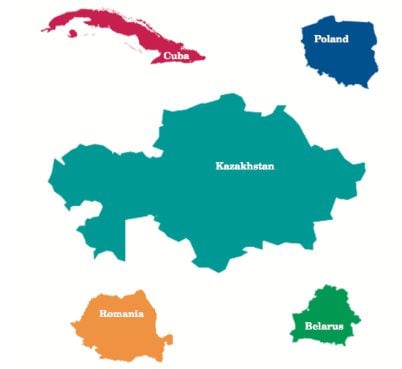
He’s conducted seders in Cuba, Belarus, Kazakhstan, Romania, Poland (seven times), rural New Hampshire, the College of William and Mary and the Norfolk Naval Base, both in Virginia, and for Orthodox friends in Passaic, NJ.
Lipman’s seders contain a plethora of rules that have little to do with Orthodoxy. Ideally, the first part of the seder, from Kiddush to the meal, is completed in an hour or less.
“Basically I do an hour and 10 minutes; sometimes an hour and 20,” he says. “But no one ever complains or looks at his watch because I make it fun. I make it engaging.”
Lipman, 68, says his basic model combines education, theatrics and logistics. “I’m very theatrical. I summarize. I paraphrase. I do shtick.
“And there’s virtually no reading of the Haggadah.”
No what?
“I’ve asked a lot of rabbis and this is what they’ve told me verbatim: You do not have to read every word. You cover the main points. So I’ll paraphrase; clarify the meaning.”
Lipman says the most boring fixture of a seder “is the proverbial going around table” — his voice slows to a laborious crawl — “with everyone reading the Haggadah but not explaining it.”
For him, this 45-60 beat per minute of the verbal metronome is fatal to the narrative’s seminal impact and significance, especially for the groups he addresses.
“‘Haggadah’ means the telling, not reading. You just tell the story.”
Lipman does not impose his level of observance on participants because he’s not there in an even remotely rabbinical capacity.
“I’m their guest,” he says. “I can’t tell people what to do. People are taking pictures, they’re texting and using other electronic gadgets. Even though I’m aware of this, it’s not my place to say anything.
“These people are not observant or Orthodox, so for me to tell them they shouldn’t do something is nonsense. I might prefer that they abstain from certain things, but it’s not up to me in this situation.”
Lipman, who will not visit communities more than once, avoids urban centers because his intention is reaching as many isolated Jews as possible.
“I go to former communist countries where people don’t know how to do the seder or have never experienced a seder, even at home,” he says. “I want to go to places that nobody else visits so they don’t feel forgotten.”
Imagine yourself about to enter a second-floor hall on a spring evening in Poland or Belarus. Everyone is a friend or neighbor, except the man handing out tickets at the door.
“I give people tickets for the Exodus trip in their native language,” says Lipman, who brings an assemblage of props. “Each one says, ‘Camel Express from Goshen to the Jordan Crossing,’ with every stop along the way.”
After a brief introduction, he asks what they would need for a journey from slavery to freedom or a trip overseas. Passports? OK. Visas? Perfect.
Lipman distributes visa applications for the Sinai wilderness requiring name, date, reason for leaving, means of travel (donkeys, etc.) and additional information.
They also receive a small version of the Tefillat Haderech ( prayer for travelers) and bracelets and necklaces in the ancient Egyptian style. One side uses hieroglyphics, and the other is in Hebrew.
Participants march around wearing the bracelets, which they remove once inside “Israel” and replace with Israeli jewelry.
“I put myself in their shoes,” he says of actualizing the imagery of travel for village-bound Jews.
Lipman says that children, not adults, are his target audience.
“I gear this toward young people,” he says.
“I always tell people that the only ones you should really care about at the seder are the kids. They are the only part of it.
“My theory is that if the kids enjoy it, the adults are happy.
“I know it sounds radical, but it works.”
Considering the harsh light of their past, do the Jews he encounters at these seders epitomize the Passover?
“Most of these people grew up under Nazism, communism, or heard stories about these periods,” he says. “They can relate to slavery. It’s not like in America, where we’re in gulat — exiled, but free.
“The Jews I meet at the seders know what it’s like, or can imagine what it’s like.
“They understand [slavery] a lot better than Jews in the US.”
He says that William and Mary College and the naval base in Norfolk, were “actual sites of slavery, built by slaves. People grew up hearing the stories, so that was my focus. I personalize each seder to the place.”
Asked what a seder should not resemble, Lipman’s typical candor affixes a dose of dry humor.
“The point is you don’t go there and read a bunch of words,” he says. “You’ve got to feel like you’re in the middle of the exodus, not just reading in anticipation of some pot roast.”
Born in Buffalo, NY, Lipman was not raised in an Orthodox household — actually, quite the opposite. His father came from an assimilated German Jewish family.
“Since my father had no Jewish background, I led seders in our home from the time I was a kid,” he says.
His mother grew up in an Orthodox household but abandoned the practice in adulthood.
About 35 years ago, Lipman became a ba’al teshuva, Torah observant Jew.
“I was living in Buffalo and had some Protestant friends who were very devout in their faith,” he says.
“I went to Hebrew school and had the whole typically boring Bar Mitzvah. But I decided I wanted to become more observant in my own faith.
“I read the Bible and it made sense.”
Lipman earned his undergraduate degree at the State University of Buffalo and an MA in journalism from Ball State University in Muncie, Ind.
After graduating in 1973, he worked for a year and a half at a weekly newspaper in Buffalo.
“I walked in one Friday and was told they no longer wanted me.”
Lipman became editor of the local Jewish newspaper until December, 1983, when he joined the Jewish Week.
Divorced after 25 years of marriage, he found himself contentedly untethered in New York.
“I was free to go wherever I wanted — including overseas to lead seders,” he says. “No one was waiting for me at home.”
Right now, Lipman (who had no firm Passover plans at press time) is at loose ends.
“It’s frustrating,” he says. “I’ve been trying to find a homeless shelter, displaced women’s shelter or maybe a communal center for immigrants. I would love to do that.
“If I have to, I’ll go to one of my friends for Passover — but that isn’t my first choice.”
Lipman would invariably ask people who invited him for Passover in New York about their seder’s estimated running time.
“If they said anything longer than midnight, I’d say no thank you. I don’t have the patience for that.”
Lipman, who’s in the process of writing a Haggadah leader’s guide tentatively titled A Bite of the Seder, says that each element must be brief in order to sustain attention.
“This is not the time for a long, boring d’var Torah,” he says. “I recommend bite-sized, quick little things — anything you can say in a minute or so.
“No one wants to hear you droning on and on.”
Lipman adds that his innovative seder technique is not solely for backcountry dwellers unacquainted with Judaism but “also for Jews who really know their stuff.
“I did the same seder I led in Poland at the home of my Orthodox friends, whose children all attended Jewish day school. And they loved it.”
Compared to the much-anticipated first night seder — typically the brightest star in the Passover firmament — the second night too often feels perfunctory and tedious.
For Lipman, the fault lies not in the retelling but its mode of transmission.
“The second night should not be like the first night,” he says. “I have a script at my seders. But I use an entirely different script the second night.
“I never duplicate.”
Lipman warns that seder duplication is the biggest challenge in the diaspora.
“Maybe you can make first night creative. But if you do it the same way the next night? ‘Hey, we’ve heard it all before!’ ”
He recommends a thoughtful search for novel elements that ramp up the interest level, beginning with new faces at the Passover table.
“Having the same people every year is like recirculating stale air in an airplane,” he says. “It’s not going to get any better.
“You always want to introduce at least one new perspective.”
Despite intentional dissimilarities between first and second seders, their mutual success depends upon participatory engagement, narrative immersion, fun detours and equal billing.
For example, the leader of the seder — head of the family, rabbinical sibling or a close friend — must be willing to allow fresh voices and ideas.
“Ask ahead if you can bring your own suggestions,” Lipman says.
“But if someone insists on total control of the seder, it’s not worth going.”
Any child or teen who shows up armed with 10 readings from day school should be restricted to three.
“You can’t read every single thing,” he says.
“That’s why these seders go on forever. You’ve got to tell them, ‘Pick three, at the most.’
“If you’re not in control of what’s going on, you’re going to lose it — and lose people’s attention as well.”
To put a Dickensian spin on it, the celebration of the Hebrews’ exodus from Egypt comes but once a year.
Get your visas, minimize the verbosity, plunge into an old story made new and forget the pot roast.
It will keep.
Andrea Jacobs may be reached at andrea@ijn.com
Copyright © 2019 by the Intermountain Jewish News