
By Deborah Danan
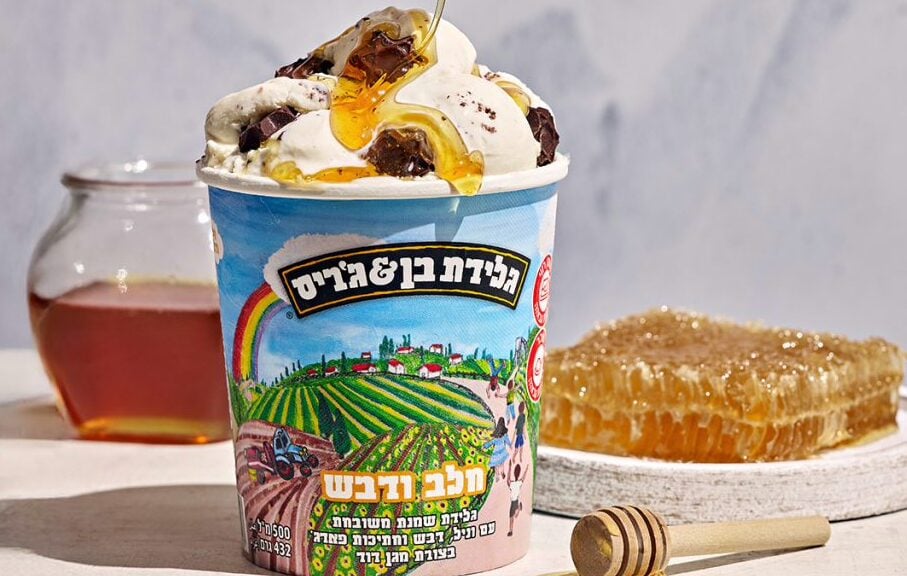
Ben & Jerry’s independent Israel operation has come up with a flavor that does not leave much to interpretation. Called “Milk and Honey,” the biblical description of the Land of Israel, its ingredients are supplied by Israeli cows and bees and its chocolate fudge pieces come shaped like Stars of David.
The company, which split from its American counterpart in 2021 after it refused to boycott Israel, is billing the new pint as its “most Israeli flavor ever.”
On its website, the flavor is a “symbol of hope, rehabilitation and positive action” after the Hamas-led Oct. 7 attack.
Its ingredients and production come from southern Israeli communities most affected by the massacre.
The company, based in Kiryat Malachi, said it “felt a responsibility to take an active part in the region’s recovery process.”
The milk and cream come from the dairy in Kibbutz Alumim, one of the Gaza-border communities infiltrated by Hamas terrorists on Oct. 7, 2023
The honey comes from the beehives of Kibbutz Yad Mordechai.
The chocolate Stars of David are made by hand at the Korint factory in Beersheba, part of the Shkulo Tov social enterprise, which helps integrate people with disabilities into the workforce.
Even the wrapper is local: the pint is adorned with “Fields of Light,” a painting by Rivi Doron-Gerloy, a southern Israeli artist who was killed in a Miami car accident last year.
Royalties from sales of the new flavor will go to rehabilitation and educational initiatives in the south.
The Israeli and American Ben & Jerry’s operations are now completely separate, a split that followed one of the more improbable diplomatic dramas ever to involve ice cream.
In 2021, the American Ben & Jerry’s said it would stop selling in Israeli settlements in the West Bank, saying sales there were “inconsistent” with its values.
President Isaac Herzog called the boycott a “new kind of terrorism.”
Benjamin Netanyahu, then opposition leader, retweeted the company’s announcement that it would stop selling in the “Occupied Palestinian Territories,” writing, “Now we Israelis know which ice cream NOT to buy.”
The original founders, Ben Cohen and Jerry Greenfield, who no longer control the company, came under fire for the decision. In an interview, they were asked why the boycott logic did not extend to places such as Georgia and Texas, despite their opposition to those states’ voting rights and abortion laws.
“Why do you still sell ice cream in Georgia? Texas?” Axios reporter Alexi McCammond asked in a video that went viral on pro-Israel platforms.
Clearly stumped, Cohen shrugged his shoulders. “I don’t know,” he said, laughing. “You ask a really good question and I think I’d have to sit down and think about it for a bit.”
Unilever’s then-chief executive, Alan Jope, said, “There is plenty for Ben & Jerry’s to get their teeth into in their social justice mission without straying into geopolitics.”
The standoff ended when Unilever, Ben & Jerry’s parent company, sold the Israeli business in 2022 to Avi Zinger, the longtime Israeli licensee and owner of American Quality Products.
Ben & Jerry’s could continue to be sold throughout Israel and the West Bank, under Hebrew and Arabic branding, while the Vermont-based company said it disagreed with the move and would no longer profit from Israeli sales.
Does the new flavor deliver a taste of the Holy Land?
One food influencer, who called the new flavor a “statement,” offered a less scriptural verdict on the taste, shrugging that it “tastes like vanilla with chocolate chips” — a conclusion echoed by others in Israeli food aficionado groups.