
For decades, here’s what it meant to become a Bar or Bat Mitzvah for many American Jews:
• Around age 10, start attending after-school Hebrew school, often under duress, to learn the Hebrew alphabet and reading and to learn basic prayers.
• Parent: Reserve a date for the Bar or Bat Mitzvah with the synagogue, shooting for the first Shabbat after a boy’s 13th birthday and a girl’s 12th or 13th (in non-Orthodox circles in recent decades) birthday.
• Nine months to a year before the “big day,” start working with a tutor to learn the Torah portion or Haftarah to be read at the Bar Mitzvah.
• Closer in, perfect prayer-leading skills and meet with the rabbi to work on the d’var Torah or speech.
• Practice, practice, practice. And parents, nag, nag, nag.
• Feel overwhelming pride — and relief — on the big day as you demonstrate your Hebrew skills and share your insight in front of beaming family and friends. Then, celebrate!
• Continue — or don’t continue — formal Jewish education and involvement in synagogue life.
Fast forward to the 2000s, when Jewish educators, synagogues and outreach organizations have realized there might be a better way to help these preteens enter Jewish adulthood with positive feelings about Judaism and the drive to live as Jews for the rest of their lives.
Several area synagogues and outreach organizations have pre-Bar and Bat Mitzvah programs that combine some traditional learning with fun experiential activities along with deep discussions and some individualized instruction.
These two-year programs are for sixth- and seventh graders who go through the process, often creating new social circles that can help propel them into their teenage years with Jewish friends and a sense of community.
Many of the participants are those who have not had a great deal of Jewish education or engagement.
Ignite Bnei Mitzvah for Life ~ Aish of the Rockies
Aish of the Rockies’ Ignite program works to give Bar and Bat Mitzvah-age preteens pride in being Jewish through experiential learning.
“We offer more than the traditional lessons, which can often leave B’nai Mitzvah disinterested or unengaged,” says Ignite’s director Rabbi Yisrael Kellner.
Ignite is a 10-month program, with a schedule corresponding to the school year during which a child becomes Bar or Bat Mitzvah. The kids are primarily public-school students. Many of them have their Bar or Bat Mitzvahs at Aish of the Rockies.
The students have mentors. Rabbi Kellner is the mentor for the boys, and Shoshana Ort, who is the founder of the Ignite program, is the mentor for the girls. Shifra Jacobs is also a mentor and trip coordinator.
Each annual cohort, usually consisting of 10 to 12 students, goes on monthly Sunday trips or outings. This past year, they visited the Stock Show; UrbanAir; Edge Ziplines; went on a hayride, followed by glow-in-the-dark fun in the evening, and received a VIP tour of the now-defunct SeaQuest Aquarium in Littleton, where they got to swim with the sharks.
This part of the program is all about having fun with other Jewish kids, Rabbi Kellner says.
Between the fun trips, there are one-on-sessions between students and their mentors. The kids discuss what it means to be a Jewish man or woman.
For the most part, the kids will have learned Hebrew and prayers in other religious school settings, and are being trained for their Bar or Bat Mitzvahs by outside tutors. If not, the mentors provide the training.
The program provides the students with a Shabbat experience. The boys participate in “shopping for Shabbat,” in which they get a tour of King Soopers’ kosher merchandise and learn to shop for Shabbat meals. The girls learn to make challah.
The activities of the year culminate in a trip to Los Angeles, where the students observe life in a larger Jewish community, and participate in tzedakah activities.
In LA, the students learn valuable lessons in helping others, says Rabbi Kellner. During this past spring’s trip, the cohort held a bowl-a-thon and ran a lemonade stand to raise money for Chai Lifeline, a national organization with a regional office in LA, that supports children with life-threatening diseases.
The Denver students raised nearly $2,000, which they presented at the Chai Lifeline office.
The kids also volunteered, making more than 200 meals for local Jewish families.
Fun activities on the trip included the beaches, amusement parks and a Colorado Rockies game at Dodgers Stadium. “We were the only Rockies fans there!” says Rabbi Kellner.
The kids stayed at a large home owned by an older Jewish couple in LA. “The kids got to be recipients of Jewish hospitality, which was an amazing thing to learn. They came back feeling more connected and realizing how Jews are connected and how much they do for one another.”
According to Rabbi Kellner, the Ignite program is less about the Bar or Bat Mitzvah day itself and more about going forward in life as a Jew.
“It’s really beyond the Bar Mitzvah or Bat Mitzvah. It’s trying to help them understand how amazing it is to be a Jew, and what they’re part of and what it’s all about.”
Open Tent Be Mitzvah ~ Judaism Your Way
Judaism Your Way is an outreach organization that welcomes diversity in background and personal approaches to Judaism — definitely no “one size fits all” approach here.

Often, people who avail themselves of Judaism Your Way’s programs and services have not been involved Jewishly and are seeking ways to “do Jewish” in ways that are meaningful to them.
That is what Open Tent Be Mitzvah is all about, starting with the name.
“We use ‘Be Mitzvah’ for a couple of reasons. Obviously, ‘bar’ and ‘bat’ are gendered terms. Using the same term for everybody levels the playing field,” says the program’s director Rabbi Amanda Schwartz. “However, if we have students who want to call it their Bar Mitzvah or Bat Mitzvah, great, they can do that.”
“We spell it ‘Be’ because we say this is a time when our students have the opportunity to think about how they want to be in the world.”
Rabbi Schwartz says there are different ways people can participate in Open Tetn Be Mitzvah. The majority of the students participate in a two-year cohort program. The earliest they can participate is sixth grade.
“The first year is very hands on, basically an introduction to Judaism class. “It’s like, ‘Here’s a buffet of how you might do Jewish, what speaks to you.’”
Most of the students have never had any Jewish education, although there have been a few Jewish day school students in the classes. “A few years ago, I had a student who had never heard the word ‘challah’ before. It’s a wide variety,” says Rabbi Schwartz.
“Many of our students are the ones choosing this. It’s not being animated by their parents. If the students hadn’t come to the parents and said, ‘I want to do this,’ they wouldn’t be getting any type of Jewish education.
“Many of them find out about us because they’ve gone to a friend’s Be Mitzvah, and they’ve been like, ‘Oh wow, that was cool. I wanna do that.”
Rabbi Schwartz says the first year of the program is focused on “exploration and meaning-making,” as opposed to skill acquisition.
During the second year, the students are still in a cohort, and they design their own ceremony. They learn about a different prayer each week and choose how they will lead it in their ceremonies. Each student designs an individualized siddur
“We don’t have an assumption that the students are learning Hebrew. They are working with a tutor for that. Otherwise, our students are working off of transliterations and recordings that we provide, or astudent could choose to do the entire service in English, although I’ve never had that happen.
“Teaching someone Hebrew is very time consuming. Our emphasis, if you have a limited amount of time, is to focus on personal exploration and meaning-making.”
Rabbi Schwartz says reading from or focusing on the Torah is optional. “I say to my students, ‘If you imagine a mountain, the prayer service is like going up and down the mountain and the top is the Torah service. That might mean reading from the Torah or giving a d’var Torah, or leading a discussion about Torah study.”
Many of the students, instead of focusing on Torah, take on a set number of challenges over the course of the year, and talk about what they’ve learned about themselves through those challenges.
“We’ve had students who have done a research project and presented on that.”
Rabbi Schwartz is currently working with a student who is exploring the topic, “how is Judaism noble.” The student is conducting a research project, will write a report and share her findings and conclusions in her ceremony.
Another student, Tali, an artist, researched the subject of Jewish art. Rabbi Schwartz connected her with Denver-based ketubah artist Risa Aqua, whom she interviewed and learned from. Tali embraced her Jewish identity as a Jewish artist and created seven pieces of art which she presented and discussed at her Be Mitzvah ceremony.
Every Open Tent Be Mitzvah ceremony looks different, Rabbi Schwartz says, but “they all look like a service. Some of them are done while hiking, but they also have a siddur.
“Most of our families have zero relationship to a routine prayer practice, but even these families feel like the Be Mitzvah should be something related to prayer.”
Rabbi Schwartz is pleased that the program has led to sustained Jewish involvement by many students.
“We have had huge success in terms of students wanting to participate in leadership roles in our High Holiday services, or even years later.
“They talk about their Be Mitzvah experience as a highlight of their upbringing.”
BMX ~ Chabad Jewish Centerof South Metro Denver
Classes and discussions coupled with outings and experiential learning are key components of Bar/Bat Mitzvah eXperience — BMX — at Chabad Jewish Center of South Metro Denver.
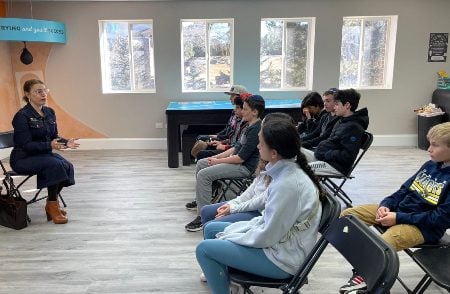
The program is led by the center’s youth director Rabbi Meir Simon, and normally takes place during normal Hebrew school hours on Sunday, at the center’s Greenwood Village.
Rabbi Simon’s Sunday morning lessons are not about Jewish symbols and rituals, but deep dives into such topics as the soul, what it means to be Jewish and facing anti-Semitism.
“One of the curriculums that I love to teach is the differences between Jewish Torah and mitzvahs and American law. American law is filled with rights and Judaism is filled with obligations.
“It’s much more of a mature and deeper curriculum compared to what is taught in the younger grades.”
The classes are supplemented with guest speakers. A perennial favorite is State Sen. Dafna Michaelson Jenet who speaks about being a Jewish politician, representing Judaism and Israel in state politics.
Israeli soldiers, usually American lone soldiers, also speak to the BMX classes.
This past year, they heard from soldiers who have fought in Israel post-Oct. 7.
To keep things fun, there are field trips, which often include experiential learning. “We go to the East Side Kosher Deli, go inside the kitchen and learn what it means to be kosher. We get a tour of the meat and dairy kitchens and the kosher substitutes for non-kosher ingredients.”
The class goes to Babi Yar Park to learn about that massacre of Jews and others by Nazis during WW II. Last year they went on the actual anniversary of the massacre in September.
The kids visit the elders at Shalom Park, hear their stories and do art projects with them. “The kids love it,” says Rabbi Simon.
The curriculum is highlighted with Shabbatons and out-of-town trips.
While having all this fun, the students are preparing for their Bar and Bat Mitzvahs.
“On the most basic level is Hebrew reading,” says Rabbi Simon, “like a classic Hebrew school.”
That includes general Hebrew reading and working on the specific prayers which will vary depending on what kind of service — Shabbat morning, Mincha or Havdalah — the kids will lead for their Bar or Bat Mitzvah.
The big day is preceded by six months of one-on-one meetings with Rabbi Simon and students, geared to their actual ceremonies.
To Rabbi Simon, one of the most important parts of Bar or Bat Mitzvah preparation is to learn what it actually means.
“Most Americans say the word mitzvah means a ‘good deed,’ but that’s not a good translation,” he says. “It is important to know what is means to become a Jewish adult, and not just recite Hebrew words by heart.”
An important side benefit of BMX for the students, according to Rabbi Simon, is the bonding that takes place between the members of the cohort.
“The most rewarding feeling is when I see two kids that live in different neighborhoods get out of the same car because they had a sleepover the night before. They might live 15 minutes away from each other. This is not a five-day-a-week Jewish day school. This is one day a week, and they’re able to develop relationships and make friends. That’s incredible.”
The Bar/Bat Mitzvah Experience ~ The Jewish Experience
The first “branded” Bar or Bat Mitzvah program in Denver seems to be the one in 2010 at The Jewish Experience. Then-women’s coordinator Eve Levy initiated the Bat Mitzvah Experience. She taught preteen girls what it means to be a Bat Mitzvah and how to perform many of the rituals associated with adult Jewish women.
The girls met as a cohort and celebrated with a banquet in their honor at the end of the program, while they each celebrated their own Bat Mitzvahs in their family’s synagogues.
Soon, a parallel Bar Mitzvah Experience for boys was added.
The Bar/Bat Mitzvah Experience at The Jewish Experience is led today by Rabbi Samuel and Gila Ross.
The Bar/Bat Mitzvah Experience cohort of sixth and seventh graders meets weekly in conjunction with the Sunday Experience, the religious and Hebrew school program of The Jewish Experience.
Most of the students are not Jewish day school student. They may have their individual ceremonies at The Jewish Experience or their own synagogues.
The Sunday Experience Hebrew instruction program emphasizes individual instruction rather than classes because everyone learns to read Hebrew at a different pace. That continues as the students approach their Bar or Bat Mitzvahs.
In addition to traditional learning, the Bar and Bat Mitzvah students go on field trips. Last Chanukah, they went to Krispy Kreme where they saw kosher doughnuts being made. They also visited different kinds of synagogue in the Denver area.
As Rabbi and Mrs. Ross are new in their positions — they’ve been in Denver less than a year — they are gradually adding their own touches to the program that Eve Levy created nearly 15 years ago.
Gila Ross’ aim is to empower Bat Mitzvah girls to become strong Jewish women in today’s world. Part of that involves observing role models.
She is adding a mother-daughter element to the Bat Mitzvah Experience, which she says will be a “great opportunity for parents and children to bond in a Jewish way. At that age, that’s not always easy.
“A big focus of our Bar and Bat Mitzvah program is that we want these kids to feel comfortable in the Jewish community because they are heading into high school, and then into college, and that’s usually when Jewish engagement tapers off. It gets challenged.
“We want to give them the most that we can at that age so the skills and excitement will continue.”
Several other congregations in Denver offer Bar and Bat Mitzvah programs. Among them: B’nai Havurah: “My Mitzvah,” led by Risa and Hal Aqua; Temple Emanuel, B’nai Mitzvah program, directed and designed by Cantor Elizabeth Sacks and Cantoral Soloist-Music Director Steve Brodsky; and Hebrew Educational Alliance: Mensch Academy, directed by Assistant Education Director and B’nai Mitzvah Coordinator Jennifer Zucker.
© IJN 2024