
Meeting Alan Golin Gass is like a journey through the 20th century and beyond. Sitting down with him in his mid-century landmarked home — which he designed— brings the journey to life. The renowned Denver architect grew up in Denver’s Jewish community, studied at Harvard and had a decades-long career that spanned New York and Denver, included founding his own firm and even working with IM Pei.

Gass’ East Denver home is recognized by the Denver City Council for its historical value, but it was avant garde at the time it was built. In fact, Gass would not have been permitted to build his home if it were sited just across the street.
“The Green Bowers subdivision had architectural regulations and this side of the street didn’t. So I was very fortunate to get this site.” It was part of his (successful!) plan to woo his future wife, Pueblan Sally Speken. The couple were married for just under 60 years until Sally passed away in 2020.
Gass jokes that Sally wasn’t a visual person — but that didn’t mean she wasn’t artistic. A musician and dramatist, Sally trained as a teacher which later parlayed into teaching music at Denver Public Schools.
“She had immense talent,” reminisces Gass, “and a voice, too.” Her first job was at Stephen Knight — what would become the Gass’ neighborhood school when their bespoke home was completed. “She was assigned there the year before we got married. Somebody had a plan,” says Gass with his inimitable twinkle.
When a music teacher resigned, Sally was asked to take over, even though she protested that her degree wasn’t in music education. Long story short, over the course of her career, Sally created a music curriculum for DPS and later one for deaf students. Along the way she also earned a master’s in music education from CU Boulder, taught drama at DPS and was part of its integrated arts team, which helps classroom teachers teach the general subjects using music, art, drama and dance.
“Every time she got a new assignment in the Denver Public Schools, it was something she was unprepared for.”
An East High graduate, Gass first had his eyes set on studying chemistry.
His foray into architecture came through a serendipitous moment. At that time, the renowned German Bauhaus architect was lecturing at Harvard, having escaped Nazi Germany for the UK where he lived for a few years before coming to North America.
Walking through the halls at Harvard, where Walter Gropius was head of the Dept. of Architecture, Gass “bungled” his way into a “jury Gropius was having with his students.” Gass had no idea who Gropius was.
“I saw these projects that the students were doing that just knocked me out,” he recalls. It took about a month for him to change his concentration.
Stepping into that room changed Gass’ life course. In Denver at that time, there was very little modern architecture. Gass was enthralled by what he saw. Quite simply, “I’d never seen anything like it before.”
The homes in Denver today that are thought of as classic — Tudors for example — were “conventional” when Gass was growing up.
It turned out Gass and Gropius had something in common, tangential though it was. A fellow Harvard friend who was also planning to go into architecture invited Gass to Gropius’ introductory lecture of his first-year design course (open only to graduate students and honors seniors). Gropius starts telling the class that he is on the committee to select the site for the Air Force Academy. In Gass’ telling, Gropius describes his trip to Colorado Springs, traveling there from Denver on “the most ghastly street I’ve ever seen.”
As a Denverite — with roots in the Colorado Springs Jewish community — Gass knew exactly the road Gropius was referring to: Santa Fe, a street only a few of his fellow Harvardians would have known.
Not that Gass was the only Coloradan, or even Jewish Coloradan, who was at Harvard. Three other kids from his class at East were also in attendance.
As a multi-generational Coloradan, Gass’ Colorado bona fides are the real deal.
His maternal grandparents, who met and married in Brooklyn, found their way to Sugar City, Colorado following a “brother-in-law with itchy feet.”
Later, his grandparents settled in Colorado City (today called Old Colorado City in Colorado Springs), opening a shop there.
“It was a small Jewish neighborhood,” Gass says.
Among his family’s items held at the Beck Archives (Gass’ architecture-related papers are at Denver Public Library) is a picture of a religious school class in Colorado Springs that included his mother and aunts. In 1920, the family moved to Denver, in large part, Gass says, because his grandfather had three daughters who’d finished high school. He was looking for prospective grooms.
On Gass’ father’s side, the family emigrated from Brest-Litovsk (Brisk) in the 1880s. They settled in Lakewood Gulch, or “Under the Viaduct” as the neighborhood was known, attending the “Little Shul on the River,” on the banks of the Platte.
His grandfather was part of the Atwood colony — an equally unsuccessful but lesser known housing attempt similar to the failed Cotopaxi colony. Like the one in southern Colorado, Atwood promised Russian Jewish immigrants arable land that it didn’t deliver.
As a married man, Gass’ grandfather found his way to Platteville around the turn of the last century where he ran a store in a building he’d built that had a dance hall on the second level. Gass’ grandparents returned to Denver when their daughter was ready for marriage and settled in Congress Park. Being the architect that he is, Gass specifies it was a Denver Square, which CU Boulder architecture professor Amir Ameri describes as having “four sides with a hallway running through the center and veranda in the front with a centrally placed door.”
Gass contends that during the Platteville years his grandparents lost their contact with Judaism. When they returned to Denver, they became members of Temple Emanuel even though they had been raised Orthodox. Nevertheless, he does have religious items from them, including talleisim and prayer books — and his grandparents’ ketubah, written in beautiful Hebrew calligraphy on a Big Chief yellow notepad.
Denver has gone through many transformations — and Gass was working for IM Pei when the now internationally renowned Chinese-American architect was designing Denver landmarks — some of which, to Gass’ consternation, no longer stand.
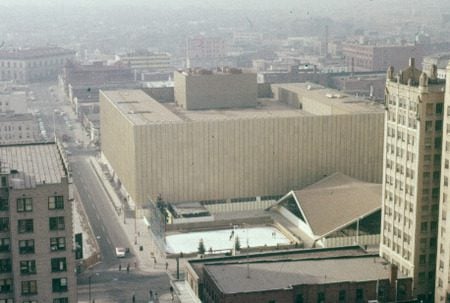
The most famous — and most mourned among architects and preservationists — was the hyperbolic paraboloid at the entrance to the downtown May D&F department store on Zeckendorff Square. The entire square was designed by Pei, whose career was in its ascendancy during his Denver tenure.
Although Gass wasn’t part of that particular design team, he was in the office when it was built — and in the 1990s gave testimony to City Council to try to save it. To no avail. Denver City Council and Mayor Wellington Webb did not agree with the architects and historians who saw the paraboloid’s value, and Denver Urban Renewal Authority approved its razing to make way for an expansion of the Adam’s Mark Hotel (today the Sheraton Downtown). Hotel space was needed for the Convention Center and the city needed the money that project would bring in, according to Gass. The city’s multi-million tax breaks for the hotel redevelopment project made the pill even more bitter to swallow for those devastated to see the mid-century icon razed.
As an architect with decades under his belt, Gass is somewhat accustomed to seeing buildings come and go, even ones he has designed and built. Such as the World Savings Building at Tremont and 16th, his “first significant building in Denver. You get used to it,” he says, but not without mentioning the waste of tearing down and rebuilding — both financially and environmentally.
According to environmental organizations, including the UN’s Environmental Program, the construction industry has an outsized impact on climate change, accounting, by some estimates, for up to 40% of greenhouse gas emissions, not to mention “the millions it takes to build and the millions it takes to tear it down.”
Perhaps that’s why Gass became a champion for preservation.
“We’ve become environmentalists,” he says of preservationists, “because we have to be. When we look at an existing building that’s slated for demolition, we look at it with different eyes. What are the attributes of this building that are positive? Can it be saved? Should it be saved? If it can be saved, how can you use it? Reuse it? How can you modify it?
“There’s a certain kind of creativity that comes with that too. It’s all the same discipline. It’s all building.”
Gass says there’s no particular building going up in Denver right now that has him excited. “I’ve lived here for so long and seen all of these evolutions,” he says pragmatically.
“War does things to cities, too,” he says. Some cities rebuild quickly without a plan, such as London; others, like Paris, recreate what was destroyed.
But there’s a third type, Gass points out, which he seems to have a particular affinity for: cities that build around the ruins — like Rome, Athens and cities in Egypt.
“Every city has its way of coping with destruction. You have urban renewal in the United States, which chopped out part of the North End of Boston,” a project that he was part of as a master’s student at Harvard. That project, later known as the Big Dig, is notorious for taking decades to complete.
“For the longest time,” reflects Gass, “although we were taught history, history was not taught at the Bauhaus. My mission was a new architecture. It took me a long time to appreciate what preservation even meant.”
That journey started for him when he moved to New York and began working on a landmarked building, one that housed Saks Fifth Avenue — right across from St. Patrick’s Cathedral.
As Gass goes into the intricacies of expanding via neighboring non-landmarked sites, he reveals that an architect’s job — in addition to conceptualizing, designing and drafting — includes become fluent in zoning codes, property rights and building codes. But because every building is unique, he says, each project comes with its own crash course.
“We used to go through a process where we actually met with the owner and all of his employees, if possible, to understand how his building, how his business, worked.
“Like, do you walk from here to there? . . . Our practice is a continuous learning process because we have to learn everything. Every new client, residential project, you learn from the owners.
“We go through a process of interviewing them and re-interviewing them. Then drawing and presenting the drawings. They’re criticizing them, so going back to the drawing board, making revisions, going back again.”
He describes a sorority house he designed at DU. When he got on site, he realized the drawings didn’t work. He asked the contractor, “‘Can you use these drawings and flip the house?’ It’s now a mirror image of what we designed. Those are the kinds of things you get into with buildings.”
While he’s done some computer-aided drafting, “it just amazes me that people are able to design a whole building on a computer,” Gass says.
His most recent project, completed in 2020 for lifelong friend Steve Berry, did make use of computer drafting — but it was all based on Gass’ drawings, which a friend digitized for him.
The project was an addition to an Aspen vacation home Gass designed in 1968.
Aspen was more eclectic back then, with creative types including Hunter S. Thompson. But Gass’ Colorado roots went back far earlier in that town to its mining heyday, to his relatives the Kobey family who ran stores there in the 1880s.
In a very full circle way, it turned out that Berry, who attended East with Gass and became a physics professor at University of Chicago, was related through marriage to Gass via the Kobeys, something they only found out later.
When talking with someone who has lived such a rich life, it’s impossible not to be enthralled by his guided tour of Denver Jewry past.
There was the camera club, Spotlight, at East that included many Jewish members, including Gass and Berry. Another member was Jack Friedenthal, whose grandparents lived on the West Side and were members of Zera Abraham, the Orthodox synagogue founded in part by survivors of the Cotopaxi colony, among them Jack’s grandmother. At that time, there were no tallises, yarmulkes or Hebrew at Temple Emanuel, Gass relays. The West Side was like a different world.
There was the Jewish fraternity at East that Gass wasn’t a member of “because my family wasn’t wealthy.” Though he eventually joined AZA, he wasn’t asked until his senior year because he wasn’t part of Pi Tau Pi.
He talks about the Jewish social club, OTC. Oriented for youth at Morey and Gove middle schools, its acronym, somewhat ironically, stood for “Old Timers Club,” in homage to square dancing according to a Jan. 26, 1950 IJN.
“We rode at the Denver Riding Academy, which is where Home Depot is now, on Kentucky (in Glendale). Colorado Boulevard wasn’t paved.
“We used to have barn dances and it sort of morphed into a square dancing club, a social club for boys and girls in junior high mostly.”
Interviewing Gass provides the opportunity to rectify an incorrect description and caption that ran in the IJN’s 100th Anniversary Magazine. It identified an OTC dance that Gass was at as a Temple Emanuel-BMH dance and didn’t include all of the attendees’ names (see Section A, Shmoos page).
It wasn’t only because of his personal connection that Gass was bothered. It was his professional ethos.
“As an architect, everything has to be precise. When I see something like that, it really turns me over. Everything I do has to be exact.”
Accuracy is a cornerstone of journalism, a value this newspaper holds high and aims to achieve. But unlike a building, newspapers are able to run corrections. That’s harder in Gass’ line of work.
For the young man whose life changed when he spotted something new in Walter Gropius’ lecture hall, Gass’ turn to preservation might seem ironic. But Gass isn’t someone to be pigeonholed. He enjoys recounting his family history and sharing stories of his circle of friends, but he isn’t stuck in the past. He loves the mid-century aesthetic in which he architecturally came of age, but is also drawn to the ruins of Rome. He appreciates the diverse, sometimes provocative perspectives of contemporary artists, but loves the opera music his late beloved wife Sally sang.
It’s no surprise that the Denver Architecture Foundation this year created an annual lecture in Gass’ name, with the goal of sharing ideas, fostering dialogue and inspiring audiences, according to the foundation’s description.
At 94, Gass continues to engage with people of all ages who he comes across in any of his areas of interest. From Harvard alumnae, architect, history buffs, Denver Jews, there is seemingly no end to the list for a person who — while his modesty would stop him from describing himself this way — could be called a Renaissance man.
© IJN 2025